Back2Work — 5 Must-Do Things to Welcome your Employees
Inventing the New Future after The Pandemic
Returning to work will be a wholly new and different experience for most workers after several months of the Stay@Home period during the covid19 coronavirus pandemic. Expect many employees returning to work to be gripped with reservations and fear, uncertainty and doubt.
They already knew that business is severely down, the value chain disrupted, marketplace disenfranchised and customers have disconnected. Bottomline, returning employees will want to know how the company intends to survive and whether they would still have jobs.
The challenge for leadership post-Covid19 is to restore employees’ trust in the leadership, re-install corporate values, embolden employee engagement and empower their commitment for the eventual corporate recovery of organic growth and profitability.
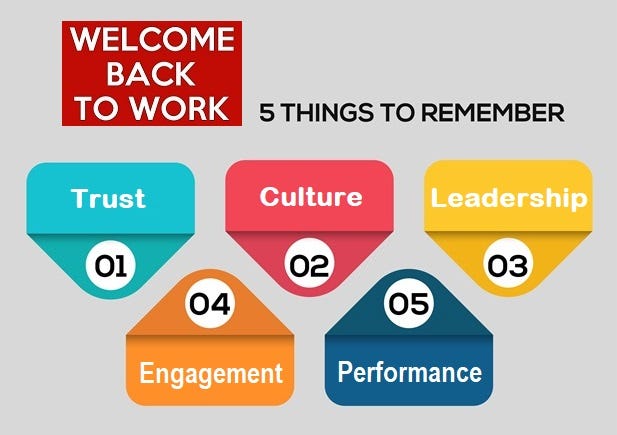
1) Trust
A person’s behaviour during a crisis betrays his values. This is also true of companies. Employees will not forget the company’s selfish actions during the beginning of the coronavirus pandemic in February/March 2020. The crisis then was projected to be protracted but not permanent, to last perhaps 6–9 months at least or into the mid-2021. The government had proactively provided several financial packages to assist companies (and individuals) in terms of tax relief, mortgage and loan deferments, payroll subsidies, rental waivers, public utilities waivers and many other short-term relief measures.
Many companies however decided to safeguard their shareholders’ interests instead and began to layoff employees despite the government’s payroll support packages. Employees were prepared to absorb salary cuts and deferments, and which some employers had also set good examples themselves in this respect. Many did not.
Post-pandemic, there is no reason for employees therefore to return to employers who chose to abandon them at the first moment of crisis. Loyalty begets loyalty; and ingratitude should not be rewarded. Remember that even dogs will not return to their own vomit. Companies will need to re-establish trust and restore confidence in their returned employees that the company will always have their back in times of danger. Prospective job applicants should ask their intended employers what they did to their employees during the pandemic, how and when they did it.
2) Culture
Corporate culture matters. It defines the personality and character of the company. It impacts systems and processes, customer relations, total quality and business performance. Organizations need to invest, nurture and grow their corporate culture or risk being outperformed by competitors who recognized a strong, positive and collaborative culture as a sustainable competitive advantage.
When employees are involved in defining and operationalizing the cultural values for implementation, these values come alive as they are demonstrated in action. Know that company culture is organic and has likely been impacted by the pandemic. Company must gather their employees and revisit their culture by providing an open and safe platform to encourage frank dialogue in order to overcome the natural organic decay by addressing the issues of impending changes in the pandemic aftermath.
3) Leadership
True leadership is about developing and growing your people through a culture of engagement. Creating a culture of engagement requires aligning employee engagement with human capital strategies and performance development. These are encapsulated in the strategic vision of leadership describing the outcome of the deliberate post-pandemic recovery plan. The critical success factor of the business recovery depends on the fundamentals of an engaging work environment.
For the leader, a strategic culture of employee engagement is not an option in the post-pandemic era. Companies should have systematic and comprehensive development programs for leaders and managers which focus on team management and the development of individuals in teams. Leadership at every level must be mindful that employee engagement is a fundamental consideration of the new people strategy.
4) Engagement
Employee engagement is not about creating touchy-feely enthusiastic and energetic employees who are happy about their work and workplace. It is an integral part of the business strategy. Improved business outcome, especially post-Covid19 recovery, should be the immediate underlying goal of employee engagement. Returning employees want to be inspired; asking “whether ‘coming back’ is worth it?” They want to be regarded and accepted as stakeholders of their own and the company’s future.
Employee engagement should focus on the needed performance management for eventual recovery. A collaborative engagement is critical to formulate the essential recovery activities. Together, management and employees can clarify the necessary work expectations consistent with the recovery strategy, identify the tools needed, the associated training and development as well as fostering a positive, cohesive and co-operative working climate.
5) Performance
Business recovery post-pandemic involves the ultimate goal of improving the workplace and obtaining viable financial performance. Business unit productivity, customer retention, total quality, safety and health are expected to yield clear and better results. Increased profitability will come from lean management, producing more with less and expanding the customer base through imaginative and innovative marketing. The marketplace is expected to grapple with regular recurrence of the coronavirus and customers have to be engaged with most of the social-distancing, masks wearing and constant use of disinfectants.
Technology will become indispensable for customer interaction and communications via tele-conferencing becomes the preferred mode to reduce unnecessary face2face meetings. Every employee is an important node of the customer touch experience; and engaged employees are more attuned to the customer as they are trained to be familiar with the service satisfaction delivery systems, processes and standards.
Positive profit streams are needed for a sustainable business recovery to enhance employee confidence and promote positive work climate so as to further assure income and job security for their loyal workforce.