
Back to Camp
Count All This — Chapter 25: everything is talking to me
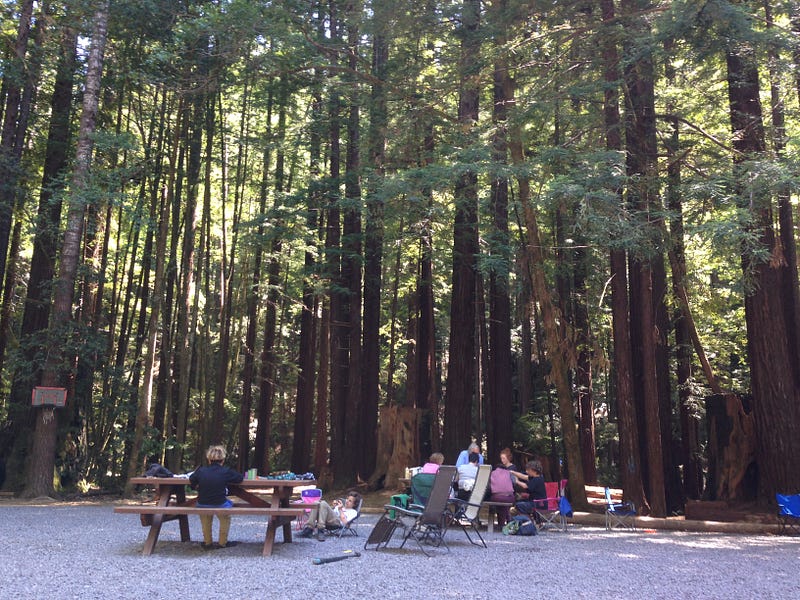
Remember the start of this story? That scene at Tall Trees Camp? We’re finally caught up to date so we can go back there… This is the twenty-fifth chapter of Count All This.
After surgery Larry was the sweetest of all husbands. For the first few days, I had tubes coming out of my side, draining the wound, and wouldn’t let him look at me. But after the tubes and the stitches and the bandages were removed, I stood before him in the bedroom and unveiled my flat chest wall.
“What do you think?” I asked meekly, remembering the story of my father’s reaction. But Larry was not my father. I was not my mother.
“I think you need to come over here.”
Larry was solicitous for two weeks, until I told him I still wanted to go to camp. He was giving me a foot massage, until he wasn’t. “You’re kidding. I thought you were going to skip all that this year. Don’t you think it’s a little soon after your operation to go off gallivanting in the woods?”
I rolled my eyes. “I won’t be gallivanting. I’ll be resting, just like I’m doing here.” I was lying on the couch beneath the window in the back bedroom, soaking up sun. “And according to Dr. Tarsa, I’m already ready to go back to work, so I don’t think it will be overextending myself to sit around on lawn chairs under the redwoods talking to friends.”
“Okay. Have fun.” He put my foot down and stood up to leave the room.
“Come on, Larry. Don’t be angry. I always go to camp with the kids. They need me to wash dishes…” He scoffed.
“Besides, I think it will be good for me to have some time in nature before I start chemotherapy.”
“Uh huh.”
“And this year, I was hoping we could try something different. I was hoping that you’d come along with us.”
“No way. I don’t do camp. You know that. I don’t like being dirty. And I don’t like sleeping in rotting old cabins with furry little rodents running across my feet.”
“But things are different this year.”
“Are they?”
“Yes.” I adjusted the surgical camisole they’d given me, a soft stretchy undershirt with hidden pockets up top, and a little foam puffball where my breast used to be. “And I want you with me.”
“Well that’s different,” he snorted.
I grabbed his hand. “Maybe it is. But it’s still true. I want you with me. I don’t want to be scared and lonely.”
“Oh, you won’t be lonely. You’ll have your friends there. And your children. You’ll have Jason. You’ll have everyone who is important to you.”
“That’s not true!”
It took some time, but eventually, he relented, agreeing to come up mid-week for a few days. Jane and Jean also decided to come this year — another first — to support me before I started chemotherapy. Michael and Rose were both coming, as usual, but wouldn’t get there until the middle of the week, planning to drive up with their dad. That left Ed. Larry and I spent a long time discussing whether or not he should go, and in the end, decided it might help him heal.
Three months had passed since he put his hand through a window, and we still weren’t certain what was wrong with him. Was he taking drugs? Was he having a nervous breakdown that would soon pass? Was he in the first stages of a long-term mental illness? Diagnosis aside, all we had going for him at home was weekly counseling sessions with a new psychiatrist we’d never met and weren’t sure we trusted, plus constant family tension.
The hospital hadn’t helped. The rehab program hadn’t helped. Moving back home with us hadn’t helped. Maybe a week in nature would.
At camp, he would be surrounded by people who loved him, people who had known him since he was a little boy. He would be safe, protected by the community. He would be in a place that he’d associated with heaven on earth for most of his life. Plus, he’d been saying that what he needed was some time alone in nature. Perhaps his intuition was right. We wanted to trust him, but weren’t willing to drop him off alone in the wilderness, as he’d been requesting. This might be a good compromise. He could go off on his own to seek solitude in nature, but still be close at hand.
He’d done well sitting through my surgery at the hospital, at least, and was behaving himself during my recovery at home. He was managing. He was fairly subdued. So it was with a hopeful if slightly trepidatious heart that I got into my little black Nissan with Eddy a few days later to undertake the five-hour drive to Tall Trees Family Camp near Mendocino.
At first, Eddy was quiet and compliant. I did all the talking. But after a couple of hours on the road, he began to get agitated. He fidgeted in his seat. He said things that didn’t make sense. In an effort to avoid conflict, I went for long stretches without saying anything, but as we got closer to camp, his mood got worse and worse. Then when I asked him to hand me a sweater from the back seat, he reached back angrily to grab it and then threw it out the window.
I pulled the car over. “What did you do that for?!” I shouted before getting out to retrieve it, being careful first to remove the car keys.
We were in the redwood forest by then, close to camp, and I was feeling uneasy about our decision to come at all. I was alone here. Unsupported. Unsure what to do next. Should I turn around and take him back?
Why was it that he had been cooperative and reasonable at home, but now was spinning out of control? Was the thought of showing up at camp and seeing old friends making him nervous?
The walk along the roadside helped to steady my mind. We should continue to camp, I decided, and if Eddy didn’t stop acting crazy, we could just turn around and drive back home. But at least I would have a chance to have a cup of tea, visit the bathroom, get hugs from my sisters, and explain to the camp managers why I wasn’t going to stay. When I got back into the car with my sweater, I broached the idea.
“Listen, Eddy,” I said. “I know you’re nervous about seeing people — about seeing your old friends. And I’m feeling nervous, too. I’m thinking this whole trip might be a bad idea, after all. So I want to make a deal with you. I want to promise you that if, at any time, you feel it’s too much for you, you feel you can’t deal with it, I will leave camp and drive you home. Okay?”
Eddy looked down at his hands in his lap and nodded. He gave a big, windy sigh, and seemed visibly relieved.
“And at the same time, I want you to promise me that if at any time I want to leave, because I can’t take it, that you’ll get in the car and come home with me. Can you promise me that?”
“Yes. I can promise that,” he looked up at me sweetly. “That helps a lot, Mom. Thanks.”
I started the car back up and we continued on our way, turning off the asphalt and onto the dusty dirt road that marked the last four or five miles of the journey. I pulled a mild tranquilizer out of my pocket and swallowed it. I didn’t ask Eddy to do hand me anything else. As we approached the outer edges of camp, recognizable by the sweat lodge erected next to the creek, Eddy asked me to pull over.
“Why don’t you let me out here, Mom?”
“Why, Honey? Do you want to walk into camp?”
“Yeah. I don’t want to come in just yet. I’m not ready for all the hubbub at the lodge.”
“Okay.” I pulled over, and popped open the trunk. He took out his backpack and hammock. I felt a flash of worry. “Why do you need all your stuff?”
“I’m going to find a place to string up my hammock out here. I think it will be better if I keep a little distance.”
“Okay. I guess…But be sure to come in to dinner, all right? I don’t want to worry about you. I need to know that you’re okay.”
“I won’t know when dinner is.”
“They’ll ring the bell.”
“Oh yeah,” he laughed at his own forgetfulness. “Okay. I’ll see you then.”
When I pulled up in front of the lodge, the wide clearing in front was alive with activity. People were walking in and out of the double doors of the big, rough-wood building; moving their cars under the watchful eyes of the parking czar; unpacking their trunks and commandeering wheelbarrows to cart their belongings to their cabins. A few young people tossed a Frisbee back and forth. Several grownups sat on lawn chairs under the trees. My sister Jean lounged like a regular camper with a book propped on her lap.
“Hi, Jean,” I approached her to give the usual hug, warning her first to go easy because my chest was still sore. “You got here before me!”
“Yes, I did,” she beamed. “Where’s Eddy?”
“I let him out outside of camp. He wasn’t ready to come in yet.”
“You let him out? Jo! That’s crazy! How could you do that?!” She had the automatic authority of an older sister. “He’s schizophrenic! You can’t leave him alone in the woods. He’ll get lost!”
Eddy is schizophrenic?! That wasn’t the way I’d been describing his condition in my head. “He won’t get lost,” I said with a firmness I didn’t feel. “He knows the area really well. We’ve been coming here his whole life. I didn’t leave him very far. He’s just out by the sweat lodge.”
“I don’t know. I don’t think it’s a good idea.” Jean shook her head, and I couldn’t help absorbing her concern.
“Well, look. Why don’t I check in with the registrar. Then you can help me take my stuff to our cabin, and we’ll talk about it there in private, okay?”
“Okay.”
I walked over to the short, lively woman with an astonishing areola of coppery hair who was manning a long table register incoming campers. “You’re finally here!” she said, smiling. “It’s about time. Your sister’s already settled in.”
“I know. I saw her,” I forced out some enthusiasm. “What cabin did you give us?”
“You have a cabin in Creekside, like you asked for — number 12,” she pointed out the cabin on a map drawn with felt pens on a long strip of butcher paper. “And you owe me another two hundred dollars. Where’s the rest of your family?”
“I’m the only one here right now — except Eddy. He’s around here somewhere. Rose and Michael are just coming for a few days in the middle of the week. And guess what? My husband Larry is coming too! He’s driving up with them.”
“That’s great, Jo. We’ll be glad to finally meet him. How’s Eddy doing?”
I remembered then that the registrar already knew something of our troubles, if not the whole story, because of an email I’d sent the camp managers earlier saying Eddy wouldn’t be coming to camp this year because of health issues. Later, I’d sent a retraction.
“Okay. I’m hoping camp will be a good place for him right now. We’ll see.”
“And you? Karen tells us you’ve been having some troubles of your own.”
“I’m okay,” I nodded, cursing Karen under my breath. I didn’t want everyone at camp knowing that I’d had a mastectomy, or that I would soon be starting chemo. I wanted this week to be a break from all that.
The registrar took my check, and directed me to a chart where I could discover which kitchen shifts Eddy and I had been assigned to before releasing me to unpack my car.
Jean helped me carry my things to the cabin, where I claimed my space on one of the four single, iron beds — two in front, on either side of the creaky swinging door, and two in back, behind rough wood closets. Jean had already laid her sleeping bag down on one of the beds in back, and her suitcase on the other, so I took the bed to the right of the door.
“It’s good to see you,” I said at last, giving Jean another careful hug after I had arranged my sleeping bag and pillow on the bed. The cabin was dark, illuminated only by the dim natural light that filtered through the massive redwoods encircling us. There was no electricity — just a line of screened windows along the walls beneath the roof. The community toilets for this cluster of cabins were up a hill behind us. The shower house was farther on, behind the lodge. Despite the gloom, we stayed inside the cabin for privacy, although I knew from experience that sound traveled surprisingly far in the forest, so I watched what I said.
“How are you feeling?” Jean asked. “Are you healing up well?”
“I’m still a little sore, but they took the drains out, and the stitches, so I’m practically like new, just lacking a breast. Want to see?” I started to lift my shirt.
“Later.” She seemed in a hurry. “And what about Eddy? How’s he doing?”
“Pretty good…” I wasn’t eager to hear her assessment of all the things that I’d been doing wrong. I tried to change the subject. “How long have you been here?”
“I got here about nine this morning.”
“Wow! You must have left before sunrise.”
“I did. And I drove pretty fast.” Jean was bristling with energy, which was unlike her. She’d started counseling, she told me, was taking Prozac, and had started a diet and exercise program to take off the weight she’d been gaining steadily for the past 10 years.
I was astonished. When had all this happened? I guess life went on while I was distracted with our dual emergencies. “That’s great, Jean! What started all this?”
“Well, Jack and I had a fight,” she said. But as it turned out, later, it was much more than that. Her husband of 20 years had moved out, and was asking for a divorce. Was the whole world coming apart?
“Oh, Jean! I’m so sorry!” I started to hug her, but she pushed me off.
“I’m still hoping we’ll be able to put it back together,” she said brusquely. “So, what do you want to do now?” She was perched eagerly on the edge of her bed. I wondered if she was taking the right dose of Prozac.
“I don’t know.” I felt suddenly overcome by a powerful reluctance. “Let’s go back to the lodge, and see if Eddy has shown up yet. If he hasn’t, maybe I will go look for him after all, just to put your mind at ease…”
Eddy wasn’t at the lodge, and when I decided to hike out to the sweat lodge, I encouraged Jean to stay behind. Otherwise, I was certain, she’d tromp through the woods calling his name too loudly, frightening him off and alerting the other campers that something was wrong.
I showed her where the workshops and activities were listed on long strips of butcher paper taped to the wall, so she could consider which ones she wanted to do during the week, and introduced her to a few other campers before heading off on my own. She wasn’t a bit shy, perhaps buoyed by the Prozac, and I had no fear that she’d be at a loss when I left.
I took the camp route, rather than the road, crossing the creek on the tall wooden bridge and winding my way through the cabin clusters. I kept my eyes open for any stray teens on the way, and when I saw one, I asked if he’d seen Eddy. None had.
I walked through the first cabin group and past the grassy circle where the kids sometimes played soccer. A labyrinth of stones had appeared one year in the back corner of this site, and would be the location of some kind of ritual later in the week. Across from it was the quiet nook where one summer Jason had set up his table and given me the world’s best massage beneath the towering redwoods and beside the rushing creek…
After the meadow came a pathway through a few tents erected by the campers who disdained cabins. One of them, I knew, would be Jason’s, and I kept my ears open for his voice as I passed.
Up a hill was the community bathroom where I’d been “imprisoned” once during a camp-wide game of Capture the Flag. After the smattering of tents came the most remote cabin cluster, where many of the staff liked to stay. Then there was another bridge over the creek, this one down at creek level and more makeshift — just a few boards thrown across water. When I got to the other side I walked along the road for a bit before veering back in towards the creek near the sweat lodge area.
I looked around carefully for Eddy’s colorful hammock, but saw nothing. There was the fire pit where rocks would be heated for use in the sweat lodge — a short half-dome structure made out of bent wood and covered with blue plastic. There were two or three tents scattered about the area, and one double air mattress encircled by an elegant white mosquito net draping down from a tree, looking like a fairy’s bed.
“Eddy,” I called out quietly, knowing sound traveled at camp. There was no answer. I walked over to the edge of the embankment above the creek. “Eddy!” I called again, a little more loudly. “Please come out. I want to talk to you.”
I was surprised when I saw his head pop up on the other side of the creek, amidst the ferns, like a little forest gnome. I could just make out a bright flash of red hammock behind him. He looked at me across the water but didn’t say anything.
“There you are! I’m glad I found you. Would you come over here?” It seemed I was coaxing a wild creature. “I don’t want to yell.”
He looked annoyed, but nevertheless made his way down the embankment on the other side with some difficulty, then crossed over on a fallen tree that spanned the creek. He walked up the pebbly bank until he was 12 or 15 feet away from me and stopped, out of my reach, a bit far for friendly conversation.
“Eddy, I’m glad I found you. I felt worried because I didn’t know where you were. Jean’s here. Are you going to come into the lodge area and say hi to her?”
“Not right now. Maybe later.” He seemed impatient with the questioning.
“Have you found a good place to put your hammock?” I forced a smile.
“Mom. What did you want me for?”
“Not anything, really. I’m sorry I made you climb across the creek. I just wanted to know you were all right, that you weren’t lost in the forest.”
He scoffed.
“Have you seen any of your friends? Are you feeling comfortable?”
“Mom. If there’s nothing else, I’m going to leave now.”
“Okay…” I felt reluctant to end the conversation and see him disappear again. “But don’t forget you promised to come in to dinner. I’ll be looking for you in the lodge.”
“Okay,” he said before turning away.
I saw Eddy that night, across the lodge, sitting with a table of young people, and I began to believe that bringing him to camp had been a good plan. He seemed comfortable, among friends. Jean made a point of approaching him and giving him a big hug. I waved at him from across the room, thinking that he’d prefer me to keep my distance, and feeling gratified that he had shown up, as promised, and was managing interacting with the crowd without apparent difficulty.
Then the problem with his camp job started.
He’d signed up to be a dishwasher and Karen, who co-managed the kitchen with her camp boyfriend Steve, had somehow contrived to find him in the forest and get him into an apron for his first shift on day two.
I was sitting in the lodge working on an art project — alone at a table surrounded by paper, felt pens, art books for inspiration, and various bowls, cups, and other circular objects for tracing a mandala— when he came up to talk. Jean had gone on a walk with the naturalist. Jane hadn’t yet arrived. Eddy looked dirty, and bleary eyed. His hair was greasy and falling into his face; his feet were filthy, and jammed into pink flip-flops two sizes too small.
“Mom, I’m having a problem,” he sat down next to me on the bench.
“You are? What is it? Do you want to go home?”
“No. I don’t think I need to go home. But I don’t think I can do this job.”
“Why not?”
“I just can’t do it, Mom. I don’t know how.”
“What do you mean, you don’t know how, Eddy? You’ve been doing it for years! It’s easy. You just rinse off the dishes and put them in the machine. Why are you wearing those tiny flip flops?”
“I forgot to bring shoes,” he said, looking down at his feet confusedly. “And I can’t go into the kitchen without shoes. So I borrowed these.”
“You forgot your shoes?! What are you wearing out in the forest?”
“Mom, what about the dishes?”
“I don’t know, Eddy. I think you should try harder to do them. Do you want me to help you?”
“Maybe. That would be all right. But Charles said he could just do it by himself, too.”
“That was nice of him, Eddy. But before we let him do that, let’s go into the kitchen together and see what’s going on.”
In the kitchen, Eddy’s old friend Charles was manning the stainless steel dishwasher station quite competently without him. As I watched him work from behind, I remembered the year the two of them had signed up for identical classes at College of San Mateo, spending so much time together driving around in Charles’s little red car and having fun that I began to wonder if they were a couple. Charles was tall and thin and graceful. They would have made a good match. But now Charles was shining alone on an island of efficiency while Eddy and I stood in a distant fog and watched. The music was blaring from a CD player perched up on a shelf. The dishes were flying through Charles’ hands.
“See what he’s doing, Eddy? You just use that retractable hose to squirt water on the dishes and then put them in the rack for the dishwasher. Want to try it?”
Eddy shook his head forlornly. I could see how having him stand there confused would make washing dishes more difficult for his dishwashing partner, so I pursued plan B. “Hey, Charles,” I had to tap him on the shoulder to get his attention. He released the lever on the hose and turned around. “Eddy tells me he’s having trouble doing the dishwashing job, and that you’re willing to do the work of two people. Is that right?”
“Oh yeah,” Charles smiled warmly. “No problem. I’m happy to do it.” Although he’d only come to camp one time before, Charles had blended in easily with the key players and made himself an instant regular. His tall, good looks and polite manner made him a favorite with the parents, and the teens liked his languid sense of humor. I wondered if Eddy was envious.
“Thank you, Charles. That’s really nice of you. Now Eddy,” I turned, “you have to go find Karen and get her approval for the substitution.”
“Could you do it?”
“No. It’s your job. You need to do it.” Eddy nodded his head with exaggerated understanding and left the kitchen in search of our friend. After she gave her permission, he took off his apron and hung it on a peg in the pantry before disappearing back into the woods.
I wondered for a moment if it wouldn’t have been better to hold Eddy to his commitment. At least then he’d have had a reason to show up at the lodge every day. On the other hand, we couldn’t stress the camp staff that needed to keep the kitchen running smoothly to feed 130 campers three meals a day, plus afternoon snacks. Placing a loose canon in their midst might derail the whole system and result in long-term consequences for both me and Ed.
I saw him only fleetingly over the next two days, but each time I did was more alarming. During the time period, Jane showed up and joined Jean and me in the cabin. Despite the presence of two of my sisters, I felt unsupported. They were both sympathetic, but didn’t know all the details, because I didn’t tell them. And though I tried to keep tabs on Eddy from a distance, asking his friends about him whenever the occasion arose, mostly, I passed the time in ignorance. I couldn’t wait for Larry to arrive to back me up.
Jason, I noticed, had brought his new girlfriend to camp, and was in a prickly mood. “Hi Jason,” I said with false cheer on day two, approaching him at a picnic table where a raft of young people was sitting together and braiding hemp bracelets. “Have you run into Eddy?”
“Yeah. I’ve seen him,” he said ruefully, not looking up.
“Have you cured him, yet?”
“No,” he scoffed. “I definitely have NOT cured him.” Then he shot me a look. “Where’s Larry? I heard you talked him into coming this year.”
“He’s coming mid-week. Amazing, isn’t it? And I thought you couldn’t teach an old dog new tricks. But he’s a new man, I guess. He’s practically given up driving. Now he rides his bike everywhere. And he came down to the beach house in June. Now he’s coming up here.”
“Wow. What’s gotten into him?”
“I don’t know.” I shrugged. “Maybe me? Maybe Eddy?”
Every young person at the table had an opinion about Eddy’s condition.
Mike Goodman, Eddy’s longest-standing friend, reported that he seemed basically okay, but difficult to talk to. Arlis said he was scattered and confused. Gem wondered if his mental problems were a ploy to get attention. Amelia thought that something was seriously wrong. Susie sent me a look of hellfire and damnation before scooting closer to her beloved Jason. I wandered off.
Eddy didn’t come to breakfast or lunch on day three. I wondered what he was eating. That afternoon, I went into Mendocino and bought him a pair of large flip-flops (I found out later that Karen had done the same). Then I set out to find him in the forest, trudging over the same path I’d followed earlier in the week. When I got to the area around the sweat lodge, I started tentatively calling out his name.
On the other side of the creek, high up on the embankment, I saw two longtime campers hiking. Then I saw Eddy, running at breakneck speed, passing them by on the narrow trail like a man being chased by the Furies. He was barefoot, I knew, and had his pajama bottoms on. His shirt-front was open and his shirttails were flying.
“Eddy!” I called. “Eddy, stop! I need to talk to you!”
He flew by at first, but reined himself in down the path, retracing his steps to stand staring at me across the creek.
“I have shoes for you,” I called out to him, holding up the flip-flops. “Do you want to come get them?”
Eddy picked his way down the embankment, crossed the tree trunk bridge, came up the creekside and stood below me on a tangle of mossy, fallen logs.
“Where were you running to so fast?”
“Nowhere.”
“But why were you running, then?” I laughed. “You looked like some kind of wild animal.”
He looked at me belligerently. “Just to run — to get exercise.”
I handed him the shoes, looking down at his feet as I did, and noticing they were covered with dirt and scratches and dried blood. “Look at your feet, Eddy. They look injured. I hope these shoes will help.”
“Thanks, Mom,” he climbed a little closer so he could reach out for them. As he stretched his arm out I noticed how terribly thin he was. His arm was skeletal, with just a bare covering of flesh.
“Are you sure that you’re feeling okay here, Eddy? Why didn’t you come to breakfast or lunch? Do you think maybe we should go home?”
“I don’t know. I’ll tell you later.” He turned away from me and started to walk back down the creek.
“Eddy, wait. What are you eating?” I called after him.
“Don’t worry. I go into the kitchen at night,” he called over his shoulder before hopping up onto the log.
On day four, Jane, Jean and I went to the morning worship at the fire circle. Spending time with my sisters was making camp bearable. Although I was worried about Eddy, I was often distracted. Jean’s marital troubles gave me an opportunity to talk about something besides my own. And unlike at home, where I would be in constant contact with Eddy, I could pass short periods imagining that he was safe and being cared for by his friends while my sisters and I went to crafts workshops, ate, and hung out together. I felt easy in their company, and comforted.
That morning the ritual involved passing a copper bowl in which were folded pieces of paper containing inspirational quotes. There were about eight women in attendance, and two men. We sat on big logs that were planed flat to form seats and tiered up in a semicircle around the fire circle. We each accepted the bowl, took out a paper, and read it to ourselves. Then we read it aloud to the group. After each quote was read, there was a period of silence while we considered the words.
In the midst of this activity, Eddy walked across the bridge and joined us. He had on his pajama bottoms, no shirt and no shoes. A long beaded earring dangled from one ear, the wire perched in the ear hole, since his lobe wasn’t pierced. He carried the walking stick I had worked on during a workshop the day before. I had decorated it by burning designs into the wood, gluing on beads, staining the length different colors and wrapping the hilt with leather thongs. A leather circle dangling from the handle displayed my name: Jo Kasten. I was surprised to see it in his hands. He must have found it leaning outside the lodge and picked it up.
Eddy sat down behind me, on the next log up, and accepted the copper bowl when it was passed to him. The group leader welcomed him with a warm smile and a few words explaining the process. He nodded. Then he took out a piece of paper and read it out to us.
Although he did everything he was supposed to — sitting quietly, accepting the bowl, reading the quote out loud — he wasn’t right. His eyes, although sparkly, had no reciprocity of understanding. There was a shield behind the sparkle, some kind of defense. If I’d been brave enough to ask him a question, I knew he would respond strangely. He’d say something cryptic, that some might interpret as witty. He clearly felt himself wise, like a guru, with an excess of confidence.
I shifted uncomfortably on the log and wondered why I was still at camp. Shouldn’t this boy be taken home? Clearly, the healing we had hoped for wasn’t happening. But clearly, too, it would be difficult to get him to agree to come now. The way he flitted about the perimeter, just out of my reach, ducking and hiding, made that obvious. And even if I was able to get him home, what was I going to do with him there? Seeing a counselor once a week wasn’t cutting it, but as far as I knew, it was the only option outside of a locked ward. Was that where I needed to bring my son? Back to the mental hospital? I couldn’t wait for Larry to show up and advise me.
Eddy passed the bowl to the person beside him and got up and left the circle, not waiting to hear what the others had to say.
That afternoon, I called Larry at his new job from the pay phone.
“Pacific Electronics,” a sexy voice answered.
“Can I speak to Lawrence Thibedeaux?”
“Just a moment.” She put me on hold.
Larry was laughing a little when he picked up the line a few moments later. And I heard reciprocal laughter in the background. Lilting. Seductive. The lively voice of an untroubled young woman.
“Hi Larry. It’s me. I’m just calling to say hello.”
“Oh. Hi.” He didn’t sound happy to hear from me. “How’s it going?”
“Okay, I guess. It’s good to be with Jane and Jean.” I wanted to justify my coming, against his better judgment. “But I can’t wait for you to get here tomorrow. Eddy isn’t doing any better here. In fact, I think he’s getting worse.”
“Great.” His voice sounded tired, heavy.
“I would come home now, if I could,” I admitted. “But I’d feel bad about leaving my sisters. And I’m not even sure I could get him in the car.”
“Really? He’s being that uncooperative?”
“Not uncooperative, exactly. But evasive. He won’t let me get close to him. He’s sleeping on his hammock out in the woods.”
“Do you think that’s a good idea?”
“Not really. But I don’t know what to do about it.”
“Okay. Just hang in there. We’ll be there tomorrow. Rose is coming to pick me and Michael up in the morning. We should get there a little after lunch.”
“I can’t wait to see you.Thanks for coming. I know you didn’t want to.”
Silence.
“Larry?”
“Yes.”
“Who was that who answered the phone?”
“That was Devie, the receptionist.” Had I imagined a slight lift in the tone of his voice?
“I love you, Larry.”
“Uh huh. Me too. I’ll see you tomorrow.”
That was the night I sat down for dinner and heard Jen’s mild account of her talk with Eddy in the lodge, and Steve’s dire report of his encounter with him in the shower house. That was the night that Karen said kindly, “I’m so sorry this is happening to you,” leaning in a little closer to convey her sincerity, extending her hand to cover mine. “I hope you are getting help for yourself.”
“You mean counseling? For me?” Karen nodded, and everyone at the table nodded, too. Both my sisters — even Steve — thought I needed counseling. My chest started hurting. And when I stood up to take my plate to the kitchen, Karen said it once again.
“I’m so sorry this is happening to you.”
I smiled, but felt annoyed. But this isn’t happening to me. It’s happening to him.
I stayed up late in the lodge that night, hoping to get another glimpse of Eddy. I worked on my giant mandala, coloring in a thousand little circles with bright felt pens, while people beaded jewelry, or braided bracelets, or played board games or card games, or read books at the tables around me.
At one end of the lodge, Jen sat before her bank of depression lifting lights, reading a heavy tome. Behind me, Jason sat with his girlfriend Susie and another young person playing Settlers, happily ignoring me.
I was in a sour mood when I finally walked out of the lodge with my flashlight in hand, frustrated with Jason ignoring me and tired of waiting for Larry’s arrival and worried about about our son. As I passed the line of cars before the path down to the creek, one of them honked.
I stopped, startled, and peered through the darkness. It took a moment to realize the car was my own. When I opened the passenger door and shined my light in the back seat, I saw Eddy.
“Eddy! Did you honk at me? What’s up?”
“Come on in.”
I sat down in the passenger seat, and tried to conduct a conversation with Eddy in the back, but since I couldn’t see him in the darkness, and since the headrest of the seat obstructed my view, I ended up facing forward and talking to a disembodied voice that floated over my shoulder.
“What’s going on, Eddy?”
“I’m just sitting here, being schizophrenic.”
“Why do you say that?” I didn’t want to repeat the word. “Do you want to go home?”
“I say that because you asked me what’s going on. Do you want to know or don’t you?”
“Well, yes. I want to know. But what do you mean by that term? Why do you say you’re schizophrenic?”
“Because I AM!! I’m schizophrenic! I’m schizophrenic! I’m schizophrenic!” he shouted. “Why the fuck are you sitting there talking to the windshield?!”
“Okay. OKAY!” I shouted back. “You don’t have to shout! I’m only looking out the window because I can’t see you there in the back seat,” I turned around to try to peer through the gap between the two front seats. I couldn’t make him out, but I continued facing backwards.
“Everything is talking to me, Mom. Everything!” He leaned forward through the gap, brushing me aside, and turned on the radio. An old song came through the speakers. Turn around. Look at me. “Listen to that! LISTEN TO THAT!” he shouted before bursting into exuberant laughter.
“Okay, Eddy. Calm down. I’m sorry you’re having a hard time. Listen. I think we need to go home. I want to take you home, okay? But I don’t want to leave right now, in the middle of the night. I can’t see very well in the dark, and I’m too tired to drive that curvy road. So what I want you to do is just try to calm down and make it through the night, and then we’ll see how you feel in the morning. Is that okay with you?”
“Did you HEAR that, Mom?”
“I heard it, Eddy. It’s just a song. It doesn’t mean anything. It’s not talking to you. Look, Eddy. I have some tranquilizers I brought with me, in case I needed them. I want you to take a couple of them for tonight, okay? Then we’ll leave in the morning.”
“Tranquilizers? No, Mom. Tranquilizers is not how you treat schizophrenia. Didn’t you know? Didn’t Dr. Hu tell you?”
“Eddy, listen,” I finally started to cry. “I don’t think I can handle this. I’m upset that Dad’s not here, and Rose isn’t here, and Michael. I’m upset that you and I are here all by ourselves. Jane and Jean can’t help us. They can’t drive us home. I need you to just make it through this one last night, okay? Then we’ll leave tomorrow.”
“Okay.” Was he sobered by my tears?
“Good. And what about right now? Is it okay for me to leave you alone in the car? Will you be okay? Won’t you take one of my pills?”
“No. I don’t want a tranquilizer.”
“What are you going to do? Where are you going to sleep?”
“I don’t know. I think I’ll just stay in the car for a while. Then, when things quiet down, I’ll go into the lodge and get something to eat.”
“Okay, Eddy. That sounds like a good idea. I think you should sleep in the car tonight. Don’t go back out to your hammock. I’m leaving now. I have to go to bed myself. Give me a kiss.”
He leaned forward and presented his cheek for me to kiss. He sounded okay again — functional, and though I knew I shouldn’t, I left him alone in the car. “Bye, honey,” I said again as I hurried away before he could call me back, stumbling alone through the darkness, down the path to the wobbly bridge over the creek.
It was cold, and so dark you couldn’t see one foot in front of you. I shined my light by my feet, and trudged without thinking — trying hard not to think — until I got to my cabin, where I swung open the squeaky door and sank onto my bed, pressing my face into the pillow and groaning.
“What is it? What is it, Jo?” Jean and Jane awoke at once.
“It’s Eddy.” I burbled out what he’d said about being schizophrenic as they huddled and held me. But I didn’t cry long, or loudly, because I knew that every cabin in our cluster could hear in the deadly quiet. Instead I held it in and lay in the darkness, looking out at nothing, at the black night, urging on the morning but also dreading what would happen until I was overcome by sleep.
That was the twenty-fifth chapter of my novel, Count All This. To continue, follow the free chapter links below or buy a digital copy of the whole book on Amazon, where leaving a rating or review will help others find my story.
>>>NEXT CHAPTER
<<
NEW CHAPTER ALERT! Here’s a head’s up to people who’ve clapped or commented on my fiction in the past that a new novel’s running and the next chapter’s been published. ❤ Alan Tabor, Alberto García 🚀🚀🚀, Anne Emerick, Brendabrown, Catherine Caruso, Catherine Durkin Robinson, Charlie O'Brien, Chidi Michaels, Christiana White, Deb Clark, Dennis Abrahamson, Esther Spurrill-Jones, Evelyn Jean Pine, Filiz Özer, Frank Delaurier, Gregory Bell, Hidayatullah, HJ Free4Life, Howard Beye, Jackie Sacco, James Finn, Jen Sonstein Maidenberg, Joann Mccormack, Julia Heussler, Kenny D, KimRae Ketcham, L. A. Jackson, Lilit A. Sargsyan, Maddy Wylie, Mark Tulin, Matthew John, Mike Behlen, Nicole Higginbotham-Hogue, Author on Amazon, Leslie Napoli, Marian Čaikovski, Nini Mappo, Paul Morriss, Rebecca Ruth Gould, Ripley J. Cloud, R.L. Raymundo, Rolli, Ronald Hall, Sandra Salamander, Shannon Mary Sims, Skippy von Alte Welt, Subhi, Suma Narayan, Taressa Watson, The Old Grey Wolf, Wendy Allen, Yvonne Vávra
My writing is always free to readers who follow links from Twitter, Facebook, and LinkedIn, but if you’d like to read more, click here to join Medium for $5 a month and they’ll give me some of that money. (Yes!) For an email whenever I publish, click here. Find more of my fiction, including another novel, on this List. And for more of the good stuff, follow Fourth Wave, where we’re changing the world for the better, one story at a time. Got one of your own? Submit to the Wave!
Copyright © 2021 by Patsy Fergusson. All rights reserved.


