
Baby-catching on the side of the road
Not for the faint of heart
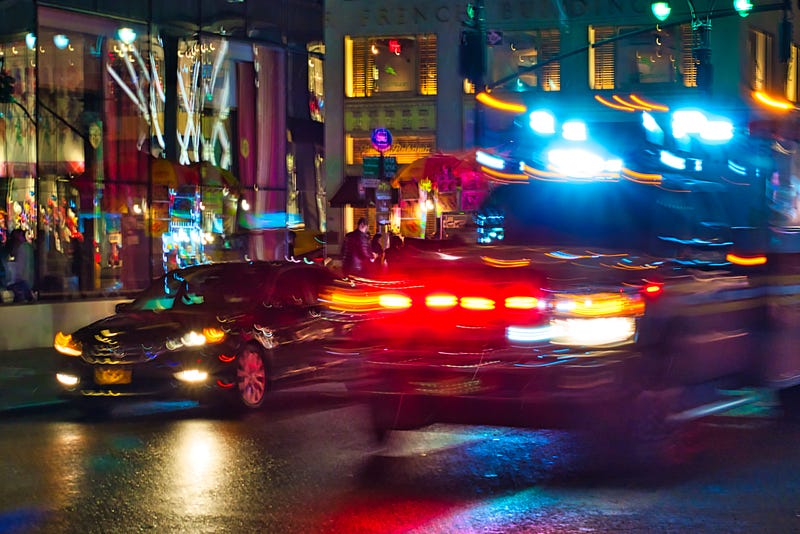
There was fear evident in his eyes when the captain of the ladder truck looked up at me, “I think I see the head”.
I looked over his shoulder as he crouched in the passenger doorway of the Toyota sedan that had angled to a stop on the side of the six-lane road. Sure enough, there was the leading curve of a shiny little black-haired dome poking out down there. We were about to have a baby.
We were all cozy and warm in our beds when the alarm came in. The lights flashed their sterile fluorescent white glare, and the station tones blasted out of the overhead speakers.
“Ladder 1, Medic 1, medic response — imminent birth.” The address was somewhere close to a strip mall/grocery store. Unusual, but we had come to accept the abnormal as routine.
As we wiped the sleep from our eyes and glided out to the medic unit we saw Ladder 1 go storming by the front of the fire station, lights ablaze but no siren due to the fact that it was three in the morning and there wasn’t any traffic to warn of their nascent approach.
Apparently, the ladder crew had already been out dealing with some other sort of emergency, so they had a head start to the next one. Did I hear the tones go off earlier? Perhaps, but the computer-automated voice from above hadn’t said the magic words, “Medic 1”, so I had blissfully slumbered on, barely (or not so much) aware of the ladder crew’s earlier departure.
I used the radio to tell the 9–1–1 dispatch center that we were in route, and the dispatcher responded with a ‘short report’ to fill us in on the details. It seems mom and dad-to-be were in route to the hospital when she felt the urge to push. He pulled over and called for help.
We were used to receiving short reports with a healthy dose of skepticism. While the 9–1–1 call takers and dispatchers were consummate professionals and did all they humanly could do to get accurate information from callers, the fact is that people that call 9–1–1 aren’t always the best narrators. Sometimes English isn’t their first language, sometimes they only have peripheral knowledge of what was going on, and often, at the very least, they were stressed out.
Truthfully, 9–1–1 dispatchers do a miraculous job of gathering information about a situation without the benefit of non-verbal clues and situational context in many cases. And often, once the caller hangs up, there is no follow up or closure to the call. They are left to wonder how things turned out.
But when an expectant mother says she feels the need to push there is a pretty good chance that we can know what to expect when we get there.
When we arrived the ladder truck was situated so as to block two lanes of travel, keeping us and our patients safe while we investigated. My partner eased the ambulance in front of the car to provide the shortest route to navigate into our heated patient compartment.
It was a typical March morning in the great northwest. About 40 degrees, light mist and a brisk breeze that helpfully blasted the cold and wet straight into your face, seemingly without regard to which way one faced.
As I crouched next to the ladder captain and peered into the car, I could tell that the thing he wanted most in the world at that second was to move out of the way and let me take over. Unfortunately for him, in this case “imminent” meant right this very second.
Plus, I hadn’t even put my latex (a few years back when latex was still en vogue) gloves on yet. My hands were firmly planted in my jacket pockets. It was cold.
As I gloved up, I instructed him to gently place his hand around the baby’s head and provide the ever-so-slightest bit of back pressure. Then, he should be ready to support the baby with his other hand as it came out. Babies are slippery little suckers.
This gentleman’s hands are massive. Strike that, all of him is massive. I had worked with this person for years. At somewhere around 6’2” and who knows how much lean muscle mass I was pretty sure that if anyone were to ask, “how much do you bench”, the answer would have been someplace in the neighborhood of “all of it”.
I had also seen him standing on the roof of a commercial building, back-lit by twenty foot flames shooting through a hole his crew had just cut in the roof, proclaim on his portable radio in a flat monotone without an ounce of emotion, “Chief, we have a lot of fire coming through our first vent hole, we are going to move down about forty feet and cut another 4 by 8 (foot hole) before we get off this section”. Not much scared him.
Today his voice cracked as he whispered, “Oh God”.
As predicted, our little baby was out like a shot a few seconds later, “Nice catch, Cap”. We wrapped him (It’s a boy!) in a snazzy little foil blanket meant to optimize heat retention, snugged a beanie on his head and made a burrito out of him with additional blankets.

Mom held him while I clamped and cut the cord. Then she handed him off to one of the ladder crew for a moment for safe portage, while we ushered her into the ambulance.
With little else to do besides take some vitals and assess an APGAR score on the little guy, we sent the ladder crew back to the station. My partner drove to the hospital while I rode in back with a tired but blissful mom and a squeaky little bundle.
When we got to the hospital, we helped mom into a bed while a team of nurses and others swept the baby off for a series of poking, prodding and other likely unwelcome attention.
We were lectured about how the baby’s temperature was too low and that we should have been much more careful about keeping the baby warm.
“Yes, well, in our ergonomically perfect, well-stocked, heated and fully-lit birthing suite we really should have been more careful”, was what I did not say.
Rather, “Thank you, oh yes, that is very good advice. We will be much better next time…”
Back in the ambulance I grabbed the radio microphone.
“Dispatch, this is Medic 1. Baby and mom are happy and healthy at the hospital, Medic 1 is back in service. Congratulations dispatch, it’s a boy!”
This story actually happened. It is 100% accurate and true based on what I remember. If a certain ladder captain reads this and feels like the story doesn’t completely jibe with his recollection of events, that is simply because my highly trained paramedic mind remembers medical details much more vividly than others. Even EMT’s. And especially ladder captains.
Timothy Key spent over 26 years in the fire service as a firefighter/paramedic and various fire chief management roles. Now moving forward to writing and consulting. For more articles like this, join the mail list.


