
THE PSYCHOLOGY OF BASIC ECONOMY
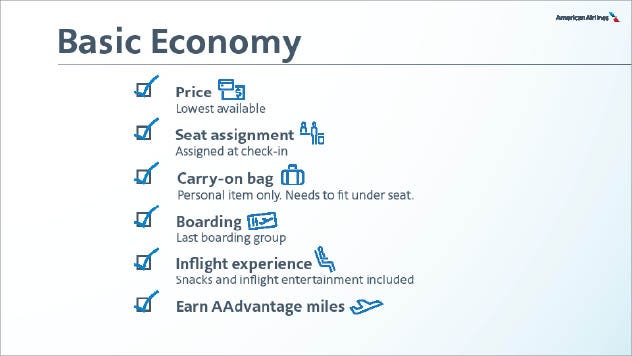
With American Airlines finally announcing the details of its version of Basic Economy — let’s take a look at some fascinating psychology behind the basic economy experience.
BASIC ECONOMY — THE MYTH
Let’s get something clear right now — Basic Economy fares are NOT about cheaper fares.
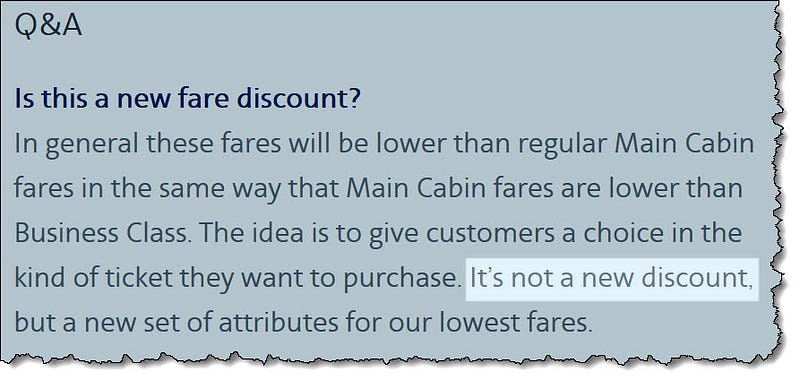
These fares are about increasing revenue — not introducing a new “cheaper” set of fares.
Unfortunately — due to the poor state of journalism, reporting and commentary — this detail has been lost in the majority of reporting on this topic.
BASIC ECONOMY — THE EXPERIENCE
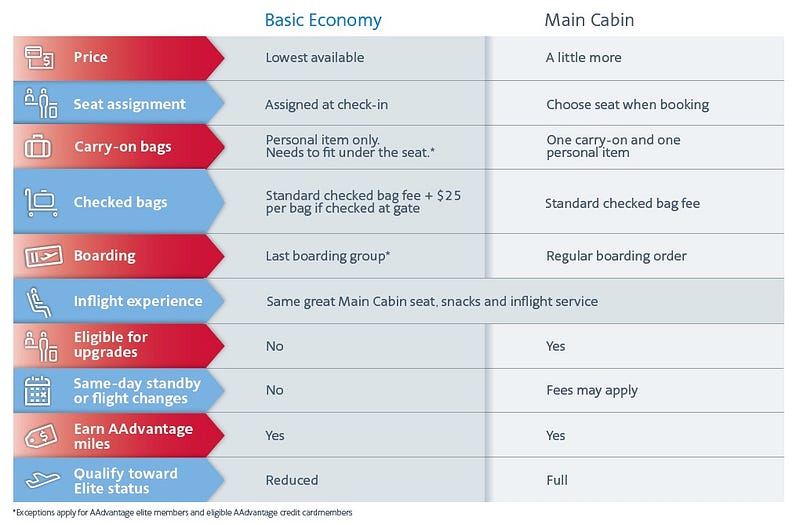
American Airlines has released the details of their Basic Economy product, which is mostly a carbon-copy of Delta’s and United’s (with some minor differences).
Essentially — Basic Economy passengers will :
- board the aircraft last (Group 9);
- be unable to pre-select seats (American will allow this for a fee 48-hours prior to departure); otherwise —
- not receive their seat assignment until check-in;
- be ineligible for upgrades of any kind;
- be unable to make any changes whatsoever to their ticket;
- only be allowed to take a small personal item on-board with them.
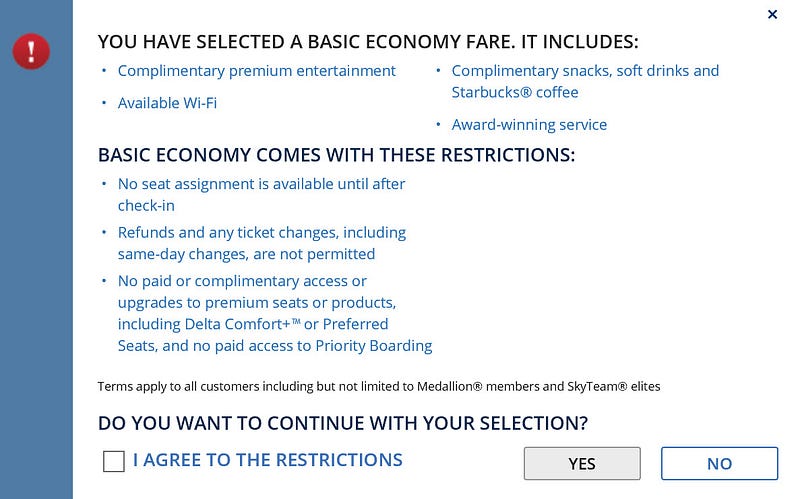
As I have previously explained — Delta, United and American don’t ‘actually’ want you to purchase these fares, they have deliberately designed them to be punitive so that you take a moment of pause — and consider “buying up” to a more palatable fare.
BASIC ECONOMY — THE PSYCHOLOGY
Whilst there are many factors at play — one of the more interesting psychological concepts relevant to Basic Economy is the concept of Observational Learning pioneered by social learning theorist Albert Bandura.
Social learning theory is all about learning behaviors (and their rewards/punishments) through observation or instruction in a social context.
Picture your Basic Economy experience…
If you haven’t been scared off by all the warnings about your Basic Economy fare — you head off to the airport to check in, and find that you’ve (most likely), been allocated an undesirable middle seat near the lavatory.
At the boarding gate, you glance at your boarding pass to see that not only are you in “Boarding Group 9”, but you have a big “B” branded on your boarding pass, reminding you that you are a second-class traveler.
The airline then proceeds to call everyone to board the plane in “group-order”, and being last — you get to observe the entire process.
You get to see other passengers board ahead of you. You get to see other passengers take full-size carry-on bags onboard with them. You get to see other passengers get to “gate-check” their bags for free.
If you or another Basic Economy passenger needs to gate-check a bag, not only will you pay the standard bag fee, but also a US$25 “gate-service-charge”.
Finally, you get to board the plane last, in a walk-of-shame that allows you to look longingly at the First Class passengers enjoying their pre-departure drinks, past the extra-legroom seats, before heading down the back and excusing yourself past the already-seated aisle passengers so that you can squeeze into a cozy middle seat.
For the regular-fare passengers observing those who purchased Basic Economy doing the “walk-of-shame” to the middle seat at the back of the plane near the lavatory, this acts as a type of reinforcement. Not so subtly reminding them of their wise decision to not purchase Basic Economy, and therefore continuing to influence their future purchase decisions.
But for those who did purchase Basic Economy, the process also allows them to observe the experience of all of the other passengers.
In simple terms — you observe that passengers who bought a standard economy fare receive better treatment and have a more enjoyable travel experience… perhaps convincing you to buy a more expensive fare next time.
As we can see, Bandura’s social learning theory can be applied to both those who purchased regular fares (to maintain behavior), as well as to those who purchased Basic Economy (to encourage a change in behavior).
Let’s breakdown a more specific example… the boarding process.
AIRPLANE BOARDING AND SOCIAL LEARNING THEORY
If you’ve flown with United Airlines in recent times — you may have noticed that the gate agents will always announce that United MileagePlus credit cardholders get to board in Group 2.
You may think that these announcements are simply to help all of the confused credit cardholders that may be unaware which boarding group line to join. But remember — the group number is printed on their boarding pass.
The purpose of these announcements is actually to remind everyone else that if you want to be able to board in Group 2 — then you should sign-up for the United credit card.
Likewise with American’s boarding process, which until now has called “First Class” passengers, followed by “AAdvantage Executive Platinum” passengers, followed by “Platinum”, “Gold”, “Priority”, and eventually Groups 1–4.
A fairly big advertisement that if you want to board the plane first, you can — you just need to buy a First Class fare, or earn Executive Platinum status.
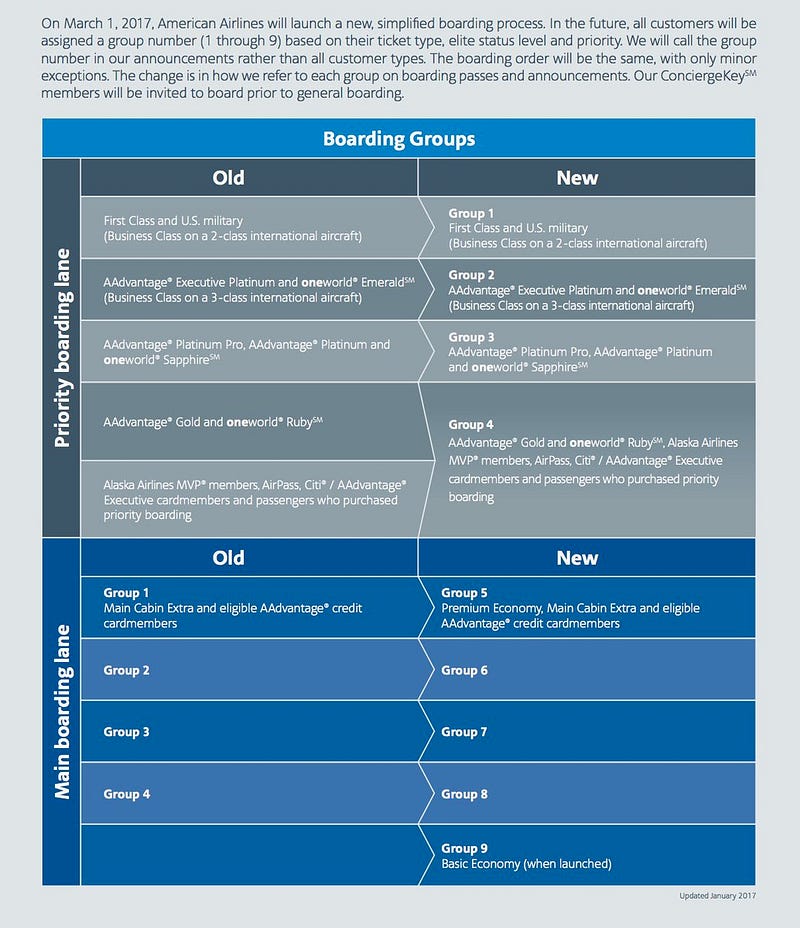
As of March 1, 2017, American will be simplifying the gate boarding announcements to simply call “Group 1”, “Group 2”, all the way through to “Group 9” (Basic Economy).
As you can see in the chart above, currently, if you’re in the Main boarding lane — you get to observe all of the passengers in premium cabins, and all of the passengers with elite status, receiving priority boarding benefits.
And more importantly — the gate announcements specifically inviting these VIP passengers to board first, act as a form of vicarious reinforcement.
By observing these premium passengers being rewarded for their behavior (purchasing a premium fare or having status) — you experience Bandura’s social learning theory.
Interestingly — although I have no doubt that American’s new boarding process will likely be more efficient, and be welcomed by those with elite status — it actually dilutes the social learning effect.
Simply hearing “Group 1”, “Group 2” etc, does not deliver the same level of vicarious reinforcement as to “why” you’re not in that group, and “how” you may be able to change your behavior to do so.
SUMMARY
For social learning theory to be effective in imparting the new/desired behavior (in this case — buying a more expensive fare/avoiding basic economy)— you need to:
- see the behavior;
- remember the behavior;
- be able to replicate the behavior (perhaps Executive Platinum status is unrealistic); and
- be motivated to replicate the behavior.
Social learning theory is an intricate ingredient in travel and travel loyalty programs.
You can read more about psychology in travel in my previous article — The Psychology of Loyalty Programs.
As a publisher and global speaker on hotel & airline loyalty programs, David is focused on developing strategic solutions for loyalty programs, and is passionate about the critical link between loyalty strategy and the customer experience. David can be contacted here.
— — — — — — — — — — — — More Articles by David Feldman:
BAD DATA: WHEN BIG DATA GETS IT WRONG
DOES YOUR AIRLINE EVEN WANT YOU TO FLY THEM?
THE DIRECT BOOKING CHALLENGE: How Hotels Can Stop Sabotaging Their Own Campaigns
HOW THE SUCCESS OF FREQUENT FLYER PROGRAMS IS DRIVING AWAY LOYAL CUSTOMERS
HOW STARBUCKS BOTCHED ITS REWARD PROGRAM — Lessons for Loyalty Program Managers
WHY AMERICAN AIRLINES IS RISKING IT ALL WITH *CONFIRMED* CHANGES TO THE AADVANTAGE PROGRAM


