
Am I a Serial Dove Killer?
Or some hawk’s BFF?
After the first hawk scared the bejesus out of my happy little flock of mourning doves I wondered — and friends suggested — that I was essentially creating a trap by putting seed out on the fire escape during the winter.
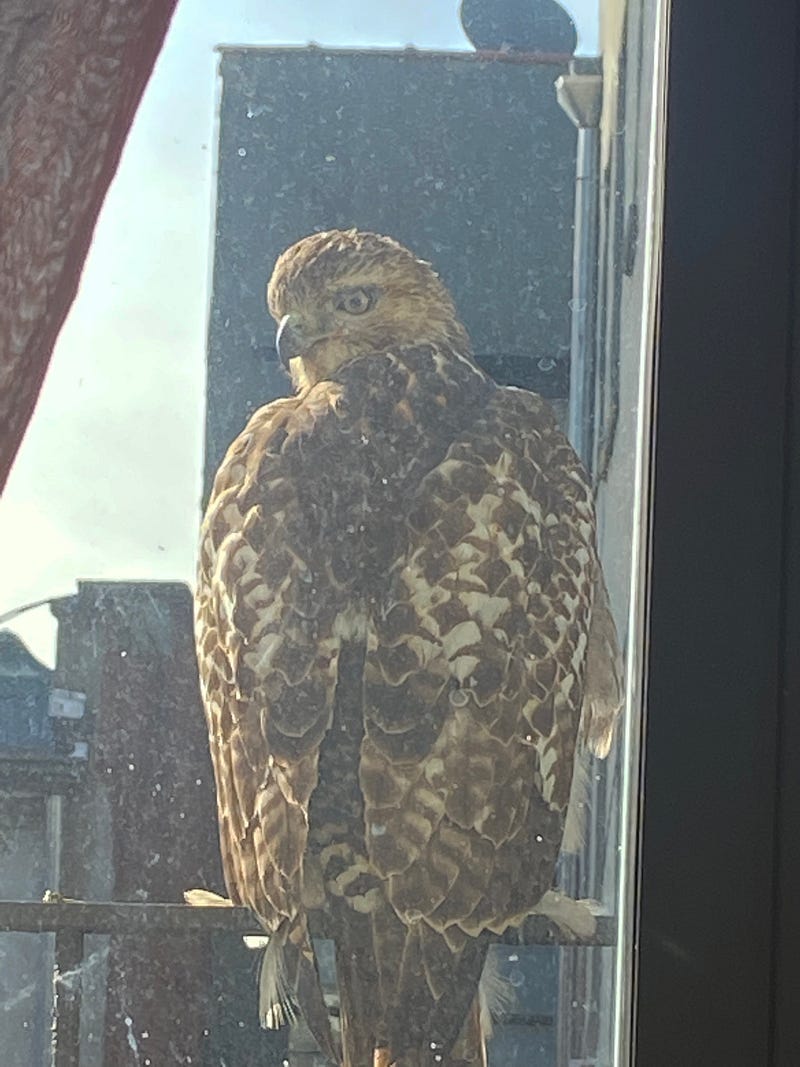
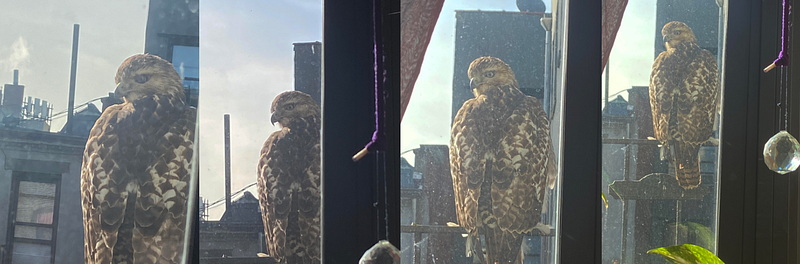
My partner urgently summoned me from the kitchen this morning to see that we had either another hawk on the fire escape or that the first one was back. Either way, it was mesmerizing to see this enormous bird of prey right outside our window.
I began putting seed out on the fire escape last winter and delighted in the birds who came by regularly to chow down and squabble (there is no social contract among wild birds and the pecking order is established swiftly and ruthlessly).
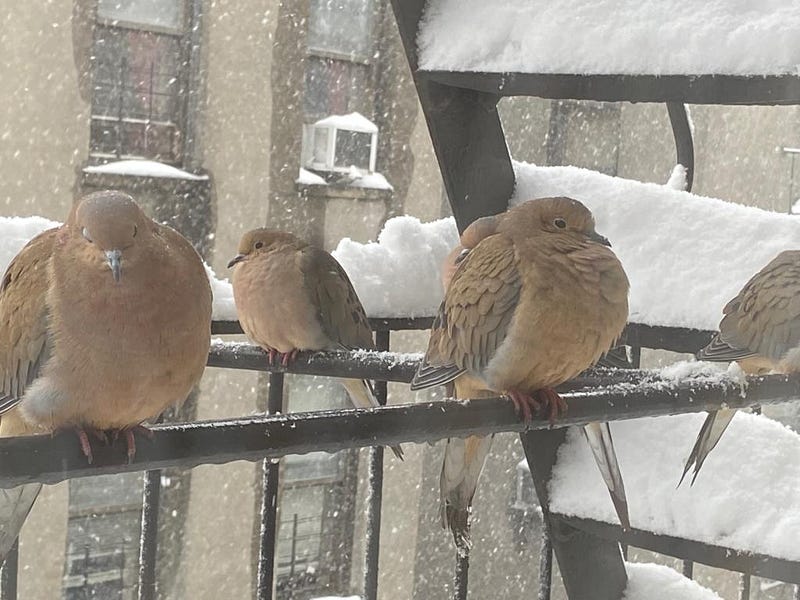
Autumn lingers well into December around here anymore — hi there, Global Climate Catastrophe! Staying long? — so I didn’t begin putting seed out until late last month. This year the customers at my fire escape diner are almost exclusively mourning doves and a few bold sparrows. The blue jays who hung around often last year occasionally appear but vanish with the first twitch of a curtain.
After that earlier hawk visit, it took a couple of weeks for the doves, et al., to return.
And, truth told, I considered then that putting birdseed out was basically setting a trap for them. But I convinced myself that there are hawks all over this city now and if they don’t get them here, they’ll get them somewhere else. Please, no need to draw my attention to this faulty line of reasoning.
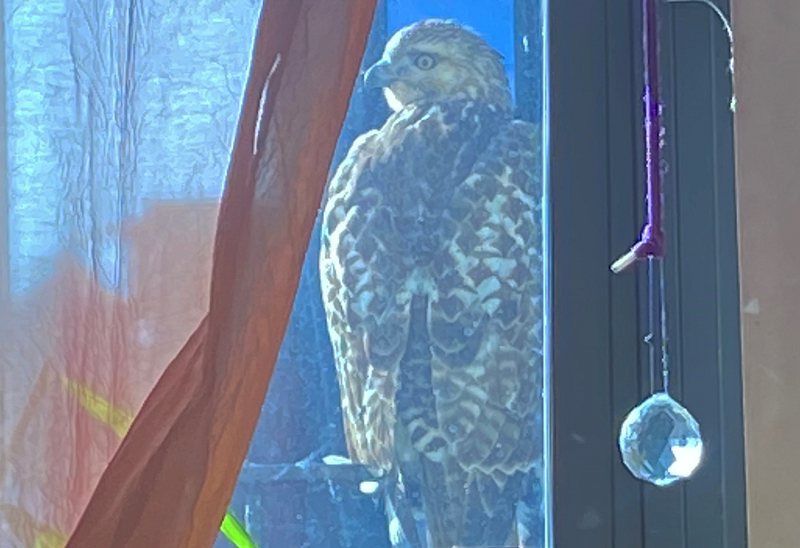
Selfishly, I continued putting out birdseed because I really love having birds jumping around outside the window next to where I write. And, even more selfishly, I have to admit that seeing that hawk on the fire escape this morning was thrilling.
Several times, it swiveled its head to look directly at us. Each time it did that we both got such a shock of…something.
In our sheltered lives where the major predator we face is an invisible virus coming face to face with something like that hawk stirs ancient terror and awe. And that awe is something we share with our fellow humans of every description.
Last week, one of our corner purveyors of chemical solutions for those in need ok, drug dealer, the guy is a drug dealer) was gazing past me with an expression of, yes, complete awe. He pointed, I turned, and less than fifteen feet from us was a hawk in one of the smaller trees on our street. As we gazed in wonder, the hawk spread its wings and swooped after an unwary pigeon. My new friend and I ran around the corner where the hawk was now perched high above us on a lamppost.
By the time I realized I was going to be late for wherever it was I was going, there were probably seven or eight of us with our phones out, gazing up in wonder at a hawk that was probably just cranky about not having caught that pigeon.
I don’t expect the hawk feels any particular gratitude towards starry-eyed tree-huggers like me who insist on putting out food for their prey. Nor do I think the doves will shun this source of winter sustenance for long. It’s good to remember how very incidental I am in all of this. The doves won’t starve if I stop putting food out. This city provides a banquet for the wild things. And, so far, the hawks have come away empty-taloned from strikes on this fire escape.
Look, my partner just lugged another five-pound bag of birdseed home last week. Let’s remember that nature is one massive cycle of living things eating other living things. And I admit that having a hawk come by and sit outside my window for five long fascinating minutes is something I’d like to see again.
Bon appetit, everyone!
© Remington Write 2022. All Rights Reserved.
Special shout-out to my quick-witted partner for getting such great photos plus the video! Yayyyy, AleXander!
Want to feed some deserving writers? Here’s how!