
Respect John Lewis’ Legacy and Pass His Voting Rights Bill
Republicans gave their condolences to the late senator, but their actions are hypocritical to Lewis’ life’s work
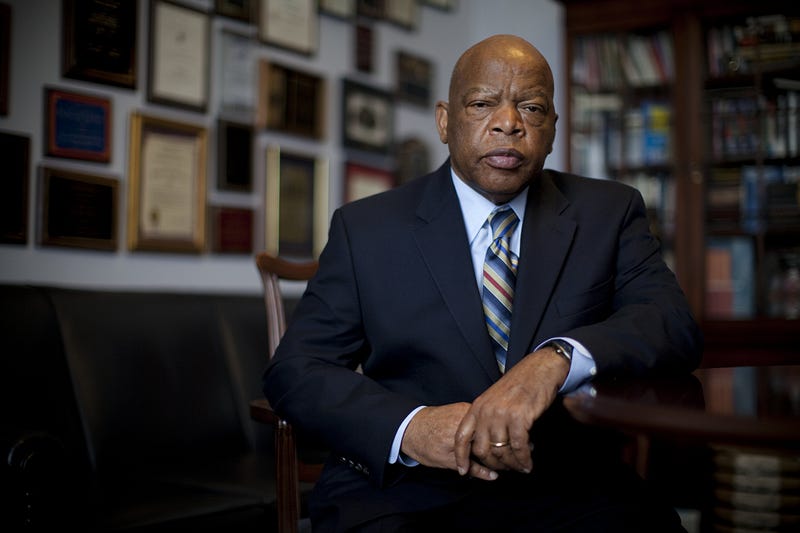
On Rep. John Lewis’ last journey, which will eventually end today at South-View Cemetery in Atlanta, Georgia, he stopped at the U.S. Capitol Rotunda to lie in state, where government officials paid their final respects. These included Republican lawmakers who have worked against Lewis, and the causes he has supported, for decades. Their presence was purely performative. It was a photo op they could tweet to their followers.
There is a far more sincere way for Republicans to commemorate Lewis’ devotion to public service. The Senate could pass HR 4, recently renamed the John R. Lewis Voting Rights Act. The House initially passed this measure in December, but it has been languishing in the Senate ever since. It would restore a key provision of the 1965 Voting Rights Act that the Supreme Court gutted in its 2013 decision Shelby County v. Holder. Specifically, the Lewis Voting Rights Act would require that states with a history of voter suppression receive federal oversight of their proposed changes to election procedures. The passage of this act into law would be one of the best ways to continue Lewis’ legacy.
Lewis spent a lifetime fighting for the right to vote. On March 7, 1965, 25-year-old Lewis, then chairman of the Student Nonviolent Coordinating Committee, and Hosea Williams of the Southern Christian Leadership Conference attempted to march from Selma to Montgomery to demand that Gov. George Wallace give Black Alabamans the right to register to vote. The day would become known as “Bloody Sunday.” It was a turning point in the civil rights movement.
At the beginning of the march, on the Edmund Pettus Bridge, Alabama state troopers beat and tear-gassed some 600 marchers and cracked Lewis’ skull. In an interview in 2015 to commemorate the 50th anniversary of Bloody Sunday, Lewis stated, “Some of us gave a little blood on that bridge to redeem the soul of America, to make America better. I thought I was going to die on that bridge.” Alongside Martin Luther King Jr. and thousands of others, Lewis made a second attempt to march to Montgomery. This time they were successful. That August, less than five months after Bloody Sunday, President Lyndon B. Johnson signed the Voting Rights Bill into law.
Specifically, the Lewis Voting Rights Act would require that states with a history of voter suppression receive federal oversight of their proposed changes to election procedures.
This fight never really ended for Lewis. Voters in his home state of Georgia have experienced some of the most egregious voter suppression in recent years. Gov. Brian Kemp, both as the former secretary of state and in his current role in the highest state office, has enacted stringent voter ID laws and purged hundreds of thousands of voters from the rolls. He spent over $100 million on new hackable electronic voting equipment, known as ballot-marking devices, which added yet another step to an already dysfunctional voting process. These machines proved disastrous during June’s presidential primary, where voters waited in lines for hours.
Lewis was diagnosed with stage IV pancreatic cancer the same month the House passed HR 4. Witnessing the calamity of the June primary must have felt like a nightmarish déjà vu. Shelby County, coupled with several governors’ hell-bent determination to roll back voter protections, had dismantled much of his legacy. Though he was at the end of his life, Lewis was having to start all over again.
Still, after the December House vote on the measure, Lewis triumphantly banged the gavel. A few months shy of his 80th birthday, 54 years after the passage of the 1965 Voting Rights Act, he was again leading the charge into a new era. Despite his illness, he never looked stronger or more determined. This is how I will remember him.
Lewis knew a tough road lay ahead. Since the moment he set down the gavel, the measure has faced a Republican-led Senate that has blocked it from going anywhere near the Senate floor. This comes as no surprise. In his 17 terms representing Georgia’s fifth congressional district, Lewis had already seen and experienced it all.
As a longtime Georgia resident and voter staring down at the November general election, I’m finding it hard not to despair. I’ve called and tweeted my Republican senators, David Perdue and Kelly Loeffler, and asked them to throw their support behind Lewis’ bill. I don’t have much faith any Republican senators will do the right thing and honor Lewis the way he would have wanted to be honored. But if there is one lesson I’ve learned from the congressman, it is that we must never stop being heard and never stop demanding justice. As he said late last year: “When you see something that is not right, not just, not fair, you have a moral obligation to say something.”