
What Would It Feel Like to Be Optimistic Right Now?
Donald Trump invoked faith as a blunt instrument. But faith is what will get us through this year.
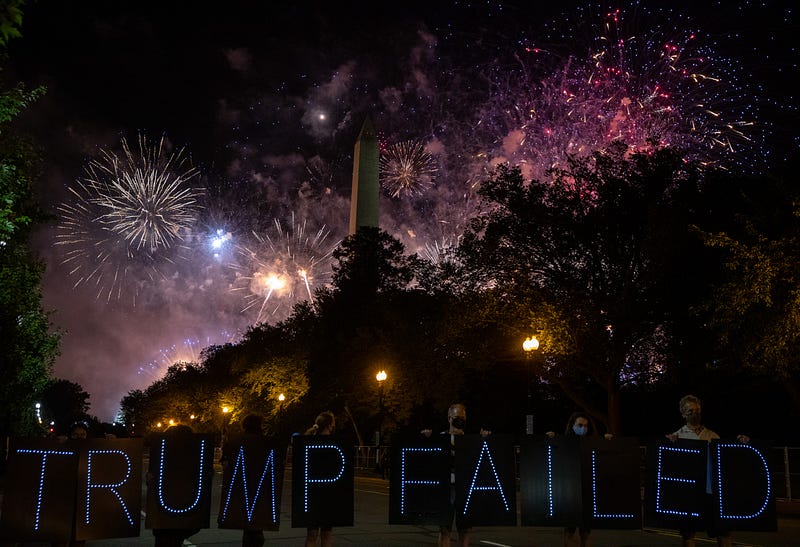
President Donald Trump’s acceptance speech topping off the Republican National Convention last night compounded surrealities: on the South Lawn of the White House, with an army of flags behind him and a sea of unmasked people seated together — after millions of Americans have sacrificed togetherness with loved ones for the past six months. It was an abdication of presidential norms, a flouting of the Hatch Act, an upturning of public health guidance, and an insult to those who’ve died in this pandemic. It was a night when God Almighty was invoked. It was a speech full of lies.
It’s been a year of grief and loss for many Americans. 2020 has been the sort of year that carries a mythic quality; it’s a cosmic test, the darkest timeline, the year from hell. Last night, on PBS’s convention coverage, presidential historian Michael Beschloss warned us that the way symbols of our country had been mixed with those of Trump’s political movement is “what happens in autocracies.”
We’ve been stacking trauma on trauma: a global pandemic, more than 180,000 Americans dead, 5.84 million diagnosed with Covid-19, elderly family members isolated, children’s school routines destroyed, careers up in a snuff of business closure. It’s catastrophic hurricanes and wildfires. It’s been the graphic witness of the country’s systemic racism laid bare in a knee to the neck, a killing in her own home, followed and killed while jogging, seven shots in front of his children. It’s also the wash of tiny disappointments; the birthdays that became just another Zoom meeting; not being able to dine in at a favorite restaurant; not being able to hug a friend hello.
In all the chaos and death, where does one find the energy to keep going or the light to energize oneself to face a new day in 2020?
Faith helps, it seems. By this, I do not mean the sort of posturing that no longer veils Christian nationalism within campaign speeches or bastardizes scripture, as Vice President Mike Pence did, substituting Old Glory into verses from 2 Corinthians and Hebrews, deleting out Jesus.
The faith that helps a country find itself again can’t be specific to any one tradition. For me, this week, a thread of something to believe in began with a cheerleader.
Recently, The Cut’s podcast returned with an episode titled “Optimism” that contemplated what it means to attempt optimism in a year with so much loss and disappointment. The episode featured La’Darius Marshall from the Netflix series Cheer. A breakout from the show, Marshall experienced abuse as a child, but through cheer, he exhibited the grit to manage extraordinary physical feats and maintain the sunny disposition required for the sport. In the interview, he balanced optimisic advice (“Baby, do what makes you happy”) with a call out for justice for Breonna Taylor; he encouraged those feeling disempowered to vote. He spoke of chasing joy but also a desire for the world to be good, to be better. His optimism is grounded in realism. He expresses faith in God, faith in change.
Trying to see my way through this year, to picture what might come of so much strain and tragedy, I am often envious of such faith. It seems like a comfort, that place to lean.
In so doing, Marshall mirrors the linkage between faith and justice that has defined many movements. Gandhi often described God as truth itself, which allowed him to “see God face to face as it were” as he defined the principles of nonviolent action and revolution. When John Lewis closed his speech at the March on Washington 57 years ago today, he proclaimed that through the force of the movement’s demands, determination, and numbers, “we shall splinter the segregated South into a thousand pieces and put them back together in the image of God and democracy.” The capacity to picture something larger and imbued with good is its own power.
The display last night and throughout the Republican National Convention also demonstrates the danger of weaponizing religion for power’s sake.
I want to be careful here. There’s a great difference between the faith that gives one stamina to pursue justice and abusing others’ faith for political ends. What I’m talking about is the personal bit, the quiet thing that can help someone get through this moment.
Trying to see my way through this year, to picture what might come of so much strain and tragedy, I am often envious of such faith. It seems like a comfort, that place to lean.
In my adult life, I’ve transitioned from Christian to atheist; and now, in 2020, I’m a theological agnostic whose faith in humanity has, moment by moment, been tested and restored only to be tested again. I’ve felt my body fill with fear and dread more times than I can count, and even as it washes away with some new, hopeful nugget of true human goodness or kindness, a residue remains. As Tara Haelle recently wrote for Elemental, for many of us, our surge capacity, the “collection of adaptive systems — mental and physical — that humans draw on for short-term survival in acutely stressful situations,” has been depleted over the pandemic’s long haul. And that’s real even before shouldering a lifetime of other immediate, systemic stressors.
I’m concerned that my capacity for optimism might be broken by this year.
If that happens to enough of us, I don’t know how we’ll navigate 2021. Superstition aside, the great curses of 2020 we’re all dealing with — inequities in public health and basic human treatment, economic insecurity, the impacts of climate change — won’t snap away with the flip of the calendar.
We’ll need the fortitude to envision and then rebuild a country.
I find myself right now thinking a lot about faith, how it works, where it can be invested. The other night I pulled an old copy of John Dewey’s A Common Faith off the shelf. In it, Dewey, a philosopher and education reformer, was at pains to separate out institutional religion from the act of being religious. A religion, in his summation, included the doctrines and theologies of a specific faith tradition. But religious experience might be observed as the effects we experience, a reorientation toward a sense of security and stability brought about through some form of devotion. His writing is a proto “spiritual, not religious” mentality, and the moments of pause are crucial. They might include reading poetry, maybe commitment to a cause. “Any activity pursued in behalf of an ideal end against obstacles and in spite of threats of personal loss because of conviction of its general and enduring value is religious in quality,” Dewey wrote.
Despite the sometimes unbearable weight of this year, it has also been a time in which people all over the country have become willing to take up the threat of personal loss to fight for an ideal. There are new allies. They are joining people whose life’s work has required the imaginative will to try to bend the moral universe’s arc toward justice.
There is something sacred in such political acts.
For many, 2020 has been a year of revelations, the year many finally could see clearly the until-now unseen structures that create such unfairness in our country. One cold reality after another. Now that it’s transparent, now that it permeates so many of our lives and is making so many people outright miserable, we have a limited set of options.
Americans are known for their optimism. To turn from this moment into something better, we’ll need more than “we can do it!” platitudes.
We can bow under it, as various leaders and thinkers are now predicting with a sort of resignation, that we may be witnessing the end of American democracy. Weighed down as we are, it can be damned hard to see the good. As much as God or other spiritual entities might qualify as the great “unseen” in our everyday world, it can also be awfully hard to see justice in the news of armed militias or a teenager armed with a semi-automatic assault rifle killing people in the street.
So yes, we can fold under all that, or, instead, assert an imaginative faith in our collective ability to heal from this time.
We live in a country that promises freedom of and from religion — whatever strength some pockets of the country are able to draw upon from their conception of God, 26% of Americans profess no religious affiliation. I’m among them. For many religious and nonreligious people, it has been disturbing to see how a singular, Christian nationalist view of American exceptionalism has been centered in this administration’s policy, as if asserting an outdated vision of hetero, white, wealthy, Christian America is enough to override the reality of our country now or the tragedies that have abounded this year.
That is not optimism; that is delusion.
But among the vast majority of Americans who want to move toward a healthier, fairer country, we require something to get us through. It might be a common faith (apply your religion or lack thereof here) that we can still evolve toward being that Beloved Community. Trump’s spectacle last night was a deviation. It’s hard to understand how we got here, let alone how we’ll move on.
“It feels impossible to try to imagine the future,” said Avery Trufelman, host of The Cut, about 2020. Optimism, of course, requires imagination. Among all the other costs of this year, the mental exhaustion and power of fear to muddle our imaginative sense for a different sort of life might be among 2020’s most insidious damage.
Americans are known for their optimism. To turn from this moment into something better, we’ll need more than “we can do it!” platitudes. This moment requires a sturdier optimism. Whether it’s faith in one’s God or justice itself or democracy’s highest ideals, we each deserve and many need some daily time spent reflecting there, devoting ourselves in quiet thought — away from the scream of social media and news alerts — to begin picturing our way through, to manifest some light from this dark time.
Trump wins by sucking all the air into the chaos of his cult of personality. Defeating his affront to democracy may require a daily regimen of civically minded self-care—20 minutes a day, unplugged from the madness, to reimagine what a healthy civil space could be. There’s a rare gift in being able to ground oneself in possibility when surrounded by strife, but that is also America’s tradition and one worthy of reclaiming.


