
The Forgotten History of the Holocaust
For years after World War II, the Jewish genocide was ignored, forgotten, or misunderstood. What changed?
By Tim Gihring
Rachel McGarry remembers the moment she began to understand the Holocaust. It was 1981. She was a kid turning cartwheels in a friend’s suburban basement, with the television on. Suddenly, a woman onscreen began recounting her imprisonment in Nazi concentration camps.
“It was gripping,” says McGarry, who now realizes she was watching a documentary called Kitty: Return to Auschwitz, about Kitty Hart-Moxon, sent to Auschwitz with her mother at 16. McGarry recalls being “frozen with shock and terror” as the nature of the Holocaust began to sink in.
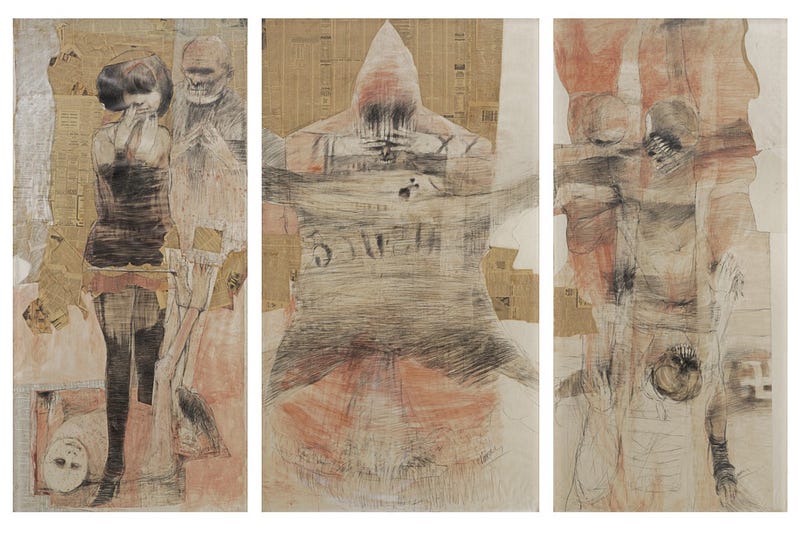
McGarry is now a curator at Mia — the Elizabeth MacMillan Chair of European Art and Curator of European Paintings and Works on Paper — where she organized the current exhibition “Envisioning Evil: ‘The Nazi Drawings’ by Mauricio Lasanky,” featuring the series of 33 drawings Lasansky made in response to the Holocaust. The son of Jewish immigrants in Argentina, Lasansky was an accomplished printmaker when he moved to the United States in 1943, and when World War II ended he was haunted by the images of Nazi death camps. But he didn’t begin “The Nazi Drawings” until 1961 — more than 20 years after the genocide began. As McGarry would learn, it wasn’t just Lasansky who needed time to reckon with the tragedy, and it didn’t always appear in the collective consciousness the way it did in her basement revelation.
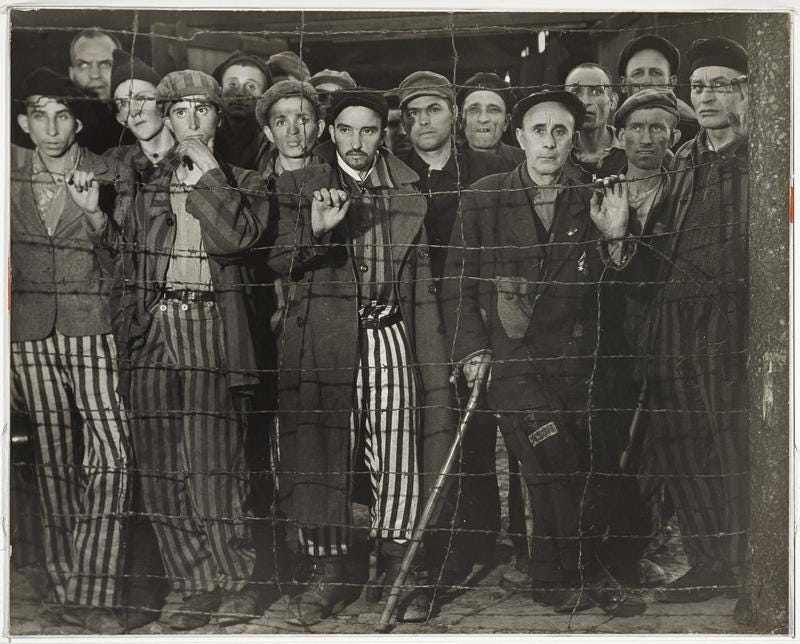
For many people, in the aftermath of the war, the tragedy of the genocide was indistinguishable from the tragedy of the war itself. McGarry studied the cover of the New York Times as it appeared every day during the course of the war — from 1938 to 1945 — and was surprised, she says, “to see how the coverage of concentration camps was buried, how the Jewish dimension was buried.” Even when the camps were liberated, and it was obvious to observers that Jews had been targeted, the media didn’t always make that clear. The Holocaust, as the historian Peter Novick put it, was “swallowed up by the carnage of war.”
Though Holocaust survivors began writing their memoirs soon after the war, or even in the midst of it, few were published. Primo Levi, perhaps the most famous of these early memoirists, finished If This is a Man in 1946 and was turned down repeatedly by major publishers. After a small printing that year in Italy, the book wasn’t republished until 1958. The diary of Anne Frank, compiled by her father, was rejected by 16 publishers in the United States and Great Britain.
Even in the homes of survivors, in conversation, what happened in the camps was often left unsaid. Kitty Hart-Moxon, whose story caught the eye of McGarry, was silenced by an uncle who said, “I don’t want to know.” What people wanted was to move on. To rebuild, not remember.
The stories that were embraced were often sentimental, bowdlerized beyond recognition. Soon after the diary of Anne Frank was published in English, in 1952, a television play aired on CBS, followed by a Broadway show and a movie, and with each production the story became less Jewish and more upbeat. The Broadway show was full of comedy; the movie was full of romance.
Then, in the spring of 1960, a nondescript factory worker in Buenos Aires was kidnapped and flown to Israel. When he was put on trial the following year, Adolf Eichmann evoked a different kind of story about the Holocaust, a true story, described by survivor after survivor in testimony broadcast around the world. Eichmann, who had helped orchestrate the murder of millions in the death camps before escaping to Argentina, evinced a kind of evil that had largely been buried since the end of the war. Now it was in everyone’s living room.
Like many others, Lasansky watched the trial and was enraged. He worked on “The Nazi Drawings” in fits and starts over the next decade: grotesque images of brutality and depravity, with allusions to prostitution, Christian complicity, and racism in the United States. The series began touring in 1967, eventually appearing at nine museums in the United States and Mexico, to widespread acclaim.
By then, the Holocaust was increasingly recognized as a singular tragedy, apart from the war itself. “There was a whole explosion of interest in people wanting to understand it through films, literature, historical studies, plays,” says McGarry. “It suggests the huge role that artists and writers and television have in shining a light on injustices of the past. Events taking place right before your eyes are sometimes only understood in hindsight.”
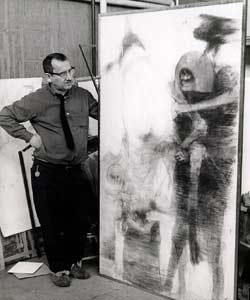
Lasansky created “The Nazi Drawings” largely with an ordinary pencil on ordinary paper. “I wanted them to be done with a tool used by everyone everywhere,” he said. There was nothing unique about his reaction, he seemed to suggest, nothing clever or cool. “Why don’t I just put down what I feel?” he said. “The fact is that people were killed — how cool can you play that?”
The picture he intended to close out the series — the last thing people would see — is a self-portrait. He has his pencil in hand and is being torn apart by a skeleton tugging at his heart. “It shows that he’s tormented by the act of producing these drawings,” McGarry says. But also, among the Nazis and conspirators in the other drawings, he has now placed himself. As if to say that evil could lurk in any of us; that to understand the Holocaust is to understand what we’re capable of, for better and for worse.


