
B.B. King
The king of blues: his life, career, and greatest achievements
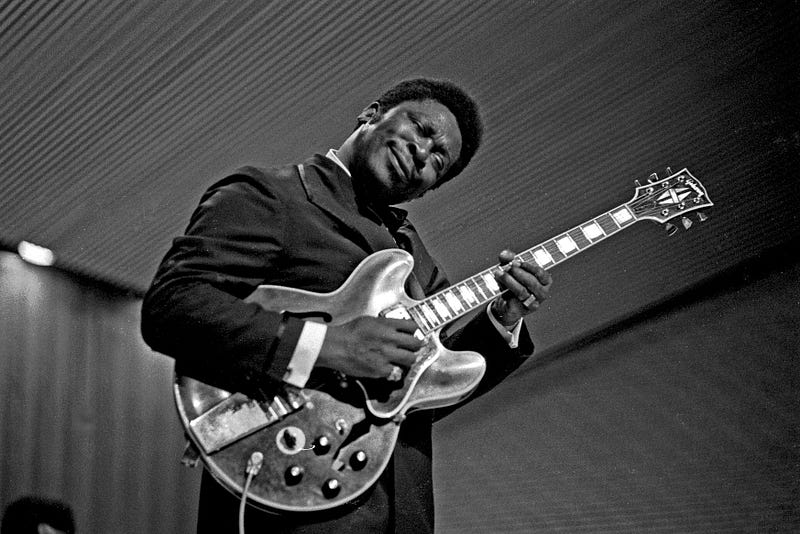
Personal life
Riley B. King was born in Mississippi on the 16th of September, 1925. King lived with his mother until her death in 1934, after which he lived alone for a time until his father found him. Working on an Indianola cotton plantation, King experienced his first encounter with blues music: the mournful songs of the cotton fields.
King served in World War II with the United States Army before becoming a DJ in Tennessee. Here, he would grow to be known as ‘The Beale Street Blues Boy’, which was eventually shortened to the nickname ‘B.B.’.
Career
A Blues guitarist without equal, B.B. King’s seismic influence over his beloved style earned him the title ‘The King of Blues’, influencing countless others in his wake.
King was influenced from an early age by the gospel music he would hear in church. Soon after loaning money for his first guitar, his talents began earning him far more than his plantation work, prompting him to move from Mississippi to Tennessee.
After settling permanently in Tennessee in 1948, the following year saw King sign to Bullet Records with his tracks Miss Martha King and I’ve Got the Blues. Building momentum with numerous other hits, King was playing roughly 300 shows a year by the mid-1950s; a work rate he kept up for another two decades.
After Rock’n’roll emerged in the 50s, King began to absorb aspects of the sound, despite being initially reluctant. After moving to the ABC imprint in 1965, he gave the world his debut album: Live at the Regal. In the wake of civil rights leader Martin Luther King Jr.’s assassination in 1968, he teamed up with fellow guitar titans Jimi Hendrix and Buddy Guy for a blues benefit show.
With acts such as Led Zeppelin hugely inspired by King, his appeal grew to a young white audience in the late 60s. His 1969 track The Thrill is Gone became his most successful song and won him his first Grammy in 1971…


