
Azure Fundamental: IaaS, PaaS, SaaS
When talking about the topic of cloud computing services, you must have heard of these concepts, Infrastructure as a Service (IaaS), Platform as a Service (PaaS), and Software as a Service (SaaS). They are the three major service categories provided by cloud providers. It is important to understand what they are and what is the difference between them because they will appear on various occasions where cloud computing services are discussed.
Infrastructure as a Service (IaaS)
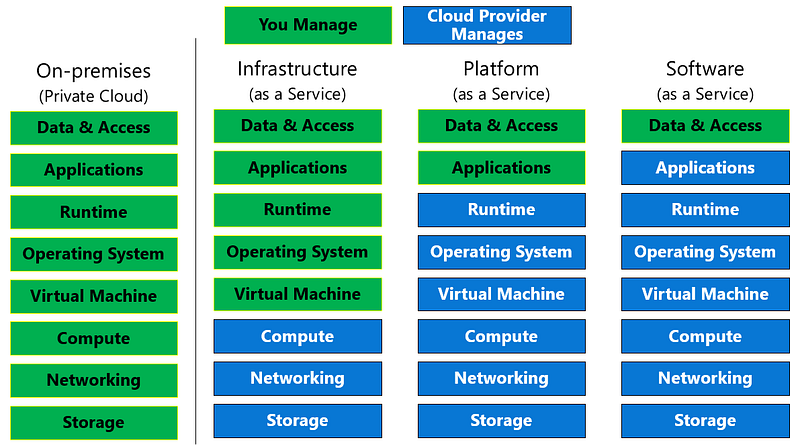
As you can see in the image above, IaaS is the most flexible category of cloud services. Instead of buying hardware, with IaaS, you rent IT infrastructure servers and virtual machines (VMs), storage, networks, and operating systems from Microsoft on a pay-as-you-go basis, and you are responsible for managing the operating systems, data, and applications.
Therefore, Azure virtual machines are Infrastructure as a Service (IaaS) and Azure page blobs are the backbone of the virtual disks platform for Azure IaaS.
Platform as a Service (PaaS)
As you can see in the image above, a PaaS solution requires less user management and does not provide access to the operating system. That means that the PaaS is a complete development and deployment environment in the cloud and provides a framework that developers can build upon to develop or customize cloud-based applications.
For example, the Azure Web Apps service provides an environment for you to host your web applications but you don't have to access the virtual machine and the operating system. And Azure SQL Database is a fully managed platform as a service (PaaS) database engine that handles most of the database management functions such as upgrading, patching, backups, and monitoring without user involvement.
Software as a Service (SaaS)
A SaaS solution requires the least management. Microsoft is responsible for managing everything, and you just use the software. SaaS allows you to connect to and use cloud-based apps over the Internet. When you are implementing a SaaS solution, you are responsible for configuring the SaaS solution. Common examples are Outlook email, calendar, and office tools (such as Microsoft Office 365).
Summary
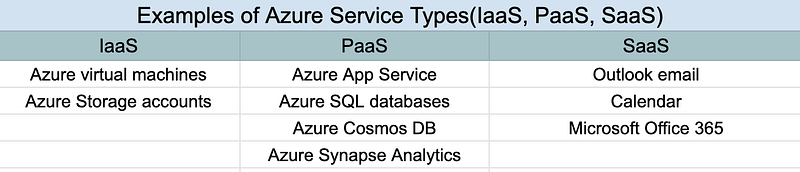
And as a summary, here is a table that shows several examples of Azure services belonging to these three categories.
Read more:
Thanks for reading! I hope it’s useful.
🏆 𝐌𝐢𝐜𝐫𝐨𝐬𝐨𝐟𝐭 𝐂𝐥𝐨𝐮𝐝 𝐒𝐤𝐢𝐥𝐥𝐬 𝐂𝐡𝐚𝐥𝐥𝐞𝐧𝐠𝐞 🚀 - 📌 https://lnkd.in/dm5dGgJu
🎯 Follow me: Jiadong Chen


