avatarTeri Radichel

Free AI web copilot to create summaries, insights and extended knowledge, download it at here

5582

Abstract

alcoholics, for reasons yet obscure, have lost the power of choice in drink. Our so-called will power becomes practically nonexistent. We are unable, at certain times, to bring into our consciousness with sufficient force the memory of the suffering and humiliation of even a week or a month ago. We are without defense against the first drink.</p></blockquote><blockquote id="b97c"><p>~ The Big Book, page 24.</p></blockquote><p id="2733">I mumbled something about doing more therapy sessions to stay in touch with my baseline feelings, but my new sponsor was having none of it.</p><p id="e1c9">‘This isn’t an emotional issue!’ he said, cutting in. ‘This is a memory issue that no amount of therapy you chose to throw money at will solve.’</p><p id="1800">He even suggested that the mental blank spot could be similar to a form of amnesia or dementia that science hasn’t picked up on yet.</p><p id="4ad6">‘But why hasn’t science picked up on it?’ I asked, holding the phone tightly.</p><p id="26fb">‘Probably because this blank spot only happens at certain times. Most of the time, it lays dormant.’ he replied before warning,</p><p id="337a">‘And unfortunately, this dormancy feature gives us an illusion of power. We think we’ve got sobriety now because our memory and willpower function normally again. Until, the condition randomly comes back online, and we relapse, leaving us totally baffled as to why it happened.’</p><p id="a3e9">My new sponsor sighed deeply.</p><p id="f455">‘It’s heartbreaking,’ he said softly. ‘Especially if you’ve relapsed after being multiple years clean. But it is sadly needed to show you that you are genuinely powerless, regardless of how much you desire and want to be sober.’</p><p id="969d">My head was spinning. Every sentence felt like the jolt of an electric cattle prod.</p><p id="8e0a">Later that day, I looked back at my recent relapses. I found no real conscious memory of consequences before any of them.</p><p id="352f">It appeared relapse was happening to me, not by me.</p><blockquote id="8aba"><p>As soon as I regained my ability to think, I went carefully over that evening in Washington. Not only had I been off guard, I had made no fight whatever against the first drink. This time I had not thought of the consequences at all. I had commenced to drink as carelessly as though the cocktails were ginger ale. I now remembered what my alcoholic friends had told me, how they prophesied that if I had an alcoholic mind, the time and place would come — I would drink again. They had said that though I did raise a defense, it would one day give way before some trivial reason for having a drink. Well, just that did happen and more, for what I had learned of alcoholism did not occur to me at all. I knew from that moment that I had an alcoholic mind. I saw that will power and self-knowledge would not help in those strange mental blank spots. I had never been able to understand people who said that a problem had them hopelessly defeated. I knew then. It was a crushing blow.</p></blockquote><blockquote id="93f7"><p>~ The Big Book, page 41.</p></blockquote><figure id="7922"><img src="https://cdn-images-1.readmedium.com/v2/resize:fit:800/0*n4r4HuNFWSnCD_WU"><figcaption>Photo by <a href="https://unsplash.com/@alicealinari?utm_source=medium&amp;utm_medium=referral">Alice Alinari</a> on <a href="https://unsplash.com?utm_source=medium&amp;utm_medium=referral">Unsplash</a></figcaption></figure><h2 id="287c">A Belief That It Will All Be Alright.</h2><p id="baea">Sadly, the ‘blank spot’ wasn’t all that was happening.</p><p id="7c3e">My new sponsor later explained that something else was happening in my mind, a kind of twisting of my thinking that I couldn’t see either.</p><p id="02a0">This is the other main feature of the relapse condition.</p><p id="da70">The Big Book explains it as follows:</p><blockquote id="f067"><p>But there was always the curious mental phenomenon that parallel with our sound reasoning, there inevitably ran some insanely trivial excuse for taking the first drink. Our sound reasoning failed to hold us in check. The insane idea won out.</p></blockquote><blockquote id="4ad8"><p>~ The Big Book, page 37.</p></blockquote><p id="da58">Anytime the ‘good idea’ of relapsing suddenly popped into my head, part of me would start to minimise the lunacy of this thought.</p><p id="e2c7">I would begin to rationalise this catastrophic idea with excuses and reasons why it would be, in fact, okay to relapse despite being in recovery.</p><p id="432a">No matter how insignificant and non-sensical those reasons were, they quickly became plausible and seemingly rational.</p><p id="6997">At the same time, the urge to want to relapse would start to surge.</p><p id="cdc4">A fear of missing out would relentlessly come crashing in like waves rolling in and out of my consciousness.</p><p id="b225">Thoughts and narratives of why it would be okay this time would dominate my thinking.</p><p id="fe2d">Finally, a tidal wave of justification would smother me into deep unconsciousness.</p><p id="c65b">Convinced of my rationale, I would carry out my plan, only to revert back to type and do everything I said I wouldn’t do, and again, find myself powerless to stop once I started.</p><p id="34a2">This twisted thinking was nothing more than a lie, but I believed the lie and didn’t see the flaw in the logic in light of my track record with partying.</p><p id="888a">To any average person, this kind of thinking and decision-making would be termed irrational, unsound, or even insa

Options

ne.</p><p id="d880">The Big Book calls this thinking an <i>‘obsession to beat the game’</i>.</p><p id="9087">Whether it’s a vague idea that this time it would be different, that I would do it differently and party like a gentleman.</p><p id="b075">Or the well-loved excuse that this will be my last relapse. After this final time, I’ll be done for good. I’ll get on with my life.</p><p id="be67">But, it never was different and that last time never did happen.</p><p id="149d">My new sponsor would remind me often,</p><p id="a62b" type="7">‘You aren’t changing your mind when you’ve decided to give in and party; your mind has been changed for you.’</p><h2 id="4c19">It Centers In Our Minds</h2><p id="f0e7">Of course, there is a body element for the addict.</p><p id="86b6">Naturally, as a consequence of the constant extreme usage of powerfully addictive substances and processes that are designed by their very nature to make you want more and more, addicts have developed a sky-high tolerance.</p><p id="2d70">But there’s this annihilation approach to our acting out and using once we start, which the Big Book describes as the <i>‘phenomenon of craving’</i>.</p><p id="01c2">In the Doctor’s opinion in the Big Book, Dr. Silkworth calls the phenomenon of craving an ‘allergy’, but my new sponsor wasn’t too keen on that idea.</p><p id="10af" type="7">‘If it’s an allergy, then why doesn’t the phenomenon of craving happen every time?’</p><p id="ae75">Regardless of whether it is an allergy, the body part becomes irrelevant, as most people with a severe peanut allergy don’t tend to keep repeating the total lost cause of trying to have another peanut to see if they will react differently.</p><p id="2e48">They don’t touch or go anywhere near peanuts because they remember how terrible it was last time.</p><p id="436a">Once or twice is enough.</p><p id="3796">Not so with the real addict because of the first two features of the disease; they will not only be back gorging on peanuts, but they will eventually take up residence in a peanut factory.</p><blockquote id="e3f6"><p>There is a complete failure of the kind of defence that keeps one from putting his hand on a hot stove. The alcoholic may say to himself in the most casual way, “It won’t burn me this time, so here’s how!” Or perhaps he doesn’t think at all.</p></blockquote><blockquote id="d5e6"><p>~ The Big Book, page 24.</p></blockquote><p id="5cb9">That’s why the Big Book says the real problem ‘centers in our mind’, not our bodies.</p><p id="22d4">‘What will happen now,’ my new sponsor forewarned, ‘as the relapses get worse, the time between them will get shorter and shorter.’</p><p id="6f0b">This condition is progressive.</p><p id="e8f1">Therefore, the blanking and twisting will naturally grow in scope and reach until you can no longer differentiate the true from the false.</p><h2 id="869b">Turning To Something Else</h2><p id="922a">If you believe in the disease concept of addiction, that this is a disease, a fatal illness precisely like any other life-threatening condition, then you have it for life.</p><p id="a2d8">There is <b>nothing </b>you can do to change that.</p><p id="d5f6">If you constantly can’t remember why or how you relapsed despite your honest desire not to.</p><p id="9aaf">Or if you continually relapse, believing some trivial reason or silly excuse to relapse while dismissing the genuine consequences, then you are a real addict.</p><p id="a47a">You have this relapse condition.</p><p id="840d">You <b>crossed a threshold </b>where, at certain times, your inability to use reasoning and rational thinking won’t even register for you.</p><p id="d8c6">The tragic truth is that once that threshold has been crossed, you have <b>no choice</b> but to relapse.</p><p id="0564">A compromised part of your brain will always fire the thought of using or acting out. That will never change. It’s wired like that for life.</p><p id="5fb0">There is no cure.</p><p id="fcca">Even this information won’t save you, as at certain times, you won’t be able to recall any of it when it matters.</p><p id="7fc5">So, let go of trying to change that.</p><p id="59f9">Let go of any old ideas around fighting it and instead get out of the way and <b>trust in something else</b>.</p><p id="b722">After all, that’s all you’ve got.</p><p id="5065">There’s nothing you or anyone else can do to stop this relapse condition.</p><p id="d1dd">But there’s everything you can do about everything else.</p><p id="5e51">There’s everything you can do about building a <b>spiritual dimension</b> to your life, by giving back, helping others, living in genuine faith and trusting in something greater than you.</p><p id="3096">There’s everything you can do to improve your awareness and intuition, raise your consciousness and develop another part of your brain.</p><p id="7598">And let this part of your brain grow bigger and stronger than that addictive part so that it can embrace and look after that compromised part.</p><p id="d2e3">Just like a bigger and wiser older sibling can care for and comfort a much younger upset sibling by giving that stressed child a big hug.</p><p id="da93">There’s everything you can do about deciding to take on a new attitude, direction, and way of life that will keep this condition dormant one day at a time.</p><p id="e415">If this article speaks to you, please follow, share and subscribe to me for more.</p><p id="fc50">Click <a href="https://twitter.com/TheDarrenJames">here</a> to follow me on <a href="https://twitter.com/TheDarrenJames">X</a>.</p></article></body>

AWS FIPS CodeCommit VPC Endpoint Returns Public IP Address

May be as designed but if not, someone should check this — and if by design it makes network security configuration difficult

~~~~~~~~~~~~~~~~~~~~~~~~~~~~~~~~~~~~~~~~~~~~~~~~~~~~~~~

⚙️ Check out my series on Automating Cybersecurity Metrics | Code.

🔒 Related Stories: Bugs | AWS Security | Secure Code | CloudFormation

💻 Free Content on Jobs in Cybersecurity | ✉️ Sign up for the Email List

~~~~~~~~~~~~~~~~~~~~~~~~~~~~~~~~~~~~~~~~~~~~~~~~~~~~~~~

Every day I’m just trying to test some simple thing and I stumble across things that make me spend time troubleshooting things I wasn’t expecting and writing tangentially related blog posts. This is one of them.

I’m testing mirroring a GitHub repo to an AWS CodeCommit repo.

I’ve written many posts about VPC endpoints and private networks, and how if you don’t configure them correctly, your traffic still may be traversing the public Internet.

But here’s the thing. Sometimes AWS uses public IP addresses and the traffic still remains on the AWS backbone. It’s just hard to tell if you send your traffic off to a public IP address if it really does stay on the AWS backbone or not. I guess it’s possible that you send something to a private IP and it somehow ends up on the public Internet if AWS has something misconfigured, but it feels less likely to me.

So I’m testing cloning an AWS CodeCommit repo and I setup a FIPS-compliant VPC endpoint (versus the standard CodeCommit VPC endpoint).

When you use a FIPS compliant VPC Endpoint you have to use a different URL for git commands. For example, in us-east-2 this is my fips clone command:

 aws_repo='https://git-codecommit-fips.'$region'.amazonaws.com/'$version'/repos/'$repo'.git'

This is the non-fips command:

 aws_repo='https://git-codecommit.'$region'.amazonaws.com/'$version'/repos/'$repo'.git'

Here are the endpoints in us-east-2 and us-east-1, for example:
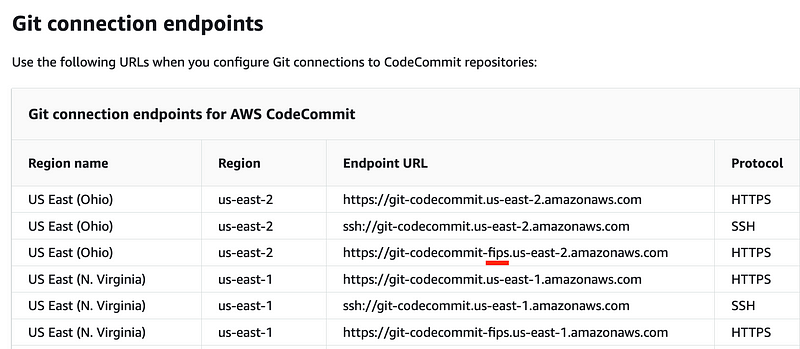
My network is tightly locked down to Internet traffic even though I have an Internet Gateway in my route table.

When I tried to leverage the FIPS compliant endpoint, my command just started to hang eternally. So I check the IP address that was returned for the FIPS CodeCommit endpoint. It happens to return a public IP address.
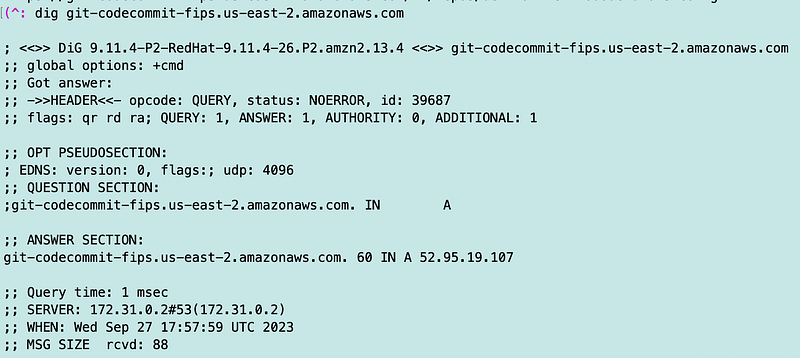
Hmm. Seems odd. I have a private DNS endpoint setup:

I wonder what I get if I set up a non-FIPS VPC endpoint.

Waiting for that to kick in I get no response.
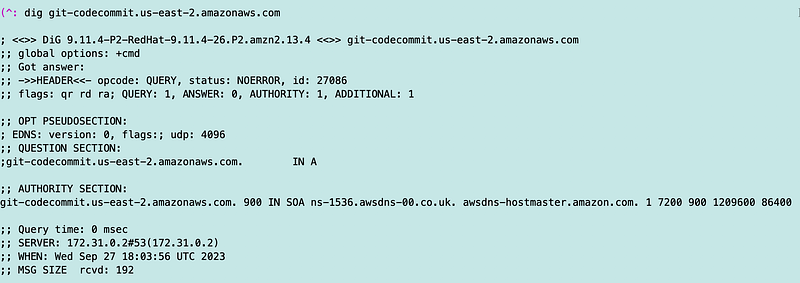
Once it finally kicks in, I get a private IP address with the standard git option, as expected.
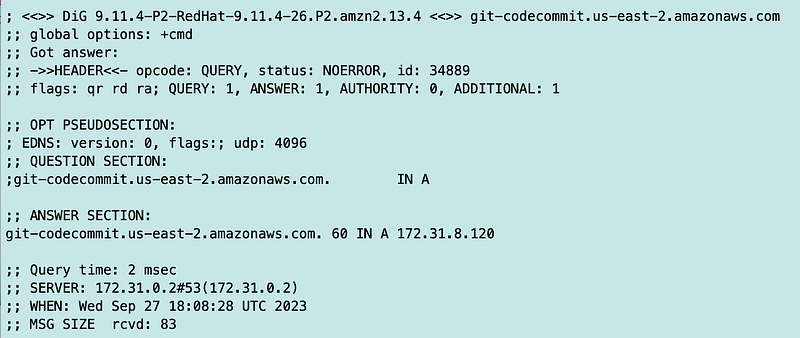
Well, this seems odd to me. And honestly, I’m more concerned about the private network versus the encryption standard so I’ll switch back to the standard git option. Hopefully this is by design and not a bug but I’m tagging it as one because I think it really should return a private IP address when you’re using a VPC endpoint. Otherwise I have to open up my network to public IPs in places where I don’t want to do that.

Additionally, how does this work if you don’t have an Internet Gateway in your route table? I presume this is some magic AWS routing where it stays off the Internet even though it has a public IP? But I still have to change my NACLs and I don’t want to have to do that.

I’m not sure if I have something misconfigured but it doesn’t seem like it — and if I do — I wish there was some kind of warning on the VPC Endpoint dashboard to explain that my traffic is not actually all going to be private as a result. I have needed this in other cases besides this one where misconfigured DNS led to traffic taking the Internet instead of private route. Seems like AWS could warn customers about that on the VPC Endpoints dashboard. #awswishlist

Note that later I discovered many issues that cause public IPs to be returned by AWS services even though private DNS is configured. If you are attempting cross-account access from one region to a different region, you need to set up private DNS resolution in the region from whence you are coming to get a private IP address (apparently — I read it in a blog post but didn’t try it due to the likely high expense. You night also be able to do something with a Transit Gateway.)

I also discovered an issue when my resource was not deployed in the same AZ as the subnet with the network interface. The EC2 instance or other compute resource likely can’t reach the VPC endpoint in the other private subnet and will try to reach the Internet instead if there is a public gateway.

In short, be very careful if you are using a VPC and subnet with both a public and private route. Your traffic might not be taking the path you think it is and you might not notice if you don’t have very stringent NACL rules.

Note that I had an interesting experience with a KMS FIPS VPC Endpoint here. You have to specify a different endpoint in the AWS CLI command or your traffic doesn’t go to the endpoint. If you have a wide open network, you might think your traffic is FIPS compliant and it’s not.

I discovered that because I block some unwanted public network traffic.

Follow for updates.

Teri Radichel | © 2nd Sight Lab 2023

About Teri Radichel:
~~~~~~~~~~~~~~~~~~~~
⭐️ Author: Cybersecurity Books
⭐️ Presentations: Presentations by Teri Radichel
⭐️ Recognition: SANS Award, AWS Security Hero, IANS Faculty
⭐️ Certifications: SANS ~ GSE 240
⭐️ Education: BA Business, Master of Software Engineering, Master of Infosec
⭐️ Company: Penetration Tests, Assessments, Phone Consulting ~ 2nd Sight Lab
Need Help With Cybersecurity, Cloud, or Application Security?
~~~~~~~~~~~~~~~~~~~~~~~~~~~~~~~~~~~~~~~~~~~~~~~~~~~~~~~~~~~~~
🔒 Request a penetration test or security assessment
🔒 Schedule a consulting call
🔒 Cybersecurity Speaker for Presentation
Follow for more stories like this:
~~~~~~~~~~~~~~~~~~~~~~~~~~~~~~~~~~~~~~~~~~~~~~~~~~~~~~~~~~~~~ 
❤️ Sign Up my Medium Email List
❤️ Twitter: @teriradichel
❤️ LinkedIn: https://www.linkedin.com/in/teriradichel
❤️ Mastodon: @teriradichel@infosec.exchange
❤️ Facebook: 2nd Sight Lab
❤️ YouTube: @2ndsightlab

Bug
AWS
Fips
Codecommit
Network Security
Recommended from ReadMedium