
Awe-Inspiring Adventure: Climbing Volcano Fuego in Guatemala — Discovering Nature’s Fury
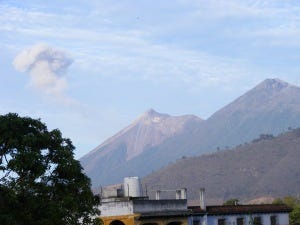
Only man would look up from a comfortable chair at a looming volcano rising almost four thousand meters in the sky, frequent eruptions emitting ominous clouds of black smoke against the blue like the barrel of a gun just-fired, and decide that would be a formidable opponent, a place worthy of a hike. That actually attempting to ascend this natural beast would be a fine way to spend a Saturday. That the view itself would be worth the treacherous climb, and that perhaps sitting atop the volcano and looking down on the land like only god must would at the very least offer a temporary shift in perspective, a sense of accomplishment, and if nothing else, a deep, well-earned nap amongst the clouds. Only a fool would decide this the night before the climb, on a whim, with no volcano-climbing experience in his pocket, out of boredom, or a vain rebuttal against that annoying voice in the back of the mind that chirps You can’t do it…You’ll never make it to the top. I am that fool.
My girlfriend and I had come to Antigua, Guatemala after graduating college to casually study Spanish and do a bit of traveling, eat fresh avocados and dabble in Mayan culture, witness the famous Holy Week processions, swim in what Aldous Huxley dubbed “the most beautiful lake in the world,” Lake Atitlan, and most importantly, get out of our parents house. For $100 a week each we were given a private room on the top floor of a beautiful two story home, with an outdoor kitchen and a terrace overlooking the town, as well as 3 homemade meals a day, 6 days a week. We quickly grew accustomed to new and simple pleasures; hand-washing laundry in the early morning, reading without the distraction of a television, not having cell phones or computers or I-pods but relying on our own very-limited, very human means of communication and entertainment. Each morning we would wake up just after dawn. The roosters usually started crowing around 4 AM and wouldn’t stop until well after sunrise, or as it seemed to us, until we stubbornly awoke. Amanda would get in the shower first and I would walk out to the rooftop terrace and look out at the volcanoes. There were three; Agua, Acatenango, and Fuego. Fuego (Fire) was the only active one out of the bunch, and some mornings when I peered out from the rooftop a fresh cloud of black smoke would be floating away from the volcano’s peak in the distance. It was always clearest in the morning.
Initially when Craig, an ex back-packer from New Zealand and the owner of my Spanish language school in Antigua unveiled to me that he and a few other guys from the school were planning to climb Fuego, my first and really only concern was, Is it steep? After Craig laughed a sort of What the hell do you think? type laugh I quickly, and without a second thought put the volcano out of my mind. One year earlier I had discovered my true fear of heights while climbing the “small” ruins around Machu Picchu in Peru, and I didn’t plan on spending any time in Guatemala hugging the sides of cliffs and cowering away from great views which I recognized only as the edge. I preferred to seek my adventure in Guatemala mulling around the markets eating big plates of chicken and rice for 15 Quetzales (less than $2), bathing in the cool crystalline waters of Lake Atitlan, swinging audaciously from beachside hammocks near the hot black sand beaches of Monterrico, maybe even stepping away from my always delicious, always cheap default drink, the Cuba Libre (Rum & Coke) and trying something new-perhaps the “ObamaNation” or the “Cuban Missile Crisis” which I had seen advertised by an American-owned bar in Antigua’s monthly event guide. These were my ideas of a good time, and I planned to leave the volcano climbing to the Aussies and Kiwis and Crazies; the real adventurers.
Then one night after sitting on the top deck of a quirky hostel-restaurant named Kafka, drinking Cuba libres for a dollar each and relishing in the act of doing nothing, Amanda and I decided to drop by the school to use the internet. When we arrived Craig and his friend Alejandro were looking at pictures of Fuego on Google Maps. They were preparing for their climb in the morning. “You can see both oceans from the top,” they were saying as they scanned across a moonlike mountain that made everything seem so much gentler and smaller than the convulsing volcano peak I watched from my rooftop each morning. “You should come with us,” Craig suggested nonchalantly. I glanced over from my Facebook page. “It’s really quite beautiful,” Alejandro mumbled. I looked again. The volcano didn’t seem so steep in the pictures. Suddenly I found my adrenaline at full throttle and my conscience chiming in like a Nike commercial on repeat; Just do it…Just do it. I tried to focus on my email but my mind wouldn’t leave me alone. ‘Are you scared?’ it asked. ‘What are you so afraid of?’
Whether it is a particular dimension of my own personality or some universal trait of man to do what the mind initially rejects, to struggle against fear and seek experiences rooted essentially in pain with the hope or false belief they will somehow make us stronger, I know not. I’m not even sure if this was my reason for going in the end. Maybe I just didn’t want to say I’m afraid of heights in front of my girlfriend while the alpha dogs were removing their macho hiking boots and Swiss army knives from their closets of manliness. Whatever it was, I decided at 6:30 PM on the night before the climb that I was in.
The first problem I had was I didn’t have any hiking shoes. So with the help of Craig I ran down to the market as it was closing to buy a cheap pair of boots, and ended up with what appeared to be a pair of knockoff Diesel clubbing shoes. They would be great if I ever decided to take up ballroom dancing, but climbing a volcano might be a different story. The bottoms were so thin I could feel every curve in the cobblestone street as I walked back to the room with lunch meat and a loaf of bread to make sandwiches for the climb. As I opened the door dripping with uncertainty, I saw Amanda sprawled out on the bed looking at brochures. Tomorrow, while I’d be off hiking towards fire and brimstone she was going to relax at the spa.
We were set to leave at 4 a.m., just when the roosters begin to crow.
* * *
Antigua is a city in sinc with the sun. It sleeps early and rises at the crack of day. As we walk down its jagged cobblestone streets, past the well preserved colonial ruins set against the faded pastel colored walls of stores and homes like pictures I’ve seen of Cuba, the city is nearly silent. Even the market is empty, and the bus station behind it which during the day is a wild parade of elaborately decorated “chicken buses” blaring their horns and Reggaeton music like discotecas on wheels, is now just a sleepy graveyard of faded yellow American school buses. All that moves this morning is stray dogs and a few early rising merchants who have made a little fire in front of the shops and sit warming their bones before the sun reclaims its position in the sky, and now and then a bus somehow teeming with people from nowhere. The three volcanoes are enormous black ghosts against the gray sky.
We climb aboard an approaching bus and ride out of town towards the base of the volcano. Men, women and children sit around us, and as the bus makes its rounds and picks up more people many have to stand in the aisles. A few young kids with book bags sit sleepy eyed, noticeably dreading the approaching day of school. In the seat across from me a business woman dressed in khakis and a gray blouse fiddles with her cell phone. Two old stone-eyed Indian women climb on carrying bags of produce and hand woven blankets with a strength and elasticity seldom seen among elders in the States. As the sun begins to illuminate a piece of sky beyond the hills and volcanoes, I look out of the window and see an old man with lumber tied to his back, hunched over from the weight of the wood so much that his body contorts to an upside down L shape, hiking towards town. He has spent the night cutting wood in the jungle, and now he’s off to the market to find a buyer.
I look around at my crew. Craig, the wild-eyed back packer from New Zealand and the current owner of my Spanish language school, Andre, a 29 year old kid from Australia that quit his job to travel for a year in Latin America or until his money runs out, and Alejandro, the lone Guatemalan among us, and supposedly (and hopefully), an expert climber. They look half-asleep. While the rest of the bus is heading off to do very practical things, we, like many seemingly foolish tourists before us, are going to climb a volcano. It suddenly all seems very strange.
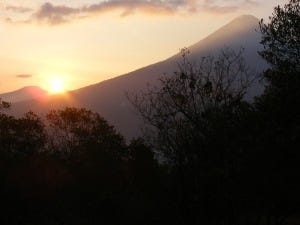
The climb has four levels. The beginning is relatively flat; a mix of rock and ash, litter strewn all over the sides of the trail. It is the hike to the volcano before the climb up actually begins. We pass a few small fincas on our right-upon return an Indian family will walk by us at dusk and gaze at us curiously as they make their way back to one of these lonesome homes. The Indians of Guatemala have the most remarkable eyes. They are like eclipsed moons, tragic, sad, and kind. It takes us one hour and ten minutes to reach the second level which begins to ascend up into the jungle. We turn around at one point to see a great orange sun rising from behind Volcano Agua. It casts the golden glow of day against our backs as we walk on. We climb further into the jungle, at times pulling ourselves up by giant roots that reach out from the volcano’s back like arms. There is rock and dirt and the crunching sound of volcanic ash beneath our shoes. We walk in single file and are very quiet. Occasionally a few foolish words are muttered-We’re really climbing now and Here we go. Never the more appropriate Is this hubris? or This must be the path to god.
Fuego is very active this morning. It erupts every 15 minutes or so, puffing out dark-gray, almost black clouds shaped like strange mushrooms. When it erupts the ground feels like a throat when it hums deeply, the throat of a monk in prayer, and at times we hear and see the rocks crashing down the side of the volcano, falling into a deep crevice that has formed like a funnel, scorched by lava years ago.
After an intense 200 meter climb the trail becomes overgrown and we can’t go on. Alejandro goes ahead to see how thick the jungle has become. He returns to tells us we must retrace our steps until we reach a lower trail. We turn around and begin descending, often sliding and at times practically skiing back down. Then Craig notices a path off to the right and suggests we try it. Alejandro has doubts but is too soft spoken to voice them and Craig waits for no rebuttals to begin walking ahead. Craig is the type of guy who when two paths diverge in the wood, he takes the one less travelled by as a general rule of thumb. This is a hell of a wood to be experimenting with paths, I think. We Follow Craig along his path to the edge of the Volcano’s crevice. We peer down into the crevice; its walls are a mix of grays and a deep earthy red. It is like an open wound cut down Fuego’s back. We walk along this edge for 35 minutes-Alejandro all the time mumbling in my ear that we should turn around-”I’ve never heard of anyone climbing this way,” he timidly says, but never actually speaking loud enough or with enough authority for Craig, who is far ahead of us, to hear. But of course he’s right, and eventually we try to cut back into the jungle only to find the path has come to an end. The jungle has grown so thick it might as well be a wall. Again, we are left with no choice but to turn around.
Upon return the path that ti- toes along the edge of the crevice seems to have gotten steeper and more dangerous. At one point it becomes very narrow. I have no problem hiking in the woods, even up steep trails, as long as I am sure that when, or if, I fall, there will be many things (roots, trees, leaves, dirt) along the way to break my fall. Along the crevice the only thing that would break my fall if I were to slip is large, loose volcanic rocks. I am beginning to get nervous. As I walk across the narrowest part of the ledge I place my hand on the wall for balance. When I pull on a rock to see if it is sturdy enough to hold my weight it comes loose and crashes down into the crevice-bad idea. Another rock breaks free under my foot and I slip. The rocks bounce into the valley-thump, thump, thump. Fortunately, the crevice is not so deep as to echo the sound of my own death, but rather scrapes and cuts, bruises and broken bones-thump leg, thump arm, thump thump thump, I imagine. Finally Andre sees me struggling and tells me where to place my foot next until I am around the steepest edge and in a safer place. I am very grateful to him and certain not to follow Craig on any more off-the-trail adventures.
Now we’re back into the jungle for two more hours of steep climbing until the halfway point. Coming from New Jersey I expect lions, tigers, and bears in every jungle, but this seems to be just trees, vines, and more trees. Other than a lone deer, we see no wildlife the entire trip. When we reach the halfway point we are more than ready to rest. The ground might as well be a waterbed, the thick root of a tree, a fluffy pillow. Food and sandwiches are passed around and at one point Craig pulls out a .22 caliber pistol he has brought along for protection. Hikers being robbed on the volcanoes is a common occurrence in Guatemala, although because of the difficulty of the climb encountering thieves on Fuego is far less likely than on the others. He begins shooting at an empty plastic bottle as he lies on his back resting on the ground. He asks me if I want to fire it (Craig isn’t your average owner of a language school). It is the first time I’ve held a gun, and Craig and Andre both find this to be very odd. I miss the bottle completely, throwing up dirt to its left. I try again. The gun feels small, strange, powerful. I’ve had enough. We eat and drink and groan over our aches and pains. We have been walking for almost five hours and we are only at the halfway point. At one point I fall asleep with my head on my bag under a big tree and have volcano dreams. Suddenly, I am woken by a deep vibration in the ground. Fuego is erupting and I look up to see an enormous dark cloud hovering near the peak and the sound of rocks tumbling down the side. Although we will never be anywhere near where the small blasts might threaten us, it is like sleeping and walking on a snoring giant.
We climb on, two or three more hours to the next level and rest again. Now the volcanic ash is deeper-in some places a finely grained sand. My thighs feel like they have been beaten by a madman with a sack of potatoes, but at least the ash is soft on my feet and the flimsy market shoes haven’t become too much of a problem. Andre has already begun taking Ibuprofens for his aches and pains, and Craig’s knee is swelling up from an old injury. He is noticeably limping with every step. Even Alejandro, the expert climber among us looks exhausted and is requesting to stop more than the rest of us. He claims he didn’t sleep the night before and is very, very tired. It is around this point I ask what the most difficult volcano to climb in Guatemala is, and to my chagrin the answer is Fuego. In fact, according to Alejandro it’s the most challenging in all of Central America. Craig, exhausted, declares he won’t be climbing Everest any time soon. “This is my Everest,” Andre says. “And other than the stairs to my bed, I hope not to be climbing anything at all anytime soon.”
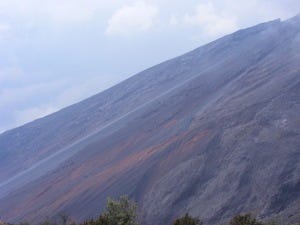
Finally we exit the jungle and emerge onto the back of Fuego. Alejandro politely informs us that this is the toughest part. It is a wide stretch of soft volcanic ash as steep as a ski slope. There are 6 parts to this final stage, each one like an enormous moon-colored sand dune, and a struggle in itself to conquer. If you’re not careful it is easy to slip and slide 5 to 10 feet back down. Other than the occasional shrub and the speckles of wheat grass, there is nothing but ash. A walking stick is essential to dig into the ground when you begin to slide, and it quickly becomes as natural as an extra limb. Dust circles in the air with every step and great groups of small pebbles tumble down together. As we rest for a moment in between one of the giant dunes Craig decides to go off ahead. Finally, when we catch up, he is at the top sitting against a rock shooting his .22 into the sides of Fuego daring it to erupt.
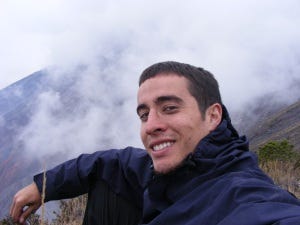
It is not a clear day to be on top of a volcano. Many of my pictures from the summit are draped in fog and clouds. We cannot see both oceans, in fact, we can’t see either one. But there is a silence on top of the volcano like nothing I’ve ever experienced. We can all hear it, even as we speak. It is absolute. For a moment we fall silent ourselves, and it as though every rough edge and sharp point and hard spot has been covered with fluffy white pillows. The world has been softened. Even Fuego itself has grown quiet and stubborn, refusing to erupt in front of us no matter how much Craig provokes it, no matter how many times he blasts tiny bullets into its side it will not reveal its fury up close.
I pull an avocado from my bag, cut it up and pass it around. It is a victory avocado from the market, and it’s delicious.
It is cold at the top. A damp mist blows by and cools my face. It is a cloud. They are flying passed us and into us like chilly ghosts. Somewhere below us thunder claps, but being above it seems to make the sound less ominous. I sit down and run my hands threw sparse patches of dried grass. There are tiny yellow flowers I have never seen before. What appears to be a bee zooms past my face. There is life, plants, bugs, even up here in the clouds. We are very tired. Although there is a bit more to the official summit, 50 meters or so, we no longer feel the need to reach the top. We have come far enough. We are content.
I think of my girlfriend who is probably having her back rubbed and her nails done somewhere down below. I ponder what it means to be sitting in the clouds on top of a volcano with three strangers I’ll likely never see again after this trip. I think of the bee and its courage to be up here so close to the bottom of the sky, and how good it feels to be so profoundly tired. For a moment all of my doubts and uncertainty vanish, and it no longer feels strange to be here in Guatemala on top of this volcano peering out at a checkerboard of farmland. For the first time since I decided to go along, climbing an active volcano actually seems like a perfectly reasonable thing to do with a day-no less practical than going to school or working in an office or bringing fruit to the market.
* * *
We do not stay long at the top. Less than an hour. We have to beat the setting sun or we’ll be stuck somewhere in the jungle on the back of a volcano with no camping equipment.
Coming down we’d be better equipped if we’d brought skis or a snowboard. The terrain demands a mix of sliding, jumping, and falling to traverse the steeper parts, my cheap market shoes constantly filling with pebbles and rocks and needing to be dumped every time I have the chance.
It takes us only 3 and half hours to get down, whereas it took almost 8 to reach the top. By the time we reach the bottom night has set in and the last hour or so we walk following a tiny light Andres has strapped around his head. Finally, we come out of the trail and look out at a quiet highway, the same place the bus had dropped us off almost 15 hours before. To our right is an old, run-down liquor store. Four or five Guatemalan men are congregated outside, some sitting on the curb, others leaning against the wall smoking cigarettes and passing around a bottle. They look at us like we are phantoms emerging from the jungle.
We cross the highway and walk up one last hill into Ciudad Vieja, where a 4 on 4 soccer game is being played under the lights of a basketball court near an old church. The whole town is out there, and I imagine they have all returned from some epic climb. We buy sodas from a street vendor and great big sausage sandwiches with fried onions, ketchup, mustard, and green guacamole sauce. Every element of every sandwich is relished, right down to the amino acids. We sit on tiny plastic stools and watch the game, waiting for our taxi to bring us back to Antigua. All of us with a restored appreciation for level ground-roads, cars, and all things that carry us.
Article was first published on Travelmag.com.
Originally published at http://nathanielkostar.wordpress.com on June 24, 2015.