
Away With the Social Media Detox!
Here’s a healthier and more sustainable way to divide our time online
I don’t believe in social media detox.
It’s one of those escapist activities where we take a long break off something that becomes toxic when consumed in large amounts. Like partying hard on a weekend after a grueling work week, this is supposed to tip the scale toward an equilibrium of sanity.
But what happens after a month-long retreat?
One week in, we’re back into consuming unhealthy amounts. That’s because we don’t practice sustainable habits when spending time online.
Let’s Do a Quick Audit
Get a piece of paper and write down the last five things you did on the internet, outside of work.
Here’s what mine looks like:
- Read and respond to a few non-work emails
- Update my content calendar
- Check my Instagram notifications
- Shop for an office chair
- Had a short exchange with my friend on Messenger (while doing the above)
We’ll get back to this later. Now, we can divide the time we spend online into two: proactive and reactive.
Proactive
Creating or controlling a situation by causing something to happen rather than responding to it after it has happened.
This includes researching, reaching out to someone via email, and looking up ‘perfect poached egg — Gordon Ramsay’ on YouTube, and watching the first video that shows up.
It is fueled by an intention.
Reactive
Acting in response to a situation rather than creating or controlling it. This includes scrolling through your feed, liking stuff, responding to comments, and reading your inbox.
This means passively absorbing information and sometimes, going down a rabbit hole from there.
When Reactive Becomes Unhealthy
Social media algorithms keep us scrolling, swiping, and clicking without end, especially when we’re mentally drained and seek some form of pleasure. Dopamine is then secreted in our brains, which motivates us to do more scrolling, swiping, and clicking.
It gets worse when I scroll through the feed while experiencing high stress or emotion. A bad day at work creates a sliver of self-doubt.
I reach out for my phone log-in to LinkedIn. I find out that a friend got accepted with a full scholarship to a school I applied for and got rejected. Then I switch to Instagram to see a photo of a friend flaunting her well-toned physique.
I go on Facebook to check my notifications, only to see I only got ten likes for that piece that took me hours to write. That sliver then expands to a gaping hole, through which thoughts of everything that is wrong about me enter.
I know what you’re thinking. Get over it. Moods go away.
Well, even if I do get over it, just how much time did I waste getting sucked into that vortex called imposter syndrome when I could have used it to feel good about myself?
Time is such a valuable asset, yet we mindlessly give much of it to big tech companies who profit from our feeling inadequate. This is why we need to cultivate sustainable habits.
Cultivating Sustainable Habits
How can we stop playing roulette? How can we use the gargantuan algorithms to our advantage?
Perhaps this matrix can help:
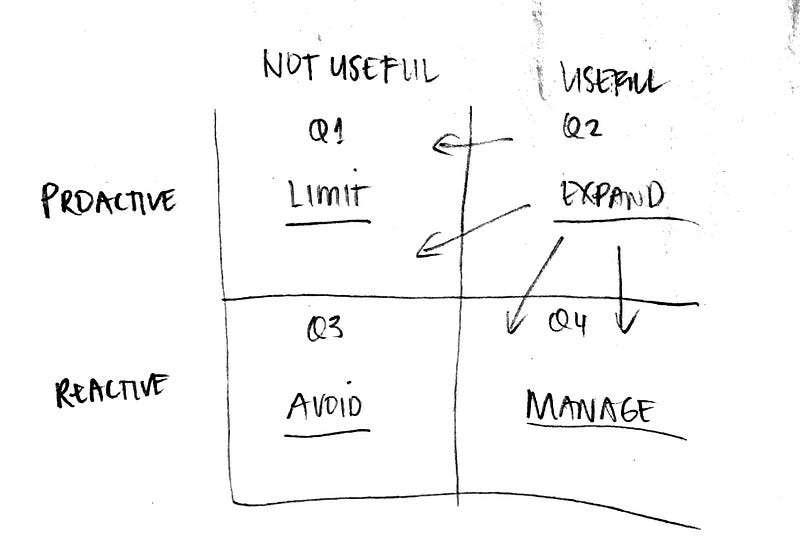
As you can see, I added another dimension: usefulness. You can define it as something that helps you achieve your goals.
Now, go back to your list and place each task into one of these four quadrants.
Quadrant 1: Proactive, Not Useful
Being proactive doesn’t mean being productive. Seeking content that does not serve a particular purpose, e.g. Hollywood news or going down meme threads on Reddit, puts a lot of time to waste.
Limit your activities in this quadrant.
Quadrant 2: Proactive and Useful
Start by making a list of things you want to use your time online for:
- Reach out to at least one friend each week
- Watch online courses on investing
- Read HBR articles on strategy and leadership
- Write one article on Medium a day
Put that list someplace you can see, such as your planner or your task-scheduling app. Spend most of your total time online doing activities in this quadrant.
Quadrant 3: Reactive Yet Useful
Examples include:
- Reading Farnam Street’s newsletters when they drop each week
- Replying to work emails on weekdays, replying to non-work (life updates) emails on weekends
- Watching TikTok videos on video editing hacks
Even then, manage your time spent in this quadrant with time blocks. For instance, limit your reading to 5 articles each morning. Watch educational YouTube videos for up to 30 minutes during lunch break.
Quadrant 4: Reactive, Not Useful
Spend little to no time on activities that don’t promote a sense of well-being.
Here’s what I do:
- Turned off all my social media notifications. That means I have to click through the app to see if anyone ‘liked’ or commented on my posts.
- Deleted my social media apps during busy work hours or days. Turning off notifications won’t cut it because I still get the urge to click through the app. Downloading the apps takes time, so the mechanism that seeks instant gratification isn’t instantly satisfied.
- Unsubscribed to news-related newsletters (e.g. Morning Brew). The FOMO feeling I get upon seeing it in my inbox is stronger than the genuine interest in what’s going on. Even if it’ll make me know more things, the information isn’t useful to me. If I want to know the latest on COVID vaccines, I can just Google it and save myself from irrelevant information.
- Un-followed influencers who negatively impact my self-esteem. Shallow as it sounds, those near-perfect personas impress upon me a standard of beauty I know I can never match. So I stay away.
- ‘Mute’ the toxic people I know. Yup, in an ultra-connected world, we need to learn to set boundaries. I’m glad that we have the tools to switch on and off the negative influences in our lives.
Final Thoughts
To sustain well-being, strategize your use of time online instead of taking excessive ‘breaks’ a.k.a. social media detoxes that don’t really address the core problem: lack of control.
By being clear with your goals and values, you can define what a good use of time is. Then, you can use the matrix to balance work and rest, play and productivity.
Social media is not all bad. It is a tool that we can use to better ourselves and build meaningful relationships.
Thank you for reading.
Hannah To is an entrepreneur and creative educator. She writes about thinking, productivity, and lifelong learning. Stay in touch! ✨
Also, if you enjoyed this article, consider joining Medium for $5 / month for access to unlimited articles. If you sign up using this link, you support the author as she earns a small commission.
If you want to read more from Hannah, you may check out the following articles:
- The Power of Being Intentional
- How To Manage Time In A Way That Best Suits You; With Principles, Not Tips
- How To Outsmart Fake Stuff On The Internet And Be More Mindful Online
You can share your outstanding stories and inspire others. Just click the below image and be a writer for The Masterpiece.
