avatarGokhan Polat ☀️

Free AI web copilot to create summaries, insights and extended knowledge, download it at here

2551

Abstract

edin.com/company/data-bulls/mycompany/?viewAsMember=true</a></figcaption></figure><p id="0599">Our first sin, pride, is related to ignoring security measures or having too much confidence. The second sin, greed, leads to ignoring stakeholder interests for the sake of profit. The third sin, envy, is the desire to imitate competitors without understanding technology, customers, and the market. Overloading systems thoughtlessly and unauthorized use of customer assets signify gluttony. Impulsive reactions to problems and not valuing employees point to the trap of wrath. The final sin, sloth, is failing to make timely organizational transformations, and not adhering to ethical issues and legal regulations.</p><p id="00d8">Millions of online transactions happening daily among crypto service providers can’t occur without a high level of trust between the related stakeholders and organizations. These entities need to create and maintain a robust digital trust environment. ISACA’s digital trust framework provides us with a roadmap to avoid these sins. Digital trust is about what consumers receive, and it matters more than what’s inside.</p><figure id="8c59"><img src="https://cdn-images-1.readmedium.com/v2/resize:fit:800/1*z7LeFT47DwyMDABBnkgtrQ.png"><figcaption></figcaption></figure><p id="f9c5">Trust is earned through high purpose, genuine effort, and skilled implementation — it’s definitely not by chance. ISACA’s Digital Trust framework points to six fundamental elements necessary for creating and sustaining digital trust within any organization and explains how to make them tangible. For now, I’ll just introduce these six elements to you. They include quality, accessibility, security and privacy, ethics and integrity, transparency and accuracy, and stability and resilience.</p><p id="a9ba">Quality affects stakeholder trust in products and services. Accessibility requires services to be always within reach. Security and privacy involve protecting personal data. Ethics and integrity demand that companies adhere to ethical behavior standards. Transparency and accuracy promote open communication. Stability and resilience ensure business continuity and resistance. By embracing these fundamental elements, organizations can boost customer trust and successfully build digital trust.</p><p id="05dd">ISACA’s Digital Trust Framework can guide us in preventing the Seven Deadly Sins that threaten our work. With this approach, we can enhance and preserve long-term success and customer trust. If you’re curious about the detail

Options

s, you can check out both ISACA’s official website and my other writings. I’ll be back with more comprehensive work on this topic in the upcoming period.</p><p id="91c8">This article was first published on <a href="https://www.coindeskturkiye.com/yazarlar/gokhan-polat/kripto-hizmet-saglayicilari-acisindan-yedi-olumcul-gunah-5198"><b>CoinDesk Turkey</b></a> on October 13, 2023.</p><h1 id="525f">More…</h1><div id="2096" class="link-block"> <a href="https://readmedium.com/how-blockchain-shapes-the-landscape-of-ransomware-attacks-fa00432c7cef"> <div> <div> <h2>How Blockchain Shapes the Landscape of Ransomware Attacks</h2> <div><h3>Let’s explore one of the most critical topics in the cybersecurity realm this week, which is ransomware…</h3></div> <div><p>medium.com</p></div> </div> <div> <div style="background-image: url(https://miro.readmedium.com/v2/resize:fit:320/1*svnyiQMxB4zzn7RzTaayMw.png)"></div> </div> </div> </a> </div><div id="7870" class="link-block"> <a href="https://readmedium.com/why-cybersecurity-should-be-a-core-business-function-1af7ecdda06c"> <div> <div> <h2>Why Cybersecurity Should Be a Core Business Function</h2> <div><h3>Cybersecurity has become essential to any successful business strategy in today’s digital and interconnected world. As…</h3></div> <div><p>medium.com</p></div> </div> <div> <div style="background-image: url(https://miro.readmedium.com/v2/resize:fit:320/1*KOidNXJKUg-e0F-wh9PjCw.jpeg)"></div> </div> </div> </a> </div><div id="ce41" class="link-block"> <a href="https://readmedium.com/enrich-your-career-in-investment-banking-with-the-best-companies-0bca2cf2beca"> <div> <div> <h2>Enrich Your Career in Investment Banking With the Best Companies</h2> <div><h3>Investment banks are massive financial enterprises that give specialized services like raising funds by issuing shares…</h3></div> <div><p>medium.com</p></div> </div> <div> <div style="background-image: url(https://miro.readmedium.com/v2/resize:fit:320/0*wxxH5-sHsqday2_c)"></div> </div> </div> </a> </div></article></body>

Avoiding Seven Deadly Sins at Crypto Exchanges by Using Digital Trust

On 19th October in Dublin, at the ISACA Digital Trust World event, we, with Onur Korucu, were on stage for this presentation. In this blog, I will make a summary of my presentation…
We’ve titled our talk “Avoiding the Seven Deadly Sins in Crypto Exchanges with Digital Trust.” In this one-hour presentation, we’ll dive into how the digital trust framework created by ISACA can be adapted for crypto asset service providers and tackle the critical risks faced in business processes.

ISACA is a world-renowned organization that sets frameworks in information and technology. I should also mention that they’re leading architects of the digital trust concept. ISACA defines digital trust as confidence in the integrity of relationships between service providers and stakeholders within the digital ecosystem.

We all remember incidents like Mt. Gox, where in 2014, a cyber attack led to the theft of over 850,000 bitcoins, resulting in the dramatic downfall of Mt. Gox. Or the ongoing fraud cases at Thodex and FTX. Before these catastrophic events unfolded, hardly anyone was concerned about these companies, given their transaction volumes, digital assets, and market presence.
The concept of the seven deadly sins, as formulated by medieval thinker and cleric Thomas Aquinas, is said to jeopardize one’s eternal life. If he’s right, committing these sins, unfortunately, sends you straight to hell. While watching the movie “Seven,” I was pondering over what our talk’s title should be. That’s when it struck me — inspired by Thomas Aquinas, I chose this title.

You’ll agree that a compelling title is crucial for an engaging presentation. Just to be clear, the “Seven Deadly Sins” for crypto exchanges represent not only moral deviations but also critical pitfalls that could lead to failure. Let’s quickly run through these traps.

https://www.linkedin.com/company/data-bulls/mycompany/?viewAsMember=true

Our first sin, pride, is related to ignoring security measures or having too much confidence. The second sin, greed, leads to ignoring stakeholder interests for the sake of profit. The third sin, envy, is the desire to imitate competitors without understanding technology, customers, and the market. Overloading systems thoughtlessly and unauthorized use of customer assets signify gluttony. Impulsive reactions to problems and not valuing employees point to the trap of wrath. The final sin, sloth, is failing to make timely organizational transformations, and not adhering to ethical issues and legal regulations.

Millions of online transactions happening daily among crypto service providers can’t occur without a high level of trust between the related stakeholders and organizations. These entities need to create and maintain a robust digital trust environment. ISACA’s digital trust framework provides us with a roadmap to avoid these sins. Digital trust is about what consumers receive, and it matters more than what’s inside.
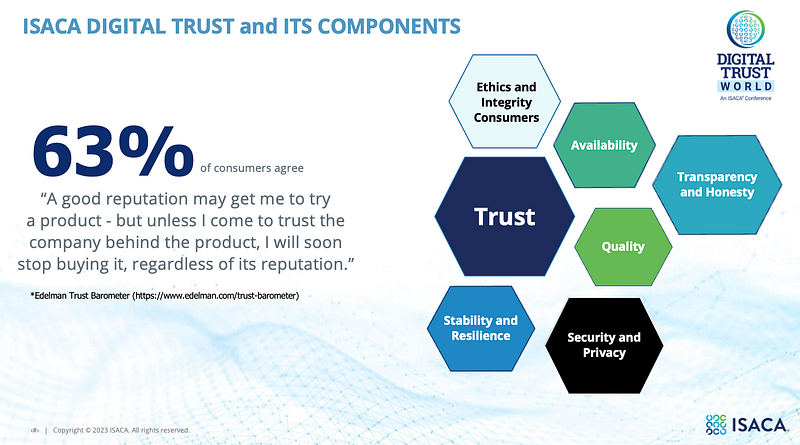
Trust is earned through high purpose, genuine effort, and skilled implementation — it’s definitely not by chance. ISACA’s Digital Trust framework points to six fundamental elements necessary for creating and sustaining digital trust within any organization and explains how to make them tangible. For now, I’ll just introduce these six elements to you. They include quality, accessibility, security and privacy, ethics and integrity, transparency and accuracy, and stability and resilience.

Quality affects stakeholder trust in products and services. Accessibility requires services to be always within reach. Security and privacy involve protecting personal data. Ethics and integrity demand that companies adhere to ethical behavior standards. Transparency and accuracy promote open communication. Stability and resilience ensure business continuity and resistance. By embracing these fundamental elements, organizations can boost customer trust and successfully build digital trust.

ISACA’s Digital Trust Framework can guide us in preventing the Seven Deadly Sins that threaten our work. With this approach, we can enhance and preserve long-term success and customer trust. If you’re curious about the details, you can check out both ISACA’s official website and my other writings. I’ll be back with more comprehensive work on this topic in the upcoming period.

This article was first published on CoinDesk Turkey on October 13, 2023.

More…

Databulls
Cryptoexchnage
Ftx
Digital Trust
Isaca
Recommended from ReadMedium