
Avatar the Last Airbender/Legend of Korra and the Nation-State
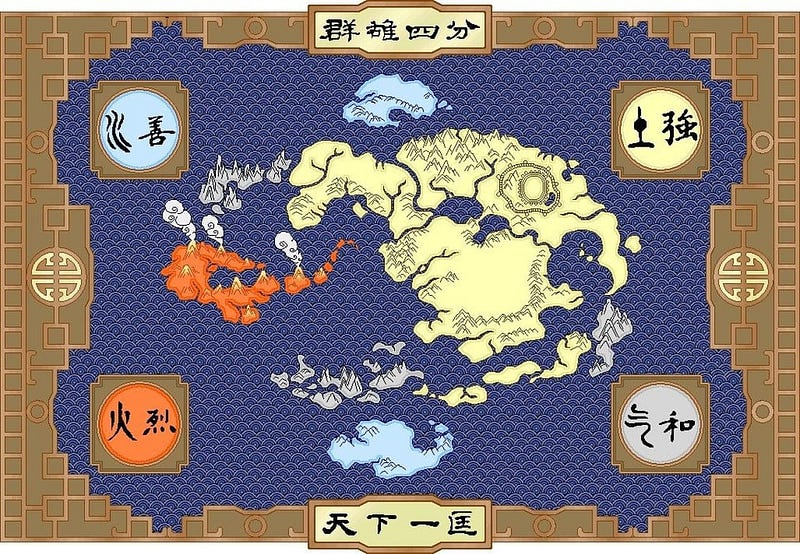
If you’ve seen Avatar and the Last Airbender, you’re probably familiar with it’s opening scene. “The four nations used to live in harmony and peace, but then everything changed when the Fire Nation attacked.” But what is the Fire Nation? Why did it attack? And what are the other three nations. What, even, is a nation? In this article, I want to talk a little bit about how we conceptualize the nation, and how it impacts our lives. I studied geography in college, and I thought it would be fun to combine my love of fantasy worlds with my studies.
Before we dive into our discussion about Avatar, I want to briefly go over some key concepts about the nation. According to Don Mitchell, a geographer at Syracuse University, the idea of a nation is not something that is natural. It is constructed. Mitchell explains that “nations are represented as spaces in which members of the nation have a strong bond with each other, a bond that trumps whatever differences (of class, gender, or religion, for example) may divide people within the nation from another. And yet this bond can only be imagined; it can never actually be known, because the collectivity that forms the nation is too large to allow any one person to know more than a few of her or his fellow nationals” (Mitchell, 2000, 269). So, because the nation is too large to actually be a naturally occurring “cultural” entity, the nation has to create a sense of national identity and incorporate people into that construct. People need to feel as if they belong to this organization in order to maintain it in perpetuity. They have to want to work for the benefit of the nation. However, Mitchell argues that “while national identity is at one level all about ‘belonging,’ it is also all about exclusion, about keeping out those you do not like and identifying yourself largely in terms of who you are not” (Mitchell, 2000, 262). Unfortunately, as described by Benedict Anderson, the Author of Imagined Communities, “no nation imagines itself coterminous with mankind.” By galvanizing people to identify with the nation, some people will be purposefully left out. As you define who you are, you are simultaneously defining who you are not.
Benedict Anderson also stresses the idea that the nation is imagined as a community because, “regardless of the actual inequality and exploitation that may prevail in each, the nation is always conceived as a deep, horizontal comradeship.” While I don’t think that idea plays out in practice (as evidenced by the 45th United States president who dodged the draft, stole money from voters to be used for his legal fees, and staged a coup to take over the country), those in power certainly try to proliferate this notion throughout the population. We are told to believe that despite our differences, at the end of the day, we are all Americans. There are a number of ways in which this message is spread. The ways in which history is taught in schools is possibly one of the most important methods. My undergraduate thesis focused on aspects of the landscape, such as monuments, museums, and even the names of roads. All of these things are ways in which the population is told who they are. I won’t get into it too much, but the idea that monuments are designed to teach history is false. According to sculptor Vinnie Bagwell, who I heard speak at a lecture at Vassar College, monuments, as well as memorials, are stories that are designed to tell the viewer who they are, and who they are not. In this way, the population knows what the nation is.
So what can the Avatar universe teach us about the nation?
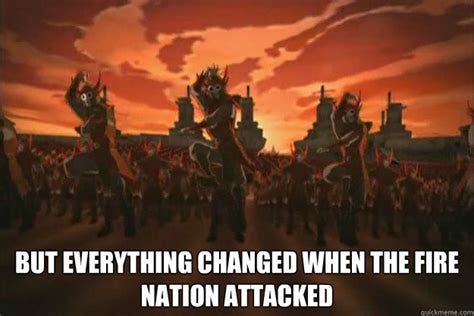
Quite a lot actually. We know from the opening sequence to each Last Airbender episode that there were four nations: The Fire Nation, Water Tribes, Earth Kingdom, and Air Nomads. The different nations seem to be tied to the ability of some of their members to bend these four natural elements. For example, some people in the Earth Kingdom can bend, or manipulate the Earth. Seems simple enough. But when we take a closer look at each individual nation, we see a lot of interesting patterns that fit into how Mitchell and Anderson think about the nation.
Let’s start by looking at the Water Tribes. We are told that there are four nations — Earth, Fire, Air, and Water — but the Water nation is actually split into two different tribes: the Northern Water Tribe, and the Southern Water Tribe. They are located at the northern and southern poles, and are literally as geographically far away from each other as they possibly could be. The entirety of the first season of The Last Airbender shows Aang and his friends slowly making their way from the south pole to the north. Though there’s reason to think that the actual world is much smaller than the planet that we live on, it still takes a considerable amount of time to traverse the distance between the tribes.
This geographical separation makes the political separation between the tribes believable. In order to effectively operate, each tribe would need their political institutions to be more focused on their respective regions, allowing each tribe to organize themselves in ways that make sense for them, rather than in a way that would make sense for a single nation. For example, each tribe has their own chief. There isn’t a single ruler or government that oversees the affairs of both tribes.
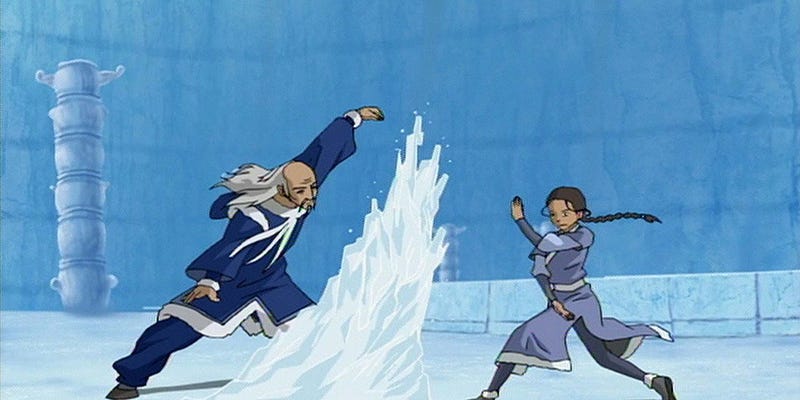
Even the culture of each tribe is different. Katara, a waterbender from the south, is pushed by her grandmother to become the best waterbender she can be, and is even encouraged to join Aang on his journey to save the world. But when she arrives at the Northern Water Tribe, she is told that women aren’t allowed to learn combative bending forms, rather, they can only be healers. The fact that Katara didn’t even know that was a part of Northern culture speaks to just how separated the two tribes are. It’s difficult to know what goes on in places that are far from your home, and the spaces that you occupy on a daily basis. In the Legend of Korra, the distinctions between the tribes are pushed even further. Korra attends a festival in the south where the people have set up stalls with games and food, and there are even rides there. She is told by her uncle, the chief of the Northern Water Tribe that the same festival up north is more focused on celebrating the spirits. We don’t get to see that festival, but if we take her uncle at his word, we can imagine a much more subdued, mystical affair without the presence of a myriad of carnival games.
And yet, despite all these distinctions, the two separate and distinct political structures, different cultures and practices, and two populations that certainly don’t have many opportunities to meet each other, being on opposite ends of the globe and all that, the Water Tribes are considered to be part of one singular nation. There are four nations, not five. When the Northern Tribe invades the South in the Legend of Korra, the other world leaders describe it as a Civil War. Before committing fully to the South’s cause, Korra tries to ease the tension in the streets by telling the southern and northern tribesmen that they are members of the same tribe.
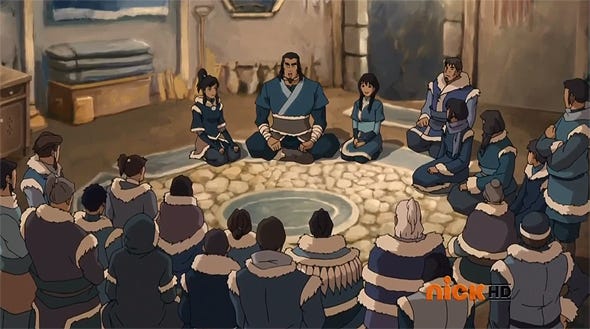
All of this begs the question, why are the Water Tribes considered to be one nation when they lead such drastically different existences from one another? This gets to the idea of imagined communities. To Anderson and Mitchell, nations are imagined because members of the nation don’t have any actual meaningful or personal connection to all the members of the nation outside of the bonds that they imagine exist. For all intents and purposes, the Southern and Northern Water Tribes can almost be thought of as having a similar relationship to New York and Alaska. I live in NY, and I don’t know anyone in Alaska. The everyday lives of people living in Alaska are unknown to me, and in order to even go to Alaska, I need to cross through multiple states and a huge area of water, or go through an entirely different nation. When I think of Alaska, I picture a lone person moving through a frozen and dark landscape hunting a moose. Is this image accurate? I don’t know, I’ve never been to Alaska. And yet New Yorkers and Alaskans are told that we all share a bond through our connection to the American Nation. We are told that we are all Americans, and that we share common values and histories, even though I have no recollection of learning Alaska’s history in school, and there are many cultural practices that are unique to each state. I don’t participate in an Iditarod through the streets of New York City every year. But this logic can even be applied to communities within the same state. Long Island NY is very different from Buffalo New York. Being close to the ocean and spending time on the water is incredibly important to me, so much so that I grow uncomfortable when I spend time anywhere where I am not surrounded by water at all times. That isn’t something that someone in Buffalo would necessarily relate to. My point is, the Southern and Northern Water Tribes are just as different from each other as New York and Alaska, as well as Long Island and Buffalo, but just like the places that I described, they are considered to be part of one nation. Korra tells the members of each tribe that they are part of one nation, even though neither the Southerners nor the Northerners feel as if they are.
I think understanding the relationship between the Water Tribes and the nation is a little bit more complicated, but I think they also imagine themselves to be part of a nation through their ties to a larger idea, in this case, water. Water is important to all four nations, but the Water Tribes have a special connection to the water, and some members of the nation can even bend water, moving it through the air through the movement of their bodies. Based on the fact that water is literally in the name of the nation, I’m going to assume that it is their connection to water that has brought the Water Nation together. Their individual connections to water allow them to imagined a connection to each other. Despite having different cultures around water and how the ability to bend can and should be used in society, the Water Tribes choose to imagine themselves, differences and all, as being part of the same nation.
This is true of many of the other nations as well. Probably the most interesting manifestation of the nation is the Earth Kingdom. It is the largest nation in both landmass and population. It has the smallest percentage of benders within its borders, but Earth is still an important aspect of the nation. There are a handful of examples of independent societies that all identify as being part of the Earth Kingdom, in part because of their connection to the Earth, though, as we’ll see, that isn’t the case for all of the communities that are part of the nation.
There are a number of ways that demonstrate the imaginary nature of the entirety of the Earth Kingdom. For starters, we are introduced to two Earth Kings during the Last Airbender: King Bumi who rules over the city of Omashu, and the Earth King in Ba-Sing-Se. The relationship between the two cities is unclear, but I interpret them as being somewhat independent. In effect, they are their own Kingdoms. Similar to the Water Tribes, the entirety of the singular Earth nation exists because these two separate Kingdoms imagine that it exists.
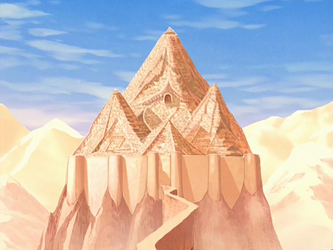
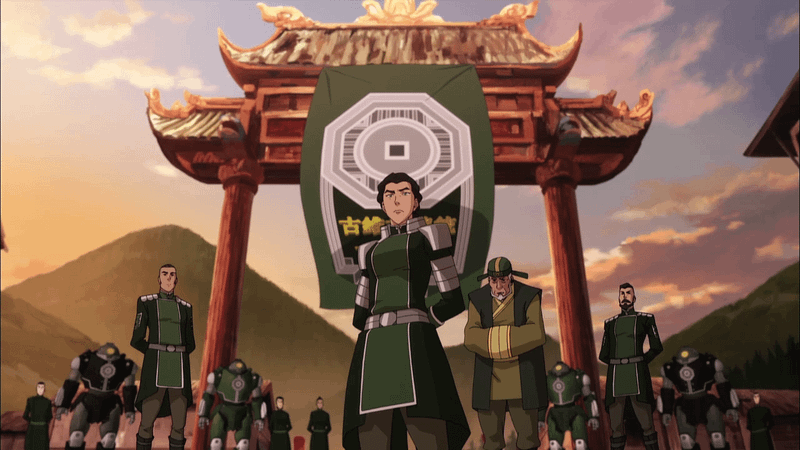
By the time of the Legend of Korra, we begin to see the Earth Kingdom break down into smaller more localized regions. The city of Zaofu, the home of the metal clan in the Legend of Korra, is the first place we see that really feels separate from the entirety of the Earth Kingdom. Omashu, despite having its own King, still felt like it was a part of the Earth Kingdom. The Earth symbol was prominently displayed on its walls, the citizens adhered to the green color scheme, even the visual aesthetics of the city and how its buildings and walls were constructed communicated to the audience that this was a part of the Earth Kingdom. Zaofu does not read as belonging to any larger organization outside of Zaofu. Aside from the visuals being different and the emphasis on metal rather than Earth, Suyin Beifong, the daughter of Toph, tells us that she founded the city as a place for people like her to start over. It is a new place, apart from the Earth Kingdom. Indeed, Suyin detests the Earth Queen, and suggests that she should step down and allow a new system of government to take her place. Omashu deliberately coded itself as part of the Earth Kingdom, embracing that imaginary community, but Zaofu cut itself off from it. Those living in Zaofu define themselves as being part of the metal clan, and other earth benders in other places don’t fit in with them. The introduction of a new form of elemental bending creates a degree of separation between the metal clan and other earth benders. When they define Zaofu as being the home of metal benders, they are also claiming that it isn’t the home of those who can’t bend metal. Broadly speaking of course, as we do see a number of non-metal benders make their home there, including a fire bender who is a member of the guard. But when thinking about the nation, these broad definitions shape how the nation organizes and how it views itself. The more that Zaofu emphasizes its affinity with metal, the more alienated from the rest of the Earth Kingdom it becomes. By the end of the show, it isn’t just Zaofu that is separated from the Earth Kingdom. King Wu of the Kingdom tells Korra that he plans to step down as King and allow different regions of the nation to elect their own leaders. It’s possible to read this as a democratization of the nation, the creation of a system of states that all follow their own laws as well as a federal government, but I think it’s possible that this can also be read as the creation of multiple nations, similar to the way the former Soviet Union broke apart into multiple independent countries. We’ll have to wait for future stories to see what path the former Earth Kingdom takes.
I have less to say about the Air and Fire Nations as we don’t really learn all that much about them in the shows, though we do see some parts of the Fire Nation. One of the best examples of the nation being imaginary is in the episode where Katara pretends to be a spirit called the Painted Lady and helps a Fire Nation village that was built in the middle of a river. Though they are technically part of the Fire Nation, the village seems to be against the army placing a factory upstream. The factory pollutes their water and is responsible for the disease and starvation plaguing the village. The villagers are more united in their care for each other than their interest in the nation. It’s yet another example of local communities in which people actually know one another holding more weight than the idea of the nation. We can’t ever truly know the nation in its entirety, but we can know our neighbors.
I’m sure there are more examples of the nation at work. I want to do a future episode on the monuments and murals of the Fire Nation, and talk a little bit more about how we come to care about the nation, but I’m going to end this episode here, on the premise that the nation is imaginary. The nation exists because we imagine it to exist, drawing boundaries based on certain perceptions of the world, and extending membership to those we deem as part of the nation. The Water, Earth, and Fire nations all show us that any one nation isn’t a given. Despite sharing strong bonds over their shared elements, conflicts still arise, some that lead to the creation of smaller, separate nations. Just as I don’t truly know what anyone in Alaska is like or what is important to them, no one in any nation can know every single member of that nation. Identifying yourself as a member of a nation takes some imagination, and a lot of work on the part of those in power who are able to shape the landscape and narratives around the nation.
I hope you enjoyed this article! Check out my podcast, “Determination, Deliberation, and Dragons,” where my friends and I workshop original stories, analyze books and films, and interview authors and other creative people. You can listen to the show wherever you get your podcasts.