
Automated Trading is Cool
But Buy and Hold is a tough benchmark to beat
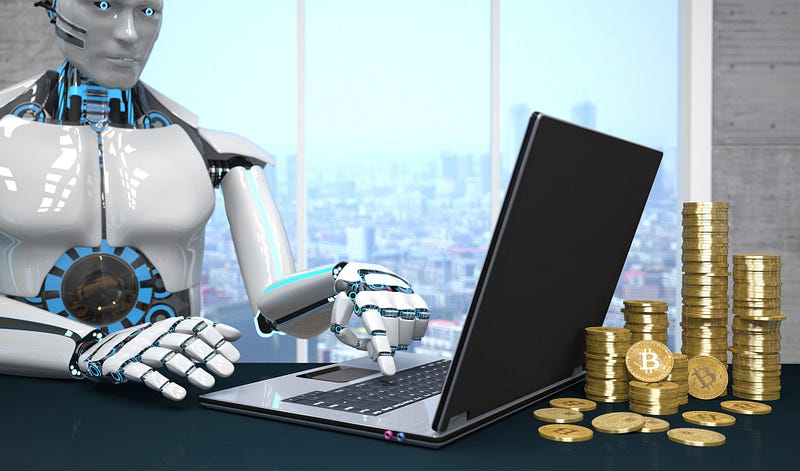
I must confess to being unduly tempted by technological whizz-bangery, often at the expense of my financial results. Who could resist the lure of setting an automated system running and just needing to check in every day or two to transfer your profits out to your bank account?
Sadly it never seems to work out like that.
In the financial arena, the first automated systems I came across for retail investors were the Expert Advisors or EAs which could be used on the MT4 Forex trading platform. These automated trading scripts are still so popular that brokers cannot wean their clients from the MT4 system, even though the vastly superior MT5 has been available for years.
This happened because a lively aftermarket developed for sales of EAs, for those like me who didn’t have the skill or time to learn the MQL coding language in which they were constructed.
Buy the EA, went the gaudy internet adverts, install it and sit back while the profits roll in. Here are a few reasons why this never really worked.
- The EA had so many variable parameters that there was an infinity of combinations to be tried, with the result that you would blame any losses on sub-optimal settings, and spend hours trying to tweak the controls (I’m talking to you, FAPTurbo)
- The EA had so few variable settings that it was only any good for the precise currency pair and market conditions for which it had been optimised (which were never likely to recur)
- The EA used a martingale or grid system to recover losses, basically doubling up the stake for subsequent trades. Grid systems generate a wonderful equity curve, as long as you don’t pay attention to the increasing trade sizes at the bottom of the graph. In the end a long enough adverse run would always bankrupt even the largest starting bank (in just the same way as the martingale system fails at traditional casinos)
Coders are smarter now and have better tools available, most trading platforms provide an automated programming interface (api) to which external systems can connect, and the arrival of crypto has added a highly volatile instrument to the retail financial landscape. For all of these reasons, a new battery of candidates has arisen to scratch that auto-trading itch. Having thrown money at many of these over the past few years, I have some of the same misgivings as with the previous generation, and some entirely new ones.
- Some highly capable automated trading platforms have become available for crypto instruments (I have used the Haas Bot extensively). But these can present an even steeper learning curve than the most complex EA. Which exchange should I activate, which instruments should I trade, what combination of technical indicators should I follow and what risk management techniques should I implement? You can disappear down a rabbit hole of perpetual tinkering, without ever settling on the “be all and end all” parameters which will ensure consistent profitability.
- Handing your money over to someone else to manage is probably the easiest possible way to lose the lot. No matter if they have a shiny website and trading platform, customer testimonials and a legitimate registration at Companies House. Many of them can and will disappear with your funds. What’s more, they will then pass your details on to accomplices who will contact you and ask for an upfront fee to recover your original funds (before disappearing themselves).
- Funding and arbitrage bots are intellectually satisfying. You can see how a difference in prices (or in funding rates) between different crypto exchanges can give rise to a potential profit (by selling what is comparatively expensive and buying what is comparatively cheap). But you are making cents rather than thousands on these round trips, while tying up significant funds on each platform, and having to periodically rebalance funding between platforms. What’s worse is that your entire profit for months can be wiped out by a single operational glitch such as an api failure leading to one half of the arbitrage not completing.
I resisted the inevitable for as long as possible, but eventually decided to invest directly in crypto without leverage and without automation. Part of my resistance to doing so was a love of excitement. Buying and holding is pretty boring — when you’re holding for the long term you get neither the clenched stomach of a sudden plunge in prices nor the elation of a spike. Just the quiet satisfaction (if you’re lucky) of a steady appreciation over time.
Holders of Bitcoin have had a bumpy ride for the past few years, but over any four-year sliding window since its creation BTC has outperformed all other major asset classes (and even individual star performers like Netflix and Domino’s). The coin suffered a 50% drop in March, in tandem with other asset classes globally, but has since recovered to above pre-March levels (which can’t be said of the Dow Jones or S&P).
In fact, even with the March dive, Bitcoin’s price has appreciated 11% in the year to date, whereas the S&P, even after recovering strongly, is still down 11% on the year.
Better results are available, depending on the luck (or skill) of your market timing. A late recruit to the Buy and Hold camp, I have owned physical Bitcoin and Ether only since early April, but have seen them return a blended rate of over 50% in that time.
A lot of this has to do with the upcoming halving of Bitcoin rewards, whose result is that digital miners will be paid half of what they are used to for generating new Bitcoins. As they have electricity bills and equipment to pay for, this will double the lowest price at which they can sell their Bitcoin and (so the theory goes) exert an upward pressure on prices in general.
It doesn’t matter too much if this theory is full of holes. If enough people believe in it, then it becomes self-fulfilling, at least in the short term. And the number of Americans who are turning their $1200 Covid checks into BTC, according to Coinbase, would suggest that the word is spreading widely.
With returns such as I have been seeing, there’s no real need for me to return to automated or leveraged trading. But that won’t stop me completely.
The intellectual challenge of mastering the bots will keep me dabbling with automation. And as for leverage, well I’m sure it’s common knowledge that adrenaline is addictive.
Many thanks for reading!
For cautionary tales in trading and finance, see the articles below.
#500Race


