Authentic Leadership: Answering a Nobler Calling
Answering the call to leadership must come from a higher plain than ourselves.
I have spent the past four decades of my life as both a leader and a follower, first in the military, then in corporate America. During that time, I have a few great examples of leadership, and WAY too many examples of poor leadership which I would NEVER aspire to practice myself. I have seen very humble men take organizations through times of great trials and come out ‘smelling like roses.’ I have also seen men and women in leadership positions ‘crash out’ because of the horrible flaws in their characters.
During these same years, as a leadership practitioner, I had some notable successes myself. I graduated with honors from an Air Force Non-Commissioned Officer school. As an Air Force Officer, I was both a leader and a follower in an aircraft maintenance squadron that was named the best Organizational Maintenance Squadron in the US Air Force in 1986. My team and individual leadership efforts were instrumental factors in my selection as the Outstanding Company Grade Officer of the Year at Columbus Air Force Base (AFB), MS, for 1986. Eight years later, I was the Company Grade Officer of the Quarter (Fall 1994) at Osan Air Base, South Korea, before I left the Air Force in 1995.
I entered the civilian workforce where I took on several positions in the IT industry. Among my greatest successes was to lead a team of programmers for 6 years, where I turned around a team that could not seemingly produce any products, to one that produced over 30 critical enterprise applications, with a user acceptance rate of 94 percent, and average development durations of 120–150 days — both of these results were WAY above industry standards.
My work in leadership has also included intensive research into best leadership practices, studying leadership across industries. I have had formal academic leadership courses at the graduate and doctoral levels. I have been involved in studying many famous (and not so famous) management and leadership experts, including Steven Covey, John Maxwell, Simon Sinek, Jim Collins, Michael Hyatt, Robert Greenleaf, and many others.
Yet for all of my work in leadership, as a practitioner, as a follower, and as a student of the best leadership minds of the past two centuries, I always felt that ‘something’ was missing in defining what made a truly great and inspiring leader. Was it character? Of course, character is important. But character comes from a sense of being accountable. There are books and books written about character and accountability. But where does someone get their sense of accountability?
That’s where I begin to find the reams and reams of books, articles, podcasts, etc falling short. Most of them stop at talking about accountability, either the leader’s accountability, or establishing a culture of accountability, or making sure that you — as the leader — hold your team accountable. But again, I have to ask, where does the sense of accountability come from?
First, I thought, “Aha, it comes from answering to a higher calling.” But the more I thought about it; the nagging thought came to me. “What does it mean to answer a higher calling?”
Hitler, Stalin, Robert E. Lee, Pol Pot, etc. — each one of these leaders thought they were answering a higher calling. The problem was that these “higher callings” weren’t higher at all, but repressive, evil callings, which had to be overcome at great cost, often by great wars that cost millions of people their lives.
Yet through the process of thinking through this, one can not deny that many answered the call to be great, inspiring, authentic leaders who inspired millions on to a greater good by answering a noble calling — “That’s it! That’s the word I was looking for.” Men and women who are great leaders answer a noble calling.
Noble. Webster’s dictionary defines noble as “having or showing fine personal qualities or high moral principles and ideals.” Applied to leadership, it means that true leaders are those who feel compelled to answer the call of ‘a greater good,’ answering the call of high moral principles and ideals.
So we start with the definition of Authentic Leadership: Authentic leaders are those who are consumed by a noble calling. This noble calling will guide their lives — often at significant personal cost to themselves — and it will shape the lives of all they come in contact with, even those who do not willingly choose to follow them.
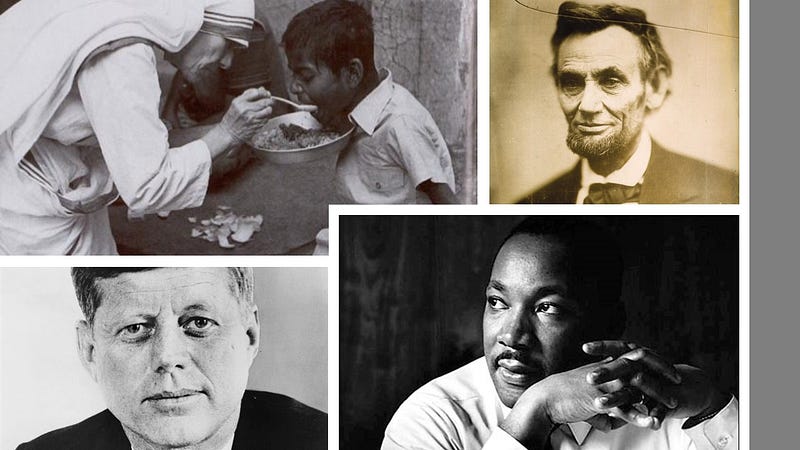
Today, however, our modern culture confuses this authentic leadership with charismatic leadership. But authentic leaders, while often seemingly charismatic, are not concerned with charisma, nor are they concerned with being popular (or even liked — although the traits of authentic leadership are themselves compelling). Authentic leaders like Gandhi, Martin Luther King, Mother Teresa, Abraham Lincoln did not concern themselves with popularity. Additionally, the authentic leaders of the great corporations that Jim Collins identifies in his book “Good to Great” were not worried about popularity. Instead, these men and women were consumed with their noble calling; it drove them, it humbled them, and the result was that it influenced millions of people around the world, even long after their deaths.
Authentic leaders can do just that: they can change the world.
The world is in desperate need of authentic leaders in every field, in government, in corporations, in non-profit organizations, and even in our religious institutions. We have way too many managers who see their positions as jobs. We don’t need more managers who are merely doing their jobs.
What the world is desperately crying out for are authentic leaders who feel compelled to answer a noble calling.


