
Australia’s Story: On the Ground 2.5 Billion years ago
The Iron Ore Seas
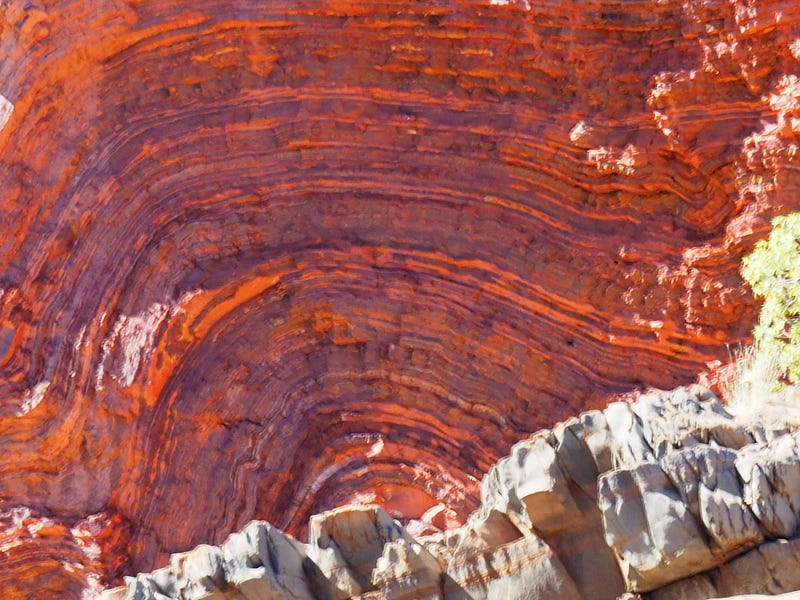
In Dales Gorge, Karajini National Park, Banyjima country, a trail winds along dry creek beds between 100-metre rock walls. When I dropped my gaze to the ground, I saw fossilized rain spatters in the sedimentary stone, and I realized they were 2.5 billion years old (2.5Ga). It was one of the most memorable moments in my hiking career—an ancient rain squall captured in stone.
Beyond that fossilized moment in time, Karajini captures one of the most important epochs in the story of modern Australia because, at that time, nearly one-quarter of the world’s iron ore was deposited here,[1] creating the country’s most significant and valuable resource.
The surrounding rocks date 3.5 Ga. We can say this because of one of the great scientific advances of the last 40 years. The Australian National University developed the sensitive high-resolution ion microprobe (SHRIMP) in the early 1980s and tested it in the Pilbara region of Western Australia.[2] They used zircon crystals that incorporate uranium atoms, which decay to lead. They discovered many of the crystals were 3.5 Ga and some 4.3 Ga. The igneous rocks of the Pilbara were forged deep in the Earth’s mantle 3.5 Ga from even older rocks, forming a tectonic raft known as a craton.
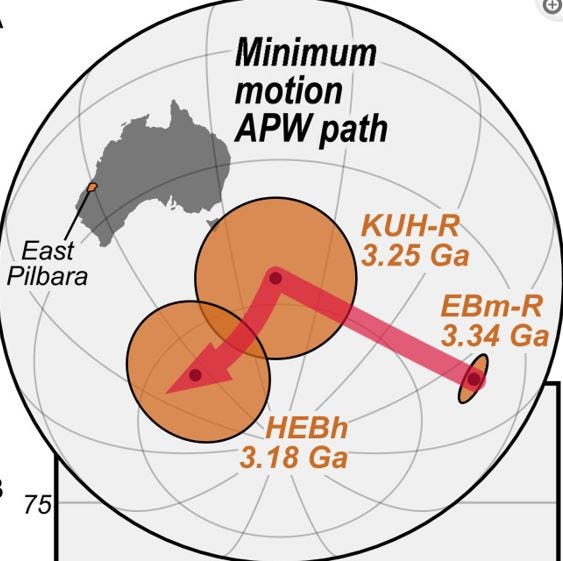
Over the same decades, geologists have also developed the science of paleomagnetism, detecting the alignment of crystals along the shifting magnetic lines between the poles. It has allowed the determination of latitude when igneous rocks cooled, providing a record of continental drift. Since the 1980s, extensive seabed drilling has mapped the tectonic drift. At 3.5 Ga, best estimates place the Pilbara Craton in the southern polar circle,[3] moving westward.
Bacteria were already dwelling in the surrounding seas and organizing into multicellular mats and mounds known as stromatolites. In 1984, a Western Australian geologist, Alec Trendall, found convincing evidence of fossilized stromatolites in the Pilbara dated 3.45 Ga.[4] The site is currently being assessed for addition to the National Heritage List.[5]
Stromatolites live in shallow seas. They dominated life on Earth for one billion years but are now only found in warm, high-saline environments, including Shark Bay in Western Australia.
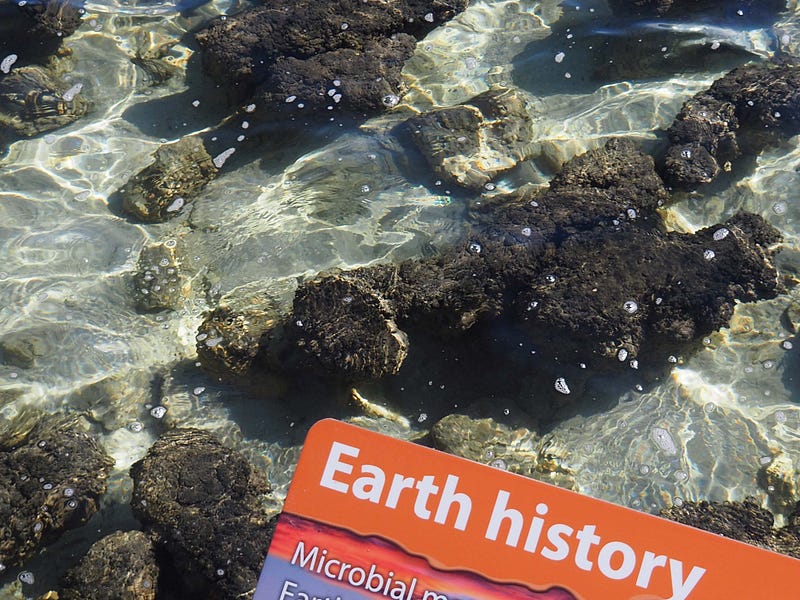
If you visit and kneel in the water, you will see why stromatolites are so significant to the story of life. Tiny bubbles of oxygen form along their rounded margins and escape into the water. 2.5 Ga ago, the sea was full of iron because it is one of the most common elements on Earth. The oxygen rapidly combined with iron atoms to form iron oxide and settled slowly at the bottom of the sea.
The process resulted in a geological formation called the Banded Iron Formation in the Pilbara. These formations are found on every continent and formed around the same time, but they are far from the size and depth of the Pilbara.
Around 2.5 Ga, the Pilbara Craton surrounded a sea basin hundreds of kilometers on each side.[6] Muddy silts formed ripple patterns in the shallows, and raindrop spatters were baked solid enough to be preserved by finer silt deposits. Stromatolites lined the shore, and cyanobacteria, cellular organisms that do not need oxygen, filled the sea. They both produced oxygen as a waste product of photosynthesis. Oxygen turned the water rust red, depositing oxides in sediments a few centimeters thick until the iron was used up. Silica or sandy silts settled on top.
Iron levels rose again, either from sea level change, allowing an influx of metal-rich water, or from erosion, causing another layer of iron oxide to settle. The alternating rust red and pale white bands give the formation its name.
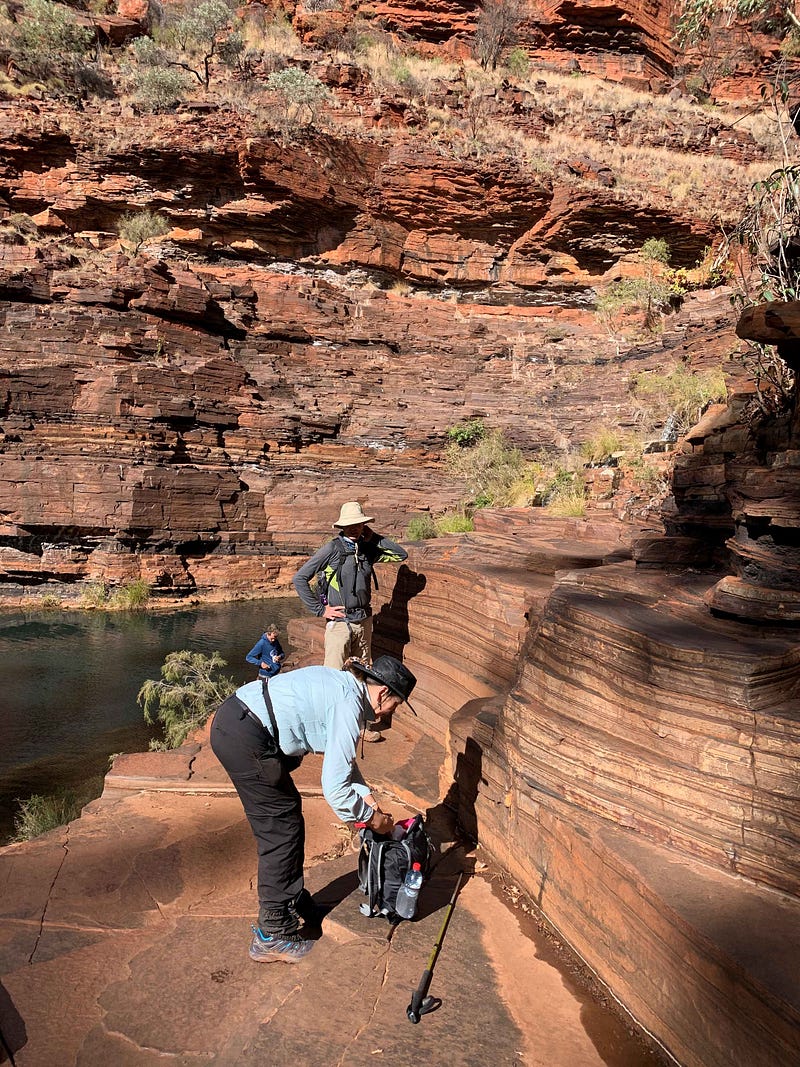
This sedimentation continued for 200 million years, producing alternating bands of iron oxide and silica to a depth of 500 meters over a vast area. The concentration of iron approaches 30%, increasing to more than 60% due to leaching from erosion.
The sedimentary layers were forged together and then folded into the Hamersley Ranges. Around 1.1 Ga, the Pilbara Craton met the Yilgern, Gawler, and Northern Australian Craton to form the supercontinent Rodinia.
Edward Hamersley was a Perth businessman who supported the exploration of Western Australia's outback. He died in 1874, having no idea how famous his name would become. In the 1860s, explorers were not interested in iron ore. A government geologist did report the presence of iron in the ranges, but they were looking for gold or copper.
The rise of the steel industry in the 20th Century changed the status of iron ore, but the earlier reports were long forgotten. By 1938, Australia was so concerned about its strategic iron reserve that it placed an embargo on the export of iron ore. This government control deterred private exploration of new reserves.
The post-war boom was hungry for minerals, and prospectors and geologists combed the outback. The rediscovery of Hamersley iron ore has taken on a mythical overtone, with the story of Langley (Lang) George Hancock, a pastoralist who flew airplanes to help manage his vast holdings in the north.
In 1864, Lang’s father arrived in the North West as part of the first wave of pastoral development[7]. Lang worked at Mulga and Hamersley Station. He was also a keen prospector. In 1948, he had sold a lease for the development of asbestos at Witenoom — a name that would later become the symbol for the tragedy of asbestos lung disease. On the 16th of November 1952, Lang flew low into a river valley to avoid a building storm and gazed at a wall of rusty red iron. After the monsoon season, he returned five months later to explore on foot and realized the vast extent of the find.
A little to the south, another prospector made similar finds. Stan Hilditch, a manganese prospector employed by Sydney mining interests, recognized haematite — the richest of all the iron ores[8].
Both tried to quietly find backers, trying not to alert other mineral explorers. However, the Government’s iron export embargo blocked any chance of rapid development. Quiet lobbying was required and finally succeeded in lifting the embargo in 1960. Hancock dropped survey teams by air to avoid leaving tracks that would point to the deposits. In 1961, Lang Hancock and his partner Peter Wright were granted ten reserved areas — over 1000 square miles.[9] He had contacts with mining giant Rio Tinto, but they had no experience with iron ores, and a big mining venture was daunting. There were no towns and no ports in the northwest. In 1961, the Pilbara, twice the size of the United Kingdom, had a population of 3243 (excluding indigenous people who were not counted in the census).[10]
Rio partnered with two other companies, including Kaiser Steel from the United States. When Lang took Kaiser executive Thomas Price for a flight over the gorges, the American immediately recognized the banded iron formations and enthusiastically drew up an extraction plan. When asked how much iron was there, Price responded, “How do you measure the air.”[11] Price, aged 71, was an experienced engineer who had worked on the Panama Canal and the Hoover Dam. He was not daunted by the thought of 1000 km railways and deepwater ports. He died the following year, a day after geologists found the wealthiest ore deposits in the area. The discovery was named Mt. Tom Price in his honor.
Hancock and Wright sold their rights for a 2.5% royalty. Stan Hilditch sold his rights for $10 million.
The demand for iron ore began with Japan's rapid growth and accelerated with China's industrialization, becoming Australia’s largest export industry. Australia’s current annual income from iron ore is US$66 billion to US $105 billion, depending on iron ore prices. Hancock and Wright became the wealthiest men in Australia.
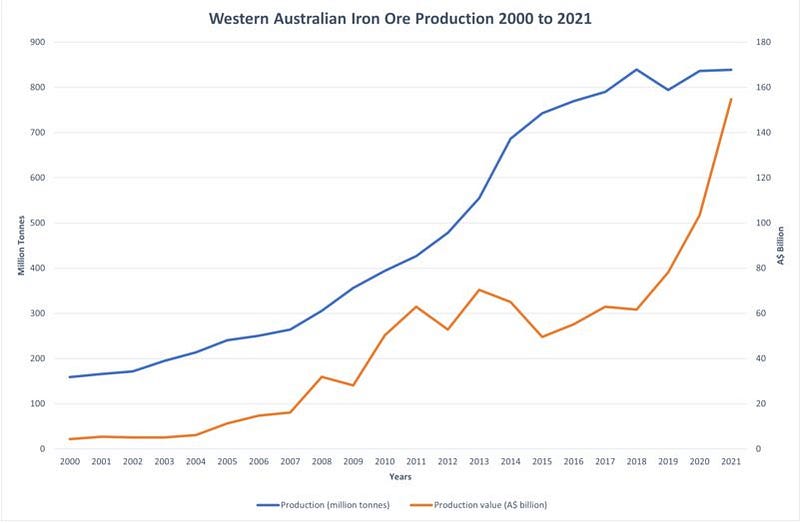
The estimated population of the Pilbara in 2023 was 52000, but it still feels empty. Small towns with big roads, big railways, and airports are full of fly-in and fly-out workers. The appearance and atmosphere are otherworldly. There is a red dust haze and flat, empty horizons. Even the mountains look flat. The wonders are underground, beautifully revealed by the gorges of the Hamersley Ranges National Park, renamed in 1999 Karijini National Park, the Banyjima word for Hilly Place.
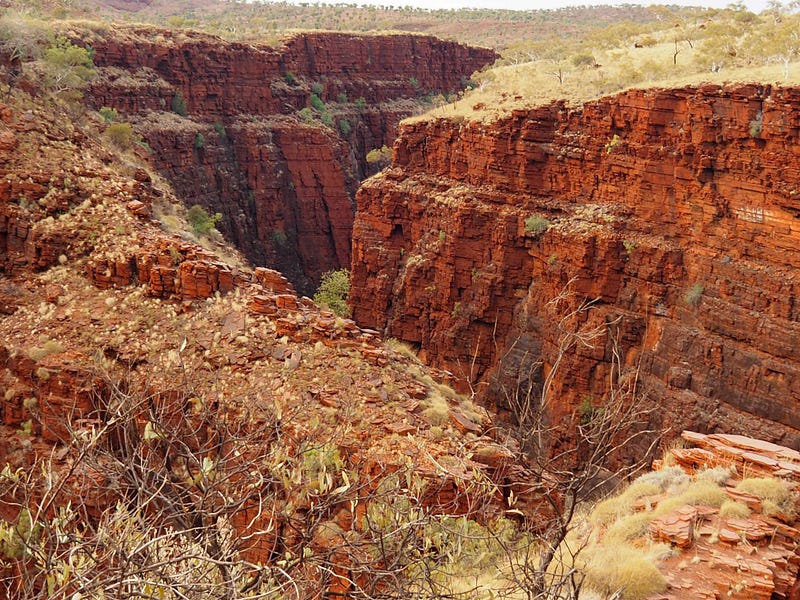
These vast plains of iron ore are the most significant component of Australia’s mining industry today and will be long into the future. The spectacular red gorges are in the most ancient part of Australia, and their towering walls preserve a record of 200 million years of iron oxide deposition. In the last fifty years, advances in geology and paleomagnetism have provided evidence of how they formed. An amazing story of early life on this planet, and standing at the base of the towering rust-red walls, you sense the deep time of your existence.
References
[1] Australia’s Iron Ore Reserves and Production https://mine.nridigital.com/mine_australia_jan24/iron-ore-market-australia.
[2] Pidgeon RT AA Nemchin C Meyer, ‘The Contribution of the Sensitive High-resolution Ion Microprobe (SHRIMP) to Lunar Geochronology’ Precambrian Research Vol 183, Issue 1 2010 p44–49 https://www.sciencedirect.com/science/article/abs/pii/S0301926810001580
[3] Alec R. Brenner et al, ‘Plate motion and a dipolar geomagnetic field at 3.25 Ga’ https://www.ncbi.nlm.nih.gov/pmc/articles/PMC9636958/
[4] ‘Stromatolites and other early life’ https://www.dmp.wa.gov.au/Stromatolites-and-other-evidence-1666.aspx
[5]‘Pilbara stromatolites showing Earth’s earliest life forms nominated for national heritage listing’ https://www.abc.net.au/news/2023-05-02/pilbara-stromatolites-nominated-for-national-heritage-listing/102273680
[6] Henderson R, ‘The Geology of Australia’ Cambridge University Press, 2016 p 97
[7] Trengrove A ‘Hamersleys’s First Decade’ Stockwell Press 1976
[8] Lee D, ‘The Establishment of Iron Ore Giants: Hamersley Iron and the Mount Newman Mining Company’ J Australasian Mining History vol2 2013 p 61
[9] Trengrove A, Hamersley’s First Decade” 1976 p28
[10] Trengrove ibid p 37
[11] The Tom Price Story, ‘The Steel Post’ August 1994 https://purl.slwa.wa.gov.au/slwa_b4813016_234.pdf


