
Attention Runners: 5 Reasons You Shouldn’t Use Heart Rate As Your Main Training Tool
And why running by feel is the better alternative
Many runners believe that it is critical to measure their heart rate if they want to improve. Thanks to running magazines and watch manufacturers’ constant praise of low heart rate training, we are led to believe that heart rate training is essential. Track your heart rate or else you are at a massive disadvantage to the rest of the running world.
As a result, many of us have forgotten how to run by feel. Thanks to our obsession with gadgets and numbers, others may have never learned it.
However, heart rate training is an overrated training tool, and you shouldn’t rely on it to make decisions about your pacing.
I don’t recommend heart training because changes in your heart rate don’t always correlate with changes in your fitness level. Here are five factors that influence your heart rate:
1. Sleep Deprivation And Stress
If you are like most people in our hustle-and-bustle society, you are sleep deprived, at least some of the time. Studies have shown that sleep deprivation can elevate your heart rate by 5–10 bpm. Likewise, stress increases your heart rate. Unlike sleep deprivation, however, stress is hard to measure, and hence its effects on your heart rate are harder to discern.
2. Caffeine
Your morning cup of java increases your heart rate just like caffeinated gels or sports drinks do. Studies have shown that consuming caffeine can increase your heart rate and that the effects can last for up to 24h.
But drinking coffee after your run can delay the natural decrease in heart rate after exercise. A study from 2017 shows that caffeine can delay the parasympathetic heart rate control, which means your body’s ability to slow down your heart rate after exercise is impaired.
How much caffeine impacts heart rate is highly individual and is tricky to measure. However, as an interesting experiment, you could stop consuming caffeine for a while and see if you detect any meaningful changes in your heart rate, both at rest and during your training sessions.
3. Weather
Many of us have experienced how running in hot and humid conditions raises our heart rate. When you exercise in the heat, your body sends blood to your skin to cool itself. That means less blood is available for your working muscles, and as a result, your heart has to work harder to keep you on your goal pace during your run.
But not only does running in hot weather increase your heart rate but also running in freezing temperatures. This is because your blood vessels shrink in low temperatures, and less oxygen gets to your heart. As a result, your heart needs to work harder, which increases your heart rate.
Generally, the more aerobically fit you are, the less impact weather has on your heart rate.
4. Altitude
If you live at sea level, traveling to altitude results in an increase in heart rate. This effect starts at around 5000 feet above sea level. The reason for this phenomenon is that you breathe air with a reduced partial pressure of oxygen. Or, in more simple terms — each breath you take contains less oxygen than the breaths you take at sea level.
After about two weeks, your body has adapted to the environment, and your heart rate decreases again. I you stay in a high altitude location for a more extended period and then return to lower altitude, your heart rate decreases slightly because your heart has become more efficient.
5. Cardiac Drift
During long training sessions or races, your heart rate naturally increases, even if your pace stays the same.
Many runners are not aware of this phenomenon, but it is a well-established concept in the scientific literature. Even if you are running at a steady pace, your heart rate drifts upwards, and it can be as much as 10–20bpm over a 30-minute interval.
The main reason for cardiac drift is your increase in core body temperature during exercise. The effects on heart rate are similar to those experienced in hot weather running.
If you use heart rate as your tool to set your pace, you may be unnecessarily slowing down as your run progresses because you see your heart rate increasing.
Running By Feel Is A Better Approach
So if heart rate training is not optimal, what should you do to make sure you are training at a pace that allows you to get the intended training effect? Train by feel.
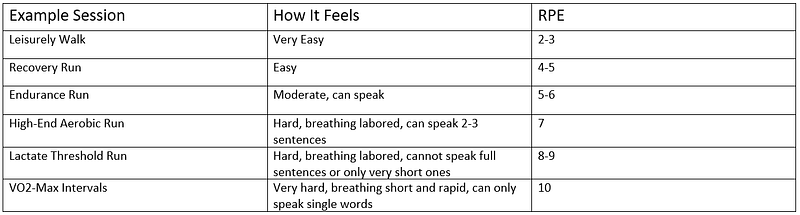
The best method to use is the “Rate Of Perceived Exertion” (RPE). This simple scale from 1–10 describes how hard you are exercising. It is used by endurance and strength athletes alike, and I use it for my own training and when coaching clients.
The picture below shows a modified RPE scale that you can use to determine your intensity level and how difficult a workout should feel to achieve the desired effect.
For a more detailed introduction to the concept, read my articles on session RPE for running and how to include RPE in your strength training program.
Should You Ditch Your Heart Rate Monitor?
While I think that you don’t need a heart rate monitor to improve and develop your full potential as a runner, it may be a handy tool to use in conjunction with running by feel.
I check the heart rate on my Garmin from time to time to see what the numbers are when I run “easy” or “hard,” and I track how my heart rate develops over time outside of training sessions.
Measuring heart rate in the morning, before you get up, is a great way to detect any changes in heart rate and can be used as a tool to gauge fatigue and recovery.
If you choose to stick with heart rate training, you need to understand how external factors can influence your heart rate and adjust your training accordingly.

You just read another post from In Fitness And In Health: a health and fitness community dedicated to sharing knowledge, lessons, and suggestions to living happier, healthier lives.
If you’d like to join our newsletter and receive more stories like this one, tap here.


