
Attention Is The New Currency — How Are You Spending It?
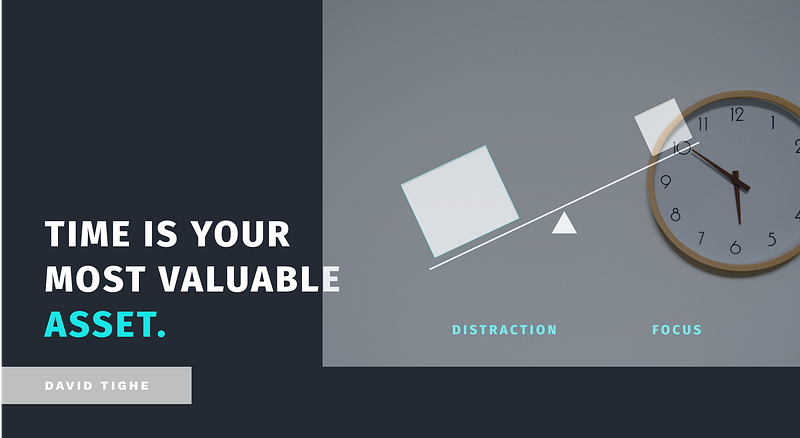
Time is your most valuable asset
Do you know what hurts more than losing money?
Losing time.
The sting of losing money is instant. We have that sinking feeling in the bottom of our stomach and a sense of desperation sweeps over us. We want to get it back at all costs.
Time, on the other hand, we give away for free. And for some strange reason, we never think twice about it.
The ironic thing is that we can always find a way to get more money. We can never get more time.
But we won’t figure it out until it’s too late — unless we intervene today.
Last week, I caught myself in the act.
It was 2 pm on a Wednesday and there I was in my living room, completely distracted and lost in thought.
I try to start each day by setting an intention:
To be as present as possible.
And yet, regularly, I find myself distracted, frustrated and staring blankly across multiple screens.
On this particular day, I managed to reclaim my attention for a split second and suddenly it hit me.
I looked at the armchair on the couch, and my two phones lay there (one work, one personal), face up. I looked at the coffee table and two laptops lay open (also one work and one personal). Finally, to the left of the couch, my iPad.
For good measure, Netflix was streaming on the TV in the background.
So let’s count them up.
That is 6 devices, all vying for my attention, all with the ability to distract me at any moment.
Each time it happens, I ask myself how I let that happen.
But maybe a better question is not how, but why does it keep happening?
Attention is Currency
The currency in today’s world is attention and Big Tech has mastered the art of capturing it.
If they can hold our eyes on the screen and keep us coming back for more, they profit.
This has never sat well with me, for a few reasons.
First Up:
Every allocation of attention is a transaction, and we are on the wrong side of it.
When we buy something, we make sure that we get the best value for our money possible, right?
But when it comes to our attention, it’s a different story.
We give it away in return for mindless entertainment and cheap dopamine.
The recipients of our attention, however, stand to gain massively.
This doesn’t happen by accident.
The brightest minds in the world are working together to hack our human psychology and create an endless craving for dopamine.
Secondly, I am plagued with the feeling that I’m not in control of my life.
At times, I feel completely enslaved by the various devices I use and I’m not alone.
The harsh truth is, we’re not in control right now. They are.
When was the last time you went to the bathroom without bringing your phone? I think the answer to this question says it all.
Setting Boundaries
Through trial and error, what I’ve come to realise is that simply setting intentions is not enough.
The enemy isn’t waking up each morning and simply saying ‘We will capture the attention of millions of people today’ without a clear plan in place.
Instead, they’re hacking psychology, systematically implementing changes to increase the attention they receive.
Well, we need to fight fire with fire.
Here are 4 simple strategies you can put in place to reclaim your attention.
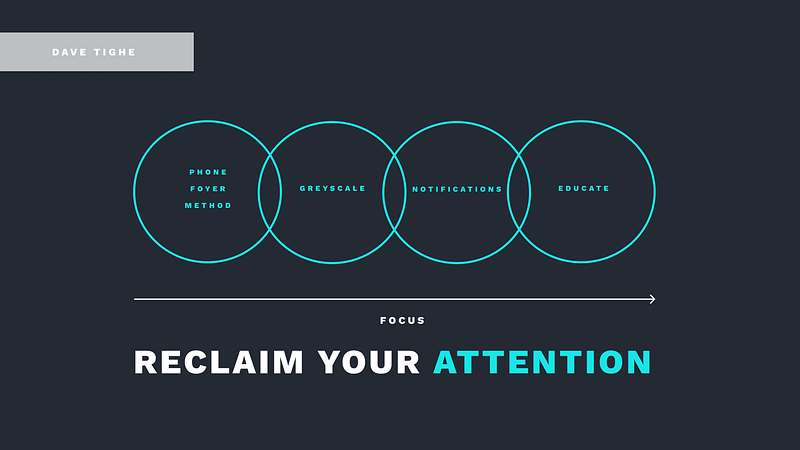
The Phone Foyer Method
Put simply, the only place you should keep your phone in the house is your foyer or hall.
Telling yourself you won’t look at your phone if it’s sitting right next to you is not going to work.
The ping or vibration is too irresistible. We need to remove the temptation and this is the simplest way to do it.
You’ll be surprised how well it works.
Greyscale
One of the many reasons we can’t seem to put our phones down is that they are very pleasing to the eye.
The bright colours and images make it irresistible and we keep going back for more.
Thankfully, buried within the settings of our phones you will find Greyscale.
Enabling this feature will remove all the colours from your phone and help reduce the constant demand for your attention.
Notifications
When was the last time you received a notification and decided ‘I’ll check that later’?
I guess that it doesn’t happen often.
Each time we hear the sharp ping pierce the air, or the vibration in our pockets, it’s almost impossible to avoid checking.
So, take it out of the equation — Mute all notifications in your apps today.
Educate Yourself
Knowledge is power.
The more you read and understand about the battle for attention, the more likely you are to beat it.
These 4 books will give you quick, actionable strategies to implement today:
- Digital Minamilsm — Cal Newport
- Stolen Focus — Johann Hari
- RAPT — Winfried Gallagher
- Indistractible — Nir Eyal
Time, like it always has, remains our most valuable resource.
Yet, we frivolously give it away. And what’s worse, we’re not even conscious of it most of the time.
It’s not a level playing field. It’s no longer sufficient to just set an intention to stay off your phone. You need to implement strategies and stick to them daily.
Start treating your attention as ruthlessly as you do money.
Protect it at all costs.
Do you have any tips for protecting your attention? Let me know in the comments.
About the Author
My name is Dave 👋
I’m always on the hunt for strategies to unlock high performance and dedicated to assisting others in their journey towards self-improvement.
If you enjoyed this article, please consider following me and subscribing to receive my articles directly to your inbox.
Note: This article contains affiliate links, which means I may earn a commission if you purchase through these links. There is no extra cost to you, and I only recommend products and services that I believe in.