
Atomic Articles
The aggregation of marginal gains on Medium
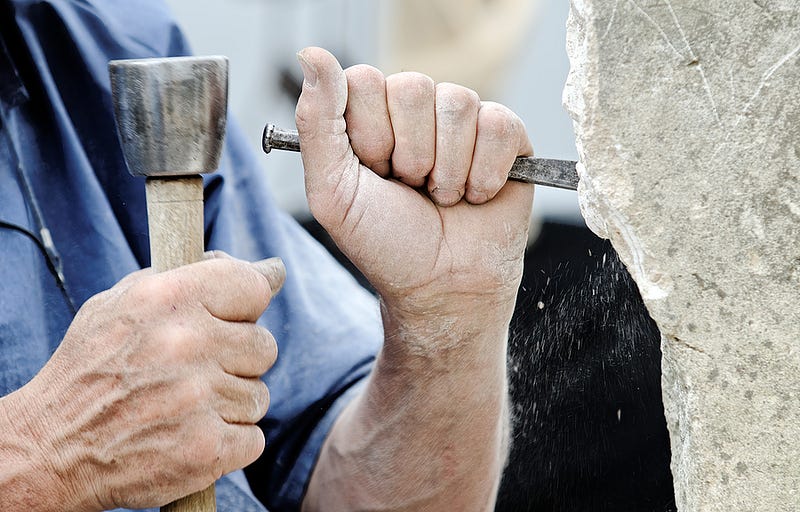
The concept of small gains may already be familiar to many of us who write on Medium! One of the most successful self-help books in recent years is James Clear’s “Atomic Habits”. I have to confess that I have only just started on the book, but it makes a good read.
The back story of the author is always interesting. Clear was seriously injured in a baseball accident and worked his way back to health, discovering his technique along the way. It worked for him, and it is always good to learn from what works.
Essentially, and I base this extensive expertise on having read the first couple of chapters, the concept is that you aim to make multiple incremental improvements in different areas, and these add up to a more significant global improvement.
If you think of the top football clubs (soccer for my American friends) like Manchester City and Liverpool, the reason they are consistently better is that they have worked on every area of their game on and off the pitch, in a scientific way, so that in each aspect they are just a bit better than their rivals, and collectively those small advantages bring them success. I once read that the Manchester City strategy involves breaking down the pitch into “zones”, and aiming to dominate each small area of the pitch. So at the best clubs, rather than going for a bender in Belfast ahead of a big match, players are all bonding and training, working on every area of their game, passing, heading, spatial awareness, set pieces, and overall fitness.
The concept of honing each aspect of performance is used in many sports. James Clear chose his example of the British cycling team in a rather unfortunate way, since they were hit by a doping scandal shortly after publication of the book, and chemically-enhanced marginal gains are not recommended (with the exception of caffeine, that would just be too much to live without)!
However doping aside, the principle of marginal gains holds true in every sport, business, home, hobby or other endeavour. Improving every aspect in modest ways pays off, and is sometimes easier than one big advance. Lots of baby steps add up to a big one, or to use the language of Clear, the “aggregation of marginal gains” pays off.
So how can this theory be applied to writing? Take all the advice we see on Medium and elsewhere, some of it repeated ad nauseam, and aim to improve our work at least a little in each aspect.
Breaking it down
Understanding our audience: We all probably have a niche that we tend to write in, or sometimes several niches if we are prosaically promiscuous. It is worth considering what readers want to know about, which issues are trending on the subject, what other people are saying and reading about. There is a concept sometimes referred to as the WIIFM principle, an acronym that stands for “What’s In It For Me” that your readers may apply when deciding whether to linger for a marathon 30 seconds on your article, to consider what benefits they get from reading it. It can seem a little selfish, but realistically it is how many of us operate.
If you want readers to hang around, your article needs to make it worth their while, or they will disappear faster than an icecube in a furnace. So an article needs to provide either something educational or entertaining, or perhaps ideally, a winning combination of both, perhaps with a sprinkling of humour thrown in for good measure, as most of us like a laugh, especially if burdened with the British weather!
A catchy headline: Like it or not, there is huge competition for eyeballs on Medium and elsewhere. We are super-saturated with reading material. Deceptive clickbait is best avoided, as it can annoy readers if they feel they have been tricked into reading about the finer points of llama farming in Western Patagonia, when your headline promised them the secret of how to retire a billionaire by the age of eleven. You are more likely to lose readers than gain them. However a relevant and clever headline can reel in your catch so to speak. Staying with that fishing analogy, I saw a good headline recently about a company seeking to produce artificial meat from eels, which read “Reinventing the Eel”. Or of course, there is the classic headline still remembered forty years on, “Freddie Starr Ate My Hamster”. Never let the truth get in the way of a good story!
A clever or amusing headline is a good way to grab attention and stop your readers swiping right to watch something more entertaining on TikTok. How dare they?! There is a good website called “Sharethrough” to test out your headlines before using them. It scores them on a range of factors and suggests improvements. Perhaps marginal ones, better still, an outright winner!
A good introduction — The sad fact is that we lose many readers early on. The sort who make a New Year’s resolution to go to the gym but have given up by the second week in January. Whoops! Or who start a seafood diet which turns into a see food diet, or my own 5K to couch regime.
So having hooked your reader, (and no animals were harmed in this analogy), you need to reel them in like a prized salmon from a Scottish river, still kicking and scales shining in the sun, before you return them to swim free in the raging torrent of Medium content. So the first paragraph is vital. Just as with a job interview first impressions matter, the same is true with the article. Does it have shiny shoes, a winning smile, and a firm handshake? Is this an article you would like to work with, perhaps share a laugh, which perhaps even does the job well?
Structure: A well-structured article can make all the difference. So an introduction, body and conclusion is typical though not essential: dare to break the rules occasionally. Similarly breaking up blocks of text with sub-headings makes it easier to read. Make the most of formatting such as dropped capitals, pull quotations, bold or italics, graphics and photos, the odd emoji if you really must, perhaps a call to action (CTA) at the end, or links to further reading and references.
Also consider the length of the article. We all have demands on our time, chores that Mrs. Pearce finds me, or Netflix to be watched. The ideal length on Medium seems to be three or four minutes. Longer than that and your reader may fall asleep (though that can help with reading time so worth considering as a tactic). So lots to consider on structure, and making incremental gains in each area will pay off if the theory holds true. One small step for an author, one giant leap for your earnings!
Quality: Oh dear. Always lets me down this one, but everyone seems to recommend it. So something original, in your unique style and your own voice is a good start. Be sure to check for grammar, spelling and punctuation so you write proper. I am a late adopter of Grammarly and it is a life-saver in terms of avoiding embarrassment, though it can make things a little bland, so I like to upset it occasionally by throwing in a very obscure or made-up word to show it who is in charge.
Joking aside if we must, we usually prefer to read content which is well-written, so aim for quality. Sometimes it helps to get a friend to read something through, or you can listen to your drafts. If you go to “share draft” in the menu drop-down, copy and paste the link into your browser, and then select the feature that lets you listen to your article. You can even choose the voice of the reader! Edit, polish, refine: every little helps.
Conversational tone: One of the things I love about Medium is the freedom to write as you want (unless you are jumping through hoops to get into a publication, or aiming to meet the Boost criteria — boring). You are not trying to get a good grade in an examination with a turgid academic style. So the most readable articles are the ones in which you can imagine you are down the pub, sitting round a roaring fire, and cracking some jokes with your mates over a pint.
However, if you are in Britain you are probably huddled under a couple of blankets at home, drowning your sorrows with some bargain booze from Aldi, and wishing you hadn’t voted for Brexit. Some of my favourite writers on Medium adopt a very conversational tone, occasionally even throwing in the odd profanity, which you wouldn’t get away with elsewhere. So imagine you are telling your readers a story in the bar and you won’t go far wrong. If you are trying to give up alcohol, imagine the same, but in a coffee shop.
Interaction: Of course we probably all know by now that the earnings formula favours engagement. A mixed blessing, but “it is what it is”, as one of the most irritating phrases of the decade goes. Talk about stating the b***ing obvious!
So the interaction could be asking questions in the article, seeking the views of your readers, and encouraging them to use the comments section, after they have clapped 50 times of course! Or there could be a call to action, or a link to your website if you have one. Don’t let your reader get away without some engagement, even if you are Tony Stubblebine and just leave a single clap. Try and respond to all the comments in some way, to show that you appreciate the visit.
Visual appeal: Remember that with Medium, we are competing with numerous other media, many of which are far more visual, and dare I say it, even more interesting. So it pays to use great photos, graphics, and lots of formatting to ensure an article is attractive to the reader.
Vary length: This technique breaks up indigestible blocks of text. Sometimes I throw in a single-word sentence for good measure. Capice? We all find it easier to eat our food if broken up into smaller pieces, and articles are no different. Nouvelle cuisine rather than a banquet. A smorgasbord of small portions. Light bites. Amuses bouches. Just pray readers don’t want to visit the chip shop afterwards, to fill up on something more substantial, perhaps thirty minutes of doom and gloom by Umair Haque.
Consistency: This one is mentioned so often it gets a bit boring, but I guess it must be true if everyone says it. Have some sort of publishing schedule. Some writers on Medium are aiming for an article a day which is seriously hard work if it is to meet the quality threshold. It is worth remembering that readers have busy lives and may not want to hear from you quite that frequently!
So referring back to “Atomic Habits” the aim should be to make marginal improvements in each of these areas, and who knows, you could have your own best-seller!
As always, thank you for reading.

To join a new Facebook group “Medium Matters” where writers can support each other and share articles.
Mastodon- you can find me here
Discord — link to an unofficial chat group for Medium members —


