
Atlas: the bipedal robot developed by Boston Dynamics
Atlas, the bipedal robot developed by Boston Dynamics, is a technological marvel that has captured the imagination of people around the world. With its advanced capabilities and lifelike movements, Atlas is pushing the boundaries of what robots are capable of and offering new insights into the possibilities of human-robot interaction.
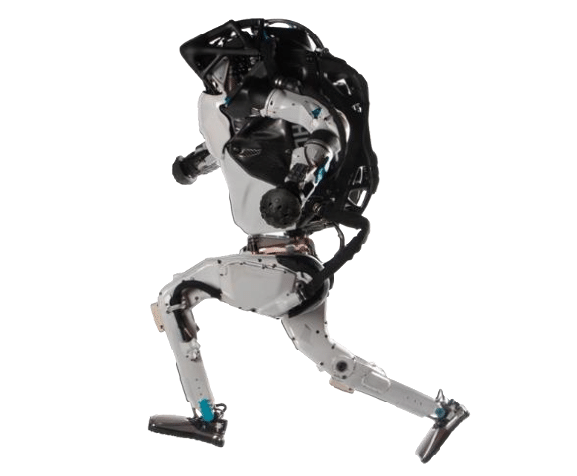
One of the most impressive things about Atlas is its ability to navigate rough terrain. Its legs are designed to allow it to walk, run, and even jump, making it possible for the robot to traverse a wide variety of environments. This is made possible by its advanced motor system, which provides the robot with the power and precision it needs to move with ease.
In addition to its mobility, Atlas is also equipped with a variety of sensors and cameras that allow it to perceive its environment and navigate with precision. These sensors include LIDAR and stereo cameras that provide the robot with detailed 3D maps of its surroundings. This allows Atlas to avoid obstacles and make its way through complex environments with ease.
Another key feature of Atlas is its ability to manipulate objects. The robot’s hands are equipped with dexterity and grasping capabilities that allow it to pick up and move objects with precision. This makes it possible for Atlas to perform a wide variety of tasks, from assembling parts to loading and unloading cargo.
What is LIDAR?
LIDAR (Light Detection and Ranging) is a sensing technology that uses laser light to measure distances to objects. It works by emitting a laser beam and measuring the time it takes for the light to reflect off an object and return to the sensor. This information is used to calculate the distance to the object and create a 3D map of the environment.
LIDAR sensors are commonly used in a variety of applications, including autonomous vehicles, robotics, and mapping. In autonomous vehicles, LIDAR sensors are used to create a 3D map of the vehicle’s surroundings, allowing the vehicle to navigate and avoid obstacles. In robotics, LIDAR sensors are used to allow robots to navigate and perceive their environment. In mapping, LIDAR sensors are used to create highly detailed 3D maps of the earth’s surface.
LIDAR sensors can be classified based on the type of laser, such as solid-state or gas, and the type of detector, such as single photon or time-of-flight. They can also be classified based on the type of measurements such as 2D or 3D, and the type of scanning pattern such as linear or circular.
Human-robot interactions
Beyond its impressive technical capabilities, Atlas also offers new insights into the possibilities of human-robot interaction. Its lifelike movements and ability to perform tasks in a way that is similar to a human, has led to a renewed interest in the field of robotics and has sparked new ideas about how robots can be used in the future.
How is Atals built?
Standing at 1.5 meters tall and weighing approximately 80 kilograms, the Atlas robot has been engineered with state-of-the-art materials and technologies to enable highly dynamic movements, dexterity, and balance.
Mechanical Structure
Atlas’s mechanical structure comprises an intricate arrangement of custom-designed joints, links, and actuators. The robot’s skeleton is primarily composed of lightweight aluminum and titanium, providing an optimal balance between durability and weight. The 3D-printed, high-strength thermoplastic components further contribute to its lightweight nature while maintaining the required rigidity. Atlas has 28 degrees of freedom (DOF), allowing it to perform a wide range of complex and natural movements.
Actuators
Atlas employs a combination of custom electric and hydraulic actuators to power its movements. The electric actuators, consisting of brushless DC motors and high-torque harmonic drives, are used primarily in the robot’s upper body, providing smooth and precise control for tasks involving object manipulation and interaction. Meanwhile, the hydraulic actuators, powered by compact hydraulic pumps, are utilized in the lower body and legs, supplying the necessary force and rapid response times required for dynamic locomotion and balance.
Sensors
A robust suite of sensors is integrated into the Atlas robot to enable advanced perception and situational awareness. The primary sensor is a LIDAR (Light Detection and Ranging) system, mounted on the robot’s head, which generates a 3D point cloud of the environment for mapping and obstacle detection. Additionally, Atlas is equipped with stereo cameras for visual perception and depth estimation, as well as a suite of inertial measurement units (IMUs) to maintain its balance and posture.
The robot’s limbs are outfitted with a range of force and torque sensors to facilitate precise control and interaction with the environment. These sensors include six-axis force/torque sensors at the wrists and ankles, joint torque sensors, and tactile sensors on the fingers and feet.
Control and Software
The Atlas robot is powered by a sophisticated control architecture, combining advanced planning algorithms, real-time control systems, and machine learning techniques. The control system integrates sensor data and high-level task objectives to generate a series of complex movements and actions. Atlas relies on a whole-body control approach, optimizing the use of all its actuators and joints to execute desired tasks while maintaining balance and stability.
The software stack includes localization and mapping (SLAM) algorithms, which enable the robot to build and maintain a map of its environment and track its position within it. Furthermore, the robot employs path planning and obstacle avoidance algorithms to navigate safely and efficiently through complex environments.
Atlas’s software also incorporates machine learning techniques, such as reinforcement learning and imitation learning, to enhance its capabilities and adapt to new tasks or environments. This enables the robot to learn from human demonstrations or through trial and error, continuously improving its performance.
Power Supply
Atlas is powered by a compact and high-capacity lithium-ion battery pack, providing sufficient energy for approximately 60–90 minutes of operation, depending on the intensity of the tasks performed. The robot can be easily recharged using a custom charging dock, minimizing downtime between operations.
Use cases
This cutting-edge technology has the potential to revolutionize various industries and make significant contributions to our daily lives. In this post, we will explore some real-life applications of the Atlas robot and how it can benefit society.
Search and Rescue Operations
Navigating Disaster-Stricken Areas
Atlas can be deployed in disaster-stricken areas to search for survivors, assess structural damage, and provide real-time information to rescue teams. Its ability to navigate through complex environments, such as rubble and debris, makes it well-suited for these tasks.
Hazardous Environment Operations
Reducing Risks for Human Workers
Atlas can be utilized in hazardous environments where human presence might be risky, such as nuclear power plants, chemical facilities, or sites with high levels of radiation. The robot can perform tasks like inspection, maintenance, and decontamination, reducing the risk to human workers.
Construction and Maintenance
Assisting in Urban and Remote Projects
The robot’s dexterity and strength make it suitable for assisting in construction projects, heavy lifting, and maintenance tasks in both urban and remote locations. Atlas can work alongside human crews or autonomously, depending on the requirements of the job.
Healthcare and Elderly Care
Supporting Patients and the Elderly
Atlas can be employed in healthcare settings to assist patients with limited mobility, provide physical therapy, or support elderly individuals in their daily routines. Its ability to perform delicate tasks and interact with people makes it a valuable asset in care environments.
Firefighting Applications
Entering Hazardous Situations
The robot’s ability to carry heavy loads and navigate challenging environments makes it a potential candidate for firefighting operations. Atlas can enter burning buildings to extinguish fires, rescue trapped individuals, or assess structural integrity, all while keeping human firefighters out of harm’s way.
Space Exploration
Extraterrestrial Tasks and Maintenance
Atlas could be used for space exploration missions, such as maintenance of space stations, moon or Mars surface operations, and construction of habitats. Its robust design and adaptability to various environments make it a strong contender for extraterrestrial tasks.
Military and Law Enforcement
Reconnaissance and High-Risk Operations
The robot can be employed for reconnaissance missions, bomb disposal, or even as a support unit during high-risk operations. Its ability to traverse difficult terrain and withstand harsh conditions could prove valuable in these applications.
Education and Research
Advancing Robotics and Artificial Intelligence
Atlas can serve as a versatile research platform for robotics, artificial intelligence, and human-robot interaction studies. Its advanced capabilities can help researchers develop new algorithms, control strategies, and interaction paradigms that can be applied to various robotic systems.
In conclusion, the Atlas robot offers numerous possibilities for real-life applications due to its advanced design and capabilities. Its ability to perform tasks in challenging environments, interact with humans, and adapt to new situations make it a valuable asset across multiple domains, from search and rescue to space exploration.
Keep an eye on Atlas, as it promises to play a significant role in shaping the future of robotics and human-robot interaction.
✍️ Hi there! Thank you for reading my post. Please feel free to leave a comment below. Your input is valuable to me and I would be happy to engage in a discussion with you. Thanks again for reading and I look forward to hearing from you!
Let’s connect: Twitter, LinkedIn, Medium, Reddit, Tenedos
Thank you for your support, Michele


