
‘At Night All Blood Is Black’ —David Diop
A Counter Arts Book Club review
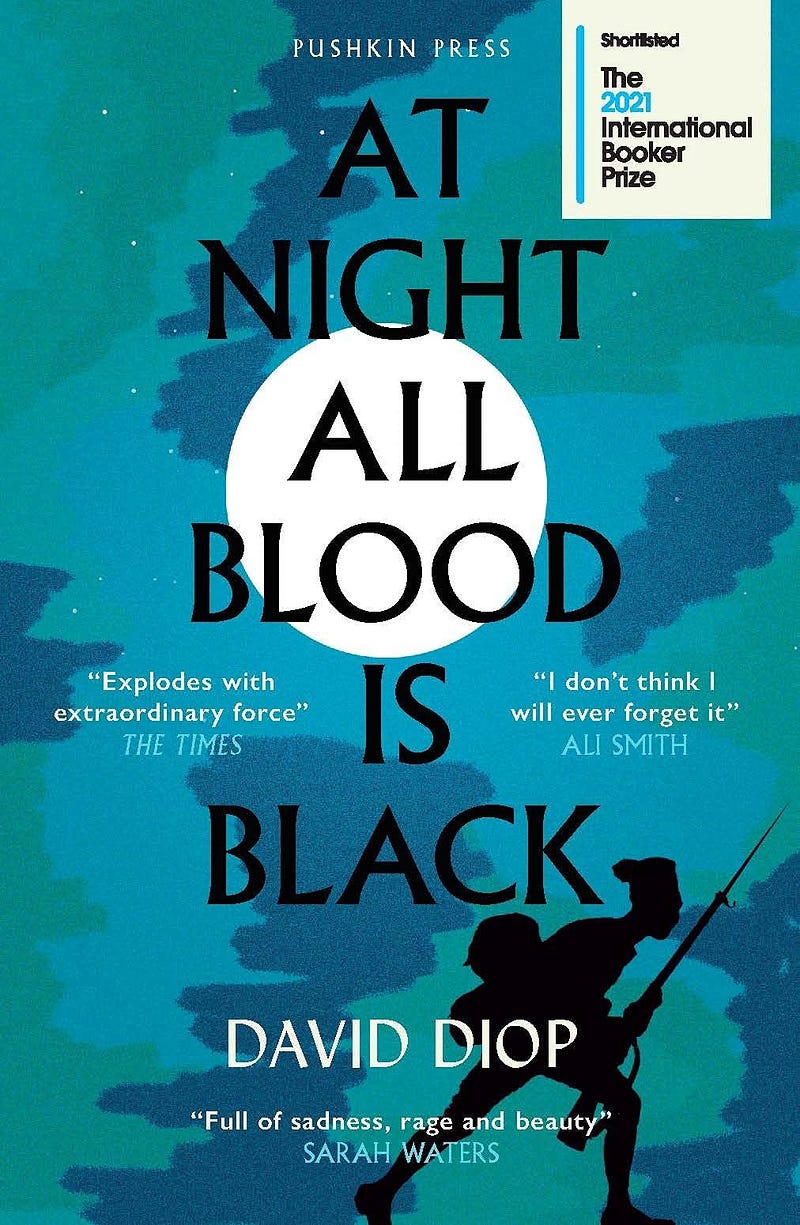
When choosing titles for Counter Arts’ 2023 Book Club list, I decided to slide this very slim volume in there because it had been announced as winning the International Booker Prize in 2021.
Published in 2020 by Pushkin Press, this novella of one hundred and sixty-two pages is a difficult read despite it’s brevity.
‘At Night All Blood Is Black’, written by David Diop and translated from it’s original French by Anna Moschovakis, is (as the title suggests) a very dark story — disturbing in it’s darkness as a representation of mental deterioration; but also, in that it is a cultural reference to the numbers of Senegalese soldiers (the ‘Chocolat’) drafted in by their French colonial rulers to fight in the front lines during the First World War.
In this novel our protagonist, Alfa Ndiaye, is brought with other young men from Senegal (from an idyll of village life they had never left before) to the trenches in France. As the novel opens, we are given a very strong sense of regret over wrong-doing, by the first person perspective of Alfa Ndiaye. He is thinking? Writing? About a realisation that:
“…I know, I understand, I shouldn’t have done it. I, Alfa Ndiaye, son of the old, old man, I understand, I shouldn’t have. God’s truth, now I know. My thoughts belong to me alone, I can think what I want…
…I know, I understand, I shouldn’t have. In the world before, I wouldn’t have dared, but in today’s world, God’s truth, I allow myself the unthinkable. No voice rises in my head to forbid me: …
…all of a sudden without warning, it hit me brutally in the head, like a giant seed of war dropped from the metallic sky, the day Mademba Diop died. Ah! Mademba Diop, my more-than-brother, took too long to die…”
— ‘At Night All Blood Is Black’, David Diop, excerpts from pages 3 & 4.
Not wanting to give away anything more about the plot , should you want to read it, I think these excerpts from the beginning of the book illustrate well how the story does hook the reader in with the desire to read more. We (the reader) discover that Alfa feels traumatised by his experience of trench warfare; that he feels responsible, culpable, for some terrible thing which happened; and that his close friend, his ‘more-than-brother’ Mademba Diop has died a horrible, drawn out death.
(What significance is held by the author giving his own surname to Mademba?)
That section does actually continue with a fairly graphic depiction of the fatal injury and lengthy death scene, which I won’t inflict upon you here but which starts the narrative off as the author means to go on. To give you an idea, Mademba has had his stomach cut open — and he did, we are told, beg Alfa to help him die.
Take this warning as it is intended: if the thought of that scene, more detailed, turns your stomach and/or triggers any other form of trauma response, then please do not buy, or read, this short novel (long novella?).
Alfa, twisted by the trauma of war and broken by the horrific death of Mademba (and his own failure to help earlier than he did), appears to suffer some kind of mental breakdown. He goes on a campaign of gruesome revenge against the enemy soldiers — ostensibly searching for that one in particular who killed his ‘more-than-brother’. He brings back ‘trophies’, which are at first celebrated by his comrades, but as he continues to descend into savagery, literally and figuratively disappearing into the darkness night after night, he seems to begin to frighten them and be ostracised.
Much of what we see represented of Alfa’s thoughts during this time, centre around Mademba. Even his fond remembrance of a girl, Fary Thiam, who he left behind at home turn into laments that while he at last had a sexual experience on the night before he left, Mademba his ‘more-than-brother’ (who, we are often told was much more physically appealing than Alfa) had died before ever having known that pleasure.
Alfa begins to fixate on that towards the end of the novel. It seems to be that he eventually thinks as much about sex as he does about death and that the two begin to blur somehow. I didn’t find that odd in itself, being well versed in Freud’s theory of Eros and Thanatos (both on an academic and personal levels):
“With the publication of his book “Beyond the Pleasure Principle” in 1920, Freud concluded that all instincts fall into one of two major classes: life drives and death drives — later dubbed Eros and Thanatos by other psychologists. Learn more about Freud’s Eros and Thanatos theory, including what others think about it.” — Freud’s Eros and Thanatos Theory: Life and Death Drives (verywellmind.com)
However, the question arises as we read, as to how consensual his encounter with Fary Thiam actually was; and also, as we reach the end of the story and Alfa’s break from reality becomes ever more pronounced, a transformation is seemingly concluded as another woman becomes the focus of his obsessive mind.
As another warning to the potential reader: the culmination of both book and mental breaking involve a potentially highly upsetting, trauma triggering event. While conscious of avoiding saying much more, because it is worth arriving at that point while reading for yourself, I also want anyone with a history of sexual trauma to approach with caution.
I wouldn’t normally read a book with the kind of setting we find in ‘At Night All Blood Is Black’. In many respects I really didn’t enjoy reading it at all, but given how short it is I persevered and I’m glad I did.
I think this was a good choice for The International Booker Prize in 2021. Despite it’s brevity and grisly content, this novel is packed with so much — and actually, I feel that the inhumanity and traumatising effects of war could be the least of it. Of course that is heavily emphasised (how could it not be?); but is also leads into commentary on colonial racism, mental illness and sexual violence. Last but not least, I think that much of this rolls together into a discussion on identity. It’s all very interesting to contemplate afterwards and despite the disturbing content quite beautifully written and full of purpose. Recommended, if you can stomach reading it.
Up next in my Counter Arts Book Club review essays, ‘Shuggie Bain’ (Douglas Stuart), winner of the 2020 Booker Prize.
For other pieces of work about books, please try Counter Arts’ dedicated ‘Literature’ section.
If you would consider adding a few coins to my coffers you will find a ‘Give a tip’ button below.
Or you could always sign up as a Medium member (if you haven’t already) and contribute by reading more of my work and that of thousands of other writers worldwide. If you’d like to use my referral link below, that would add a portion of your small monthly membership fee directly to my earnings — and my book collection would swell ever larger in happiness.
Join Medium with my referral link — Sadie Seroxcat
As always… Stay safe. Stay well. With love — Sadie


