
Astronomers have caught supermassive black holes on the edge of the junction
Combined in an epic cosmic waltz nine billion light-years away, two supermassive black holes seem to orbit each other every two years. Long-term radio monitoring of a supermassive black hole in the center of the galaxy shows that it has a massive invisible companion. A 13-year study conducted by the Kaltek Institute by the Owens Valley Radio Observatory in Northern California found that the radio black hole would soon merge with the black hole that accompanied it to form a supermassive binary black hole.
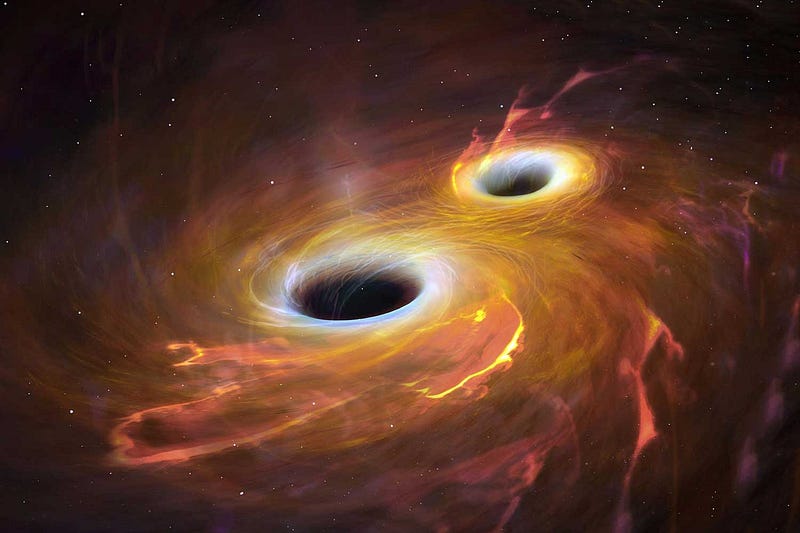
These two supermassive black holes orbit each other every few years. Each of the two giant bodies has mass hundreds of millions of times greater than the mass of our Sun, and the objects are separated by a distance that is approximately 50 times bigger than the distance of our Sun and Pluto. When the pair merge, in about 10,000 years, a titanic collision is expected to shake space and time itself, sending gravitational waves across the universe. A team of astronomers has uncovered evidence for this scenario, which takes place inside a fierce energy object known as a quasar. Quasars are the active nuclei of galaxies in which a supermassive black hole extracts material from the disk that surrounds it. In some quasars, a supermassive black hole creates a jet that comes out almost at the speed of light.
The observations are described in detail in a paper appearing in The Astrophysical Journal Letters.
The quasar observed in the new study, PKS 2131–021, belongs to a subclass of quasars called blazars in which the jet is directed towards the Earth. So far, this is only the second known candidate for a pair of supermassive black holes caught in the act of merging. “From an astrophysical perspective, supermassive binary black holes are expected to exist,” said Joseph Lazio, an astrophysicist at NASA’s Jet Propulsion Laboratory and one of the co-authors of the paper, citing Forbes.
“Most, if not all, large galaxies have supermassive black holes at their centers. It is noticed that galaxies go through mergers, so there should be supermassive binary black holes that are the result of that, “the scientist stated.