
Astonishing Secrets of Spiders — Human Wisdom is Way Behind
What we learn from these creatures
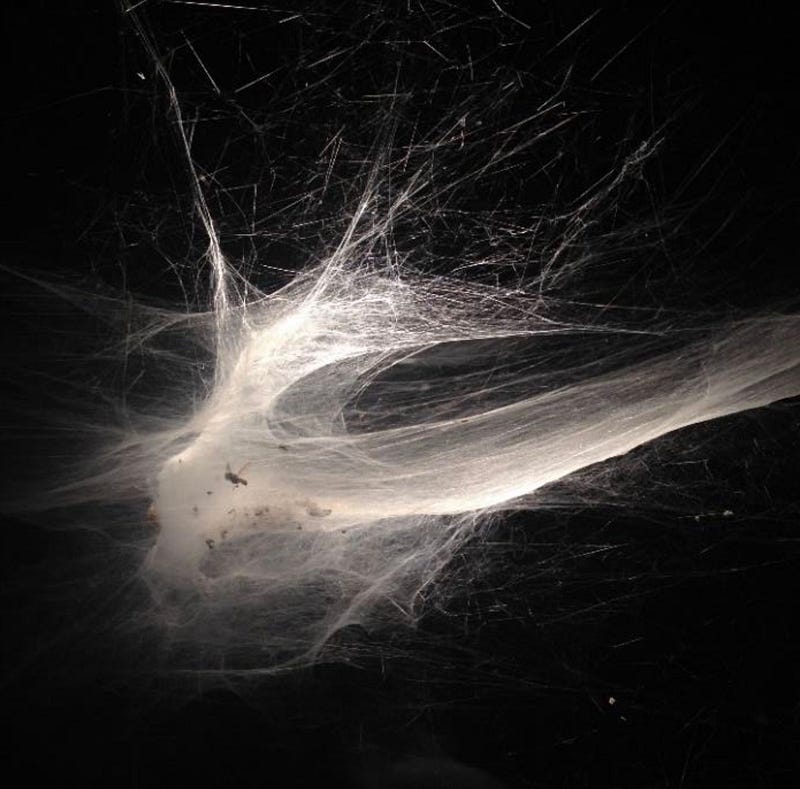
Of 40,000 spider species, many eat their mating partners for sustenance¹. Exhibit A: The notorious Black Widow. Yikes! The 25 truly social species², however, are wise, advanced creatures. So what does that have to do with us humans?
Social spiders team up to feed the young, as in international humanitarian programs. Some share preys with rivals, like trade allies. Then there are species that travel 20 km on lengthy free floating single silks they spin, snacking a bit on the way, and jump right in to function with the new society on arrival — as global professionals and migrant laborers do. These ballooning species³ have solved the problem of aviation long before humans. My favorites. Very cool.
How are spiders smarter than humans?
The star of the show are the hundreds of tiny hairs on each spider’s body and 8 well spread out legs. Spiders can hardly see nor hear — a spider’s 3 or 4 pairs of eyes, some on the abdomen, are almost useless. Their hairs (trichobothria), however, become erectile when stimulated; each hair picks up any air movement down to one-ten billionth of a meter, about the size of an atom⁴, to form what I call “intuition”.
In fact, spiders can sense practically the entire universe through their hairs and legs that point in all directions, often with their silky webs as extensions. When one node of the web receives a signal, all nodes receive signals. This super intuition — the sensing before anything happens — is what we humans could use more of.
What can humans learn from this sensory culture?
Live jamming sessions with spiders, anyone? Musical instruments that are in fact hybrid webs? At the exhibition Arachnid Orchestra. Jam Sessions⁵ at NTU Center for Contemporary Art Singapore, artist Tomás Saraceno showcases his spider web artworks, collaborating with professionals of numerous other disciplines.
Saraceno brings in webs from his innovative Berlin studio⁶, and stages the world’s first known public attempt in 2-way musical communication between humans and spiders (this collaborative contemporary art form itself is a topic for another time).
“Hello!” Says sound artist Bani Haykal by feeding tender vibrations to the web. Then waits. The spider responds. A civilised conversation. Haykal has an entire manuscript for ways of saying “hello”, an attempt to reach across to a new culture that humans do not yet fully understand. Hint: Don't start by thinking we’re the highest almighty. Doable?
Buddy collaborator Brian O’Reilly, arachnologist, performs soulfully with human-made musical instruments and a “cello” made of spider webs. At one point, he picks up micro-vibrations from the spider with an extremely sensitive microphone held close to a gong. This amplification highlights how we humans need to pay extra attention to the tiniest, yet potentially important voice for a fuller picture.
Sensing that first minute movement is mindfulness.
Presence at the jam sessions is an absolute delight.
What do these artists tell us?
That we have a lot to learn. At a panel discussion⁷ of the exhibition, critical theorist and anthropologist Elizabeth Povinelli correlates a dog’s nose to a spider’s hairs. A dog’s nose is front and forward, Povinelli explains, as a spider’s hairs are front and forward:
A friendly love-everyone-dog is an evolution from the I-don’t-trust-you-and-want-to-bite-your-face-off wolf, as the take-care-of-everyone social spider is an evolution from the eat-your-mating-partner spider.⁸ (Elizabeth Povinelli)
Wow, are we socially behind!
How does that translate into human spaces?
Competing countries attempt to bite one another’s head off, instead of collaborating as one big human race for survival. We humans are still along the evolution path to the ideal no-one-eats-anyone phase.
Cultures evolve. We often live in hybrid cultures and don’t realize it. Just as most of Saraceno’s spider-web musical instruments are hybrids by design, hybrid cultures steer us away from xenophobic mentalities and behaviors.
How do we form hybrids? First and foremost, by sensing what we don’t know. Paraphrasing what Povinelli says⁷ about European conflicts, dialogues between Washington D.C. and Beijing, and other world situations:
Everyone can say what they want, but AFTER sensing what others want to say, you might then not want to say what you want to say. (Elizabeth Povinelli)
There’s a difference between “cannot say” — which is thoughtful, and “cannot breathe” — which is absolute (although “cannot breathe” now takes on a new meaning). Years pass. Incidents happen. The concept of “not want to say what you want to say” still applies, whether to single human digits or countries.
Start early
I often wonder if we humans all showed our offsprings the concept of inclusiveness at pre-school age, would we have a very different world now? We tend to think our own culture is the best. That doesn’t mean to exclude other cultures (I must stipulate except hate culture, as hate is against the cultural concept of inclusiveness). We humans can share the road when driving, and coexist with fellow passengers on a train or a plane. And that doesn’t mean agreeing to all politics. Note the difference between “culture” and “politics”. Separating the two is a good idea.
Can optimizing our social sense make a difference?
The world feels our behaviors because of mutual links, like the nodes of webs. Sensing that first minute movement is mindfulness.
Seu © PseuPending 2021
Discover more from Society Needs More Imagination and Pour Your Favorite Drink. This One is Artisanal.
References
¹ What Type of Spider Kills the Male After They Mate? By Amy S. Jorgensen
² Meet the spiders that have formed armies 50,000 strong. By Jason G. Goldman. BBC Travel. 2016
³ Aerodynamics and the role of the earth’s electric field in the spiders’ ballooning flight. By Moonsung Cho. Korea Aerospace University. Published by Journal of Comparative Physiology. 2021
⁴ Spiders’ Hundreds of Fine Hairs Are Hundreds of Ears. By Dave Mosher. WIRED. 2011
⁵ ARACHNID ORCHESTRA online platform. 2015
ARACHNID ORCHESTRA. JAM SESSIONS. Web Review by Marybeth Stock. Nanyang Technological University/Center of Contemporary Art Singapore. Published by AsiaArtPacific. 2015
⁶ STUDIO TOMÁS SARACENO. ABOUT . 2020
⁷ Panel discussion, Arachnid Orchrstra.Jam Sessions — Panel including Tomas Saraceno (artist), Peter Jager (arachnologist), Elizabeth A. Povinelli (critical theorist and filmmaker). Moderated by Ute Meta Bauer (NTU CCA Singapore Founding Director), Anca Rujoiu (NTU CCA Singapore Curator, Exhibitions) and Magdalena Magiera (NTU CCA Singapore Curator, Outreach & Education). NTU Center for Contemporary Art Singapore. 24th October 2015
⁸ Attribution of reference origin — The author first came across this quote/paraphrase at the panel discussion⁷ above, and subsequently read the same words on other websites.