
Asking for it: Law Reform in Australia is Making it a Requirement to Ask for Consent
Affirmative consent legal reforms reveal what we believe about sex.
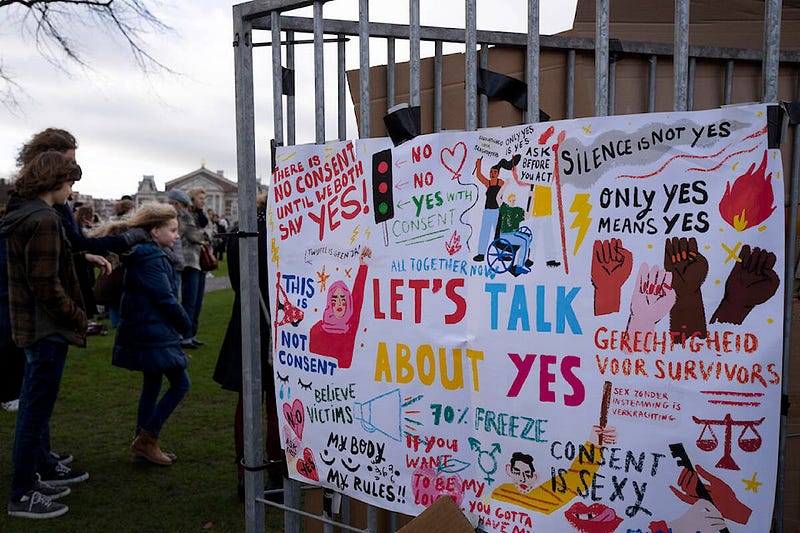
Over the last couple of years in Australia, there have been significant reforms in domestic and sexual violence legislation. In my home state of Queensland, there has been a sweeping change this past month. Truthfully, the other states (Victoria, New South Wales and Tasmania) were forerunners in these reforms, but good ol’ Queensland finally made it.
Amongst criminalizing coercive control, there has been a change in how we understand consent legally. This is big because we often can become despondent about the legal system and despair but accept that it is the way it is and we can’t adapt it to suit sexual violence cases. But these changes have in part contributed to demonstrating that we can change how we legally define consent and how we prosecute or prove whether it has been obtained. Let me take you through what it was before.
Before these reforms, the courts relied on assessing whether the defendant believed the other person consented and whether this belief was reasonable. This placed the onus on the victim to prove that they outwardly and explicitly didn’t consent. This allowed defendants to argue they hadn’t received a no, so they believed it was a yes. Needless to say, this is very simplistic and a detached from reality-view of consent. There could be many reasons why a woman cannot say no. She may be scared, frozen, drunk, just wanting it to be over. We also don’t just say no with words. Again, we read body language all the time from people we interact with. As they say, communication is mostly body language. To imply that our skills to read body language somehow disappear once we’re in the bedroom is a cop-out.
But this is what the law allowed. It allowed defendants to argue that she didn’t say no so I thought it was a yes. The victim then had to get up and be on trial and prove that they said an outright no. Body language rarely is enough for this argument.
Thankfully, this has changed.
You have to get consent
Under the affirmative consent model, the individual seeking to have sex with another must explicitly obtain clear consent, whether it is an action or verbal, before and during each sexual act. This means that the defendant cannot have a reasonable belief that there is consent unless they have said or done something to find out whether the other person consents. This is intended to shift the focus to the perpetrator of sexual violence to prove they obtained consent.
In New South Wales law it explicitly says:
A person who does not offer physical or verbal resistance to sexual activity is not, by reason only of that fact, to be taken to consent to the sexual activity.
To me, this is a welcome change and honestly, common sense. Of course, there are opponents to this reform but why? Why are we so afraid of asking for a yes?
This will lead to consensual sex being criminalized
The argument goes:
I can’t believe you have to get consent, whether through word or action, before every sexual act, whether it be touching, kissing or penetrative sex.
This is going to make sex awkward, and less sexy and stop the ‘flow’ of it.
But who are these arguments from and who are they serving?
Interestingly, the arguments against getting consent are always that it will make it awkward, weird or not as sexy. I find that quite insulting. This narrative has guided and shaped how we teach consent, think of consent and love for too long. It relies on the idea that women are sexual objects designed for men’s pleasure.
Why else would it be so ‘awkward’ for you to ask for consent? You wouldn’t want your object to speak back, would you? The idea that somehow sex becomes less sexy if you have to ask for consent or take notice of your partner’s body language implies the woman is an object, not a human. A human has emotions, feelings, desires and a voice. Why would it be less sexy to allow for that in sex?
I’m not sure what type of sex people are having that are making these arguments. If it is that hard to either ask, check in throughout, or read your partner’s body language to understand whether they are engaging and consenting to having sex with you, then you need to reflect on your idea about sex. Sex is a mutual act.
Regardless of whether you agree with me as to why it seems like such a problem to ask for consent, can we concede that the sexual safety of women is more important than the second of ‘awkwardness’ you might feel in asking your partner whether they are into it? And if you’re so scared to ask that question, ask yourself why.
Before you respond to this piece with, ‘but now men are afraid to even approach women at a bar’, please think a little more critically. Men are not stupid so stop acting like it. By saying these things you are dehumanizing yourselves. Acting like you don’t know the difference between someone who is into having sex with you and who is not, implies that you don’t understand how human interaction works. At best it implies that you don’t have the social skills to read another human being. At worst, it implies that you are monster who doesn’t care. But see if a woman says that, you’ll say ‘not all men’ or ‘you’re a man-hater’. No actually, the reason why women are requiring more from you is because we believe you can rise to the occasion. Don’t make us think otherwise.
On the other hand, is it not far enough?
Yes, context exists around sex and can influence when someone says yes and it isn’t a truly free choice. Relationship dynamics, gender roles, cultural expectations, economic reliance, political and legal definitions, and models of consent are just some. These greater, more invisible factors are slowly being addressed and challenged. But to cite these as a reason to not reform consent laws is counterproductive. Steps need to be taken in the right direction. Actively seeking consent is a step in the right direction. The yes that is sought is influenced by a whole host of factors that are being broken down and challenged by feminism and other movements. But to point towards the complexity of life to argue that a simple yes isn’t enough, doesn’t mean that it can’t be enough for right now. I’m sure in 30, 40, 50 years, we will think these were simplistic laws. But marital rape had to be outlawed to get to this stage. Each thing builds on the last step.
The steps have to be small, so I’m glad we’ve taken this one.
As an Australian, I only really know the context that I’m living in. I’m interested to know what models of consent other countries have and what people think about them, comment and tell me.


