Asking for Help is Difficult, but It is Harder to Survive Alone
How I learned to accept help
I was thirty days from retirement, enjoying a weekend away at our cabin retreat. All seemed right with the world. Then the phone rang. Yes, I acknowledge a 7 a.m. Sunday morning wake-up call creates an abrupt awakening, but it happens sometimes. However, when my husband answered, I heard long pauses and tones of concern. Thinking something had happened to my 84-year-old father, I listened attentively. When Randy used the pronoun “she” alarms blared. Something had happened to one of my babies.
By the end of the call, I knew it was Kari, our 33-year-old daughter. The situation sounded critical because my eavesdropping only deciphered more unknowns: life-threatening, sudden, undefined, unidentified. Kari lay in the ICU without the ability to talk or move her right side.
Randy and I dressed, piled in the car without bothering to pack anything except the phones. We drove down the mountain road we had traveled many times before. Only this time we soared around curves and bends, memorized from extensive navigation the past 25 years.
Anybody who has visited a patient in ICU knows it is a traumatic experience to see a loved one hooked to tubes extending from numerous body points, feeding into one unit that acts as a brain for thoughts and movements. Having lived this nightmare before with different characters, terror stabbed my heart.
With my daughter as the protagonist, my breathing became shallow, my heart pounded violently, and my brain seized on worst case scenarios. My bodily functions didn’t return to normal until many days later, but the stress tapered when our baby looked at us with recognition and smiled.
She was in ICU five days, and in the hospital a total of eleven days.
Following doctors’ recommendations, Kari transferred to St. Luke’s Rehabilitation Hospital for an additional thirty-two days. During that time, her husband, Dan, and I defiantly sat by her side. Our mission to protect her remained unnamed but clear.
Forty-three days is not a lot in the course of a lifetime, but as our family lived the nightmare, each day following Kari’s stroke moved in slow motion. Waiting prompted fear. The unknown paralyzed emotions. When our daughter experienced a traumatic brain injury, a stroke, logic no longer existed.
The radiologist, Dr. Peal, entered the room to discuss test results; the medical explanations sounded like lines from the poem, “Jaberwocky” by Lewis Carroll .
’Twas brillig, and the slithy toves
Did gyre and gimble in the wabe;
All mimsy were the borogoves,
And the mome raths outgrabe.
At that moment, he made about as much sense as those lines while instilling as much dread. We listened, mouths agape, minds filled with unending questions, wondering which to ask. “What is a . . .? Why did . . ? ? How can . . ? ? ? ? ?”
Dr. Peal’s compassion provided wisdom more valuable than the diagnosis. He encouraged us not to expect quick results because overcoming a stroke takes months — years. Let the hospital staff do their job and do not hurry the process. He said, “It is a long journey. Think of it as a marathon, not a sprint. Take care of yourself.”
We had been in the hospital so many hours, time held no value. The first day, my husband and I never even thought about eating; our needs became secondary. Eventually, with coercion, we ventured to the cafeteria, attempted to eat a bowl of tomato soup, only to discover it was squash. We left the full bowls on the table with our appetites. Yes, labels probably provided that information, but reading would have required a higher level of consciousness.
When my sister-in-law arrived, she ordered us home to sleep with strict instructions, “Take care of yourselves.” At home with the assistance of two over the counter sleeping pills, I slept. My husband’s body absorbed the rest as if coma induced. In a conversation driving back to the hospital the next morning, I commented on my exhaustion during the ride home the previous night. Randy pointed out I had driven my own car. OMG! I possessed no memory of driving home.
Our youngest daughter, Kat, called often to check on the situation but I think she was mostly checking on her dad and me, “What have you eaten? Did you sleep? Are you taking care of yourself?”
My immediate response, “Yes, don’t worry about us.”
Even the social worker asked the dreaded question, “Are you taking care of yourself?”
I wanted to scream, “It’s not about me. My daughter is laying in a bed. She can’t talk or move her right side. I must take care of her. I can’t even begin to take care of myself.” Instead, I said, “I’m fine.”
Not until I sat and talked with my granddaughter, Kari’s oldest child, and her other grandmother did the situation turn surreal. In front of my granddaughter, Grandma Virnene asked, “How are you doing?”
There was that question, again! Unable to avoid it, I stiffly replied, “I’m fine — just fine.”
To change the focus I asked Jodi, “How are you?”
This mature 12-year-old responded like a parrot, “I’m fine — just fine.” Her four simple words slapped me in the face. She lied.
We were all emotionally broken. By modeling strength, persistence, and optimism without sharing my pain, I stifled emotions. Thereby, teaching Jodi to do the same. At that moment I confessed and explained how I really felt while looking her in the eye, “OK. I will tell the truth. I am not fine! This situation sucks and maybe we should all be honest and share our pain.”
Emotions bottled too long explode; by ignoring my grief, it grew stronger. After that night, dialogue flowed easier. I feared sharing my pain would expose my wounds, force me to lose control, but sharing allowed me to garnish comfort and offer comfort. I felt less alone.
Everyone around me found a strategy to confront worry. Kari’s father-in-law wrote positive affirmations. My husband used humor and made work an outlet. Friends and family prayed, scheduled counseling appointments, and volunteered to help. Different approaches provided relief of the grief. I learned I am no good to anyone if I do not take care of myself.
My first impulse pushed me to take control only to realize that the situation was uncontrollable. Not until I surrendered to the professionals did I begin to understand the prescription, “Take care of yourself.” Slowly with resistance, I relinquished power knowing I would fail if I didn’t. When my body tired, my faith wavered, and my spirit plummeted, I received the message, “Take care of yourself.”
Though I am not a person who asks for help, I discovered the value in accepting help. When incapable of taking care of myself, others stepped up to take care of me. When I said, “I am fine,” they heard my words but understood what I didn’t understand — wouldn’t admit. They took care of me when I couldn’t.
Kari had a stroke 3+ years ago that changed her life forever and impacted every loved one in her life. The first time I stood beside her bed in the hospital, emotions flooded rational thoughts. When she opened her eyes unable to talk, I knew it would be a long, difficult journey but never anticipated her strength and determination.
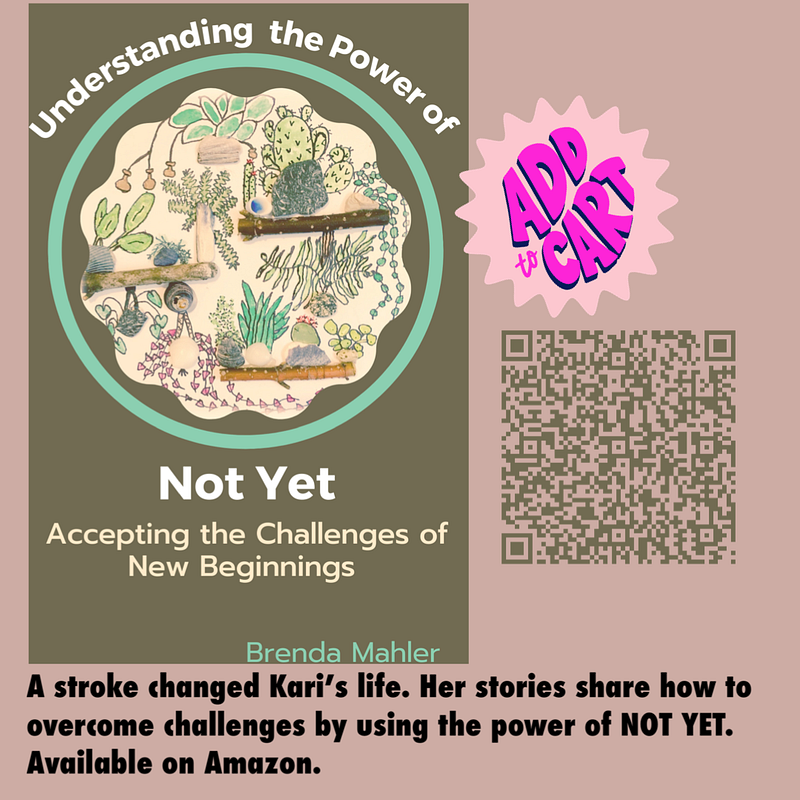
On day one I started writing to remember, to reflect, and to curse fate. I didn’t understand why. Writing became my way to survive in an attempt to make sense of the chaos. Now years later, all the stories and emotions have evolved into a book, Understanding the Power of Not: Accepting the Challenges of New Beginnings.
I share it to inspire others who are in the midst of their own trials. Though the memories still tighten my heart, I believe our experiences are opportunities to support others. It is a reminder that life is a series of challenges and when times are difficult, as long we can say, “Not Yet” we continue to explore what is possible.
https://www.amazon.com/dp/B0BR73TK4G/ref=sr_1_2...
Please know — selling this book is not for profit but to enlighten others and provide hope.