
MEMOIR
As The First Year Of My French Adventure Wound Down, A Couple Of Things To Accomplish Before I Visit The States
And an unexpected distraction (number 9,998) that threw me off course. . .
Moving to France alone, at 68, had been a step into the unknown. Of course, I’d wanted it to work out but I honestly didn’t know whether it would.
An initial obstacle, the place I’d leased sight unseen, was not an auspicious start, but I’d found ways to work with that and a few other early hiccups and by the end of my first year, I knew that I would stay in France — if not in the same apartment.
I’d planned a visit back to the States and wanted to find a different place to live when I returned. Something with more light and some outdoor space. Something with less falling plaster . . .something a little less cavelike.
You can read about my first place, here.
With just a couple of months to go before I left for the States, I needed to start looking — don’t ask why I didn’t start sooner, I infuriate myself— for a new place and pack up the cave.
Although I’d arrived in France with just three suitcases, in less than a year I’d accumulated a surprising amount of stuff. A few pieces of furniture, numerous carpets — necessary to cover the cave’s concrete floors — lamps, plants, dishes were acquired during a long weekend in Spain. Since I hoped to save on rent while I was back in the States, everything would have to be stored somewhere until I got back.
Just the thought of it all was arduous enough that I kept wondering if there was any way —more mirrors, more carpets, more plants — that I could continue living in the cave. Experimentally, I hung flashing Xmas lights around the window which looked sort of funky and theatrical, but . . . Nah.
Still, I had mixed feelings about leaving the village. Although I knew no one when I arrived, I’d made a few friends and some Friday nights, I’d wander up to the village cafe and find people I knew to talk to and share a glass or two.
And there was Paulette, the elderly (from my perspective of 68) woman across the road reputedly once the lover of a famous French chanteur, who offered to teach me to cook like a French woman and advised that if I wanted to speak the language of Moliere, I should find a French lover.
I thought the cooking lessons were more likely.
You can read more about her here:
So, to move or not to move, that was the question — whether it was easier to suffer the flaking plaster and concrete floor of the cave or to venture forth to discover a new abode and new adventures.
I decided not to overthink it. If I found something, great. If not, maybe the cave was my destiny. Perhaps I would change the Madame Olga decor — achieved with amber lamps, scented candles, and gauzy fabric draped everything that could be draped— and go for animal skins and primitive artwork. The jury was out on that.
The other thing I had to do before I left for the States was to finish writing and then submit the Margaret book — a novel I’d been working and working and working on forever and ever and ever.
Inspired by my arrival in the States as an English teenager, a partial manuscript of Not A Normal Girl had been a finalist in a literary contest, earned very positive comments from judges and it was a story I wanted to tell. And finish. Partly so friends and family would stop asking if it was ever going to be finished and I could stop lying that it was . . . almost. Except I kept finding things I had to change.
But enough of that. I burrowed in. Days passed in an undistinguished blur. A week went by. I might be living alone in a small French village, but in my head, it was the late 1940’s and I was holed up with an English teenager, her GI Bride mother Gracie, and the new husband, H.G. all living unharmoniously in a ramshackle house on a deserted stretch of the Washington coast.
Here’s the house.

I pinned the picture on the wall above my desk so that I could imagine Margaret wandering through the warren of rooms, pining for England while wondering if she could swim across the Strait of Juan de Fuca to Canada and make it home from there. Without that as a reminder, I’d sometimes stare out of the window and get distracted by Paulette — walking her little dog up to the boulangerie or sitting behind her lace-curtained windows.
Once I inadvertently made eye contact. Paulette raised a glass.
More Planter’s Punch?
I smiled and looked away.
Distractions begone. Except for an hour or so spent searching the web for affordable digs, my life was all Margaret all the time. Occasionally, at the end of a day spent entirely with Margaret, I’d realize that I hadn’t used my voice all day. No phone calls, no one had dropped by — probably fortunate since I often didn’t bother to change out of the shirt and sweat pants I slept in.
(See a few other reasons to think twice about living with a writer.)’
I’d wake up thinking about Margaret, stand at the stove heating potato soup, or lentils — my diet staples — and hoping the flickering flame didn’t mean the paraffin was running out because I had no idea how to replace the tank and think about Margaret.
I endlessly tooled away at her character arc. Margaret wants to feel like a normal girl. If she could return to England, she’d feel like a normal girl again — but as Gracie is always reminding her, she never really felt normal there either. At fifteen, Margaret has lavender hands covered in scabs and scratches, the result of the eczema she was born with. She’s also flat-chested and people are always thinking she’s only twelve.
If there’s a bright spot in her life, it’s this Indian boy, Lukah who lives on the nearby reservation. With his long black hair and toffee-colored skin, he’s incredibly exotic. The most incredible boy Margaret, with her lavender-hued skin, has ever seen in her life. One day he stops by the house to sell some salmon he’s just caught and winks at her.
Since Margaret isn’t exactly the kind of girl boys wink at, this is pretty earth-shattering. The imaginative girl that she is she spins endless fantasies. Since there’s no one else to talk to, she foolishly shares a few musings about star-crossed lovers with Gracie.
Already at her wit’s end coping with a new husband and a life that is nothing like the American dream she’d imagined back in war-torn London, Gracie has little patience with Margaret’s dreamy notions. The last thing she needs is Margaret getting into trouble with an Indian boyfriend.
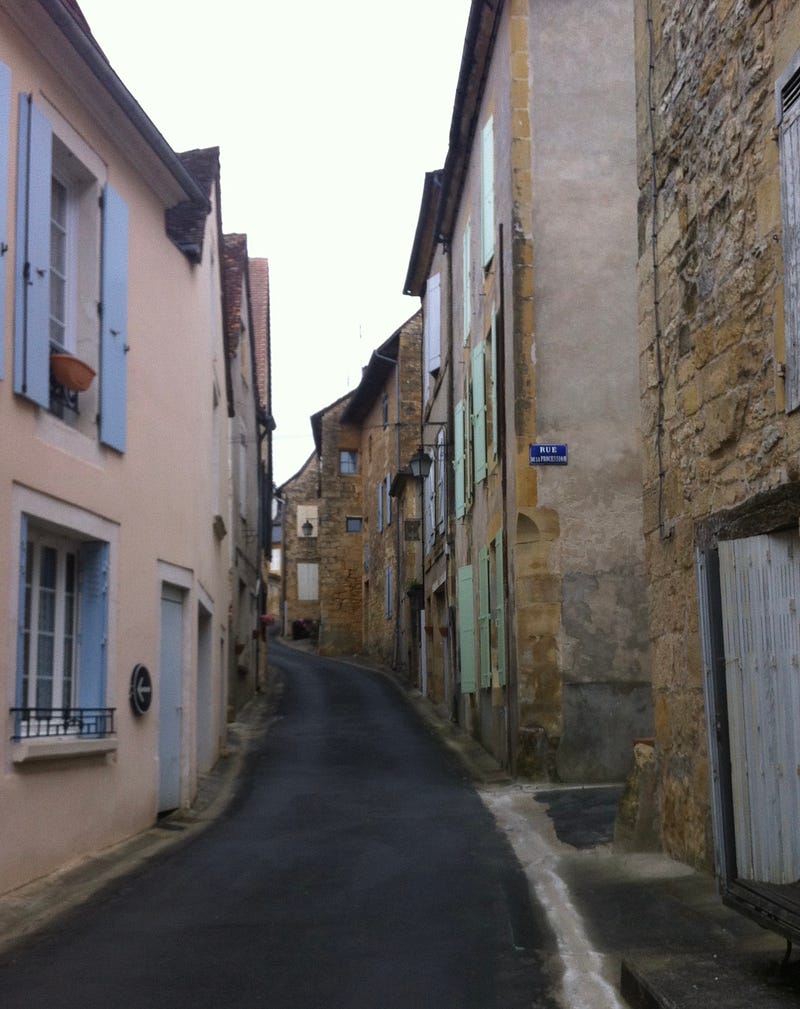
One windy evening, my head full of Margaret and Gracie’s latest row, I ran outside to close the window shutters. Most French houses have heavy wooden shutters. You open them every morning, close them at night. But I hadn’t closed mine properly the night before and, I was informed by my neighbor, they’d rattled and banged and kept her awake all night.
I may have heard them too, but I think I’d incorporated the sound into a dream. Probably Lukah banging his Indian war drums. Or Margaret slamming the door in anger. I might find it difficult to focus at times, but once I get into the zone, little else exists.
As I fastened the shutters with the rusty metal clasp that keeps them closed — the step I’d failed to complete previously — a guy walked past, glanced over at me, and nodded. I ignored him. Back inside, I joined Gracie as she reassured Margaret that of course, she’d develop bosoms one day. Then I heard a knock at the door.
It took me a moment to switch from Margaret’s undeveloped chest to the guy standing in front of me and I just stared, probably slightly wild-eyed. I then realized it was the guy I’d just seen.
He grinned. “You do not remember me?”
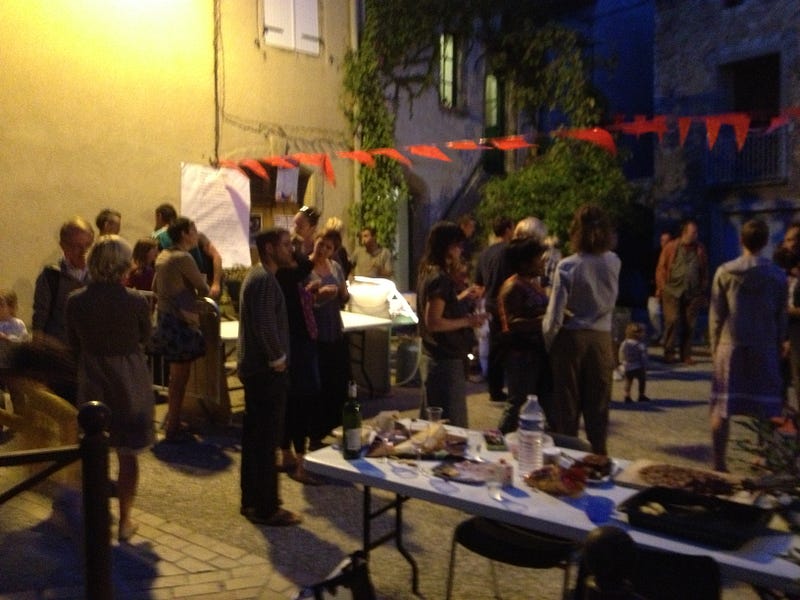
Suddenly it clicked. This was the guy I’d been talking to at the New Year’s Eve Party two weeks earlier. My daughter and her husband were visiting and we’d gone to a party in the village. Carolyn and Bill were soon part of a crowd sitting around a long table with enough English speakers for them to participate. I’d ended up spending part of the evening speaking, mostly in English, to this guy whose name I couldn’t remember the next day. . . only partly due to the wine and champagne at midnight. At the end of the evening, I’d laughed off his request for my phone number and hadn’t thought about him again.
Now, I stood at the open door, aware of my bird's nest hair, the clothes I’d slept in the night before with Margaret yammering on about her bosoms and I couldn’t think of what to say. I took a deep breath, and tried to get with it. He wore work clothes and heavy boots. Short white hair, a trimmed beard. Mostly, he looked amused.
“You are . . .” He hesitated. “Dérange?”
I laughed. My handy default response. He was asking if he’d disturbed me, but the word sounded enough like deranged that I thought it might be a question. Yes, I probably do look deranged. Maybe I am a little.
I tried to recall what we’d talked about at the party. Nothing came to mind.
“I’m a writer,” I said and he nodded. Possibly, I’d mentioned this at the party. “I’m trying to finish a book. But some days I sit at my desk and . . .it’s difficult. Maybe nothing I write is any good . . .”
He smiled. “Not good.”
I smiled back at him. “Not good. In more ways than one.”
He held his head slightly to one side in a way I now recalled from the party. He was not French. I sifted through my hazy recollections. German, I think. He’d lived in France for many years, but didn’t feel French. Or German. The way I didn’t feel American, or English. His English was better than my French, which wasn’t saying much. Now, I remembered the way he seemed to process what I’d said before he responded . . . much as I have to in French conversations.
“More ways than one?” he repeated. “What means this?”
“Things can have two meanings,” I said.
Across the road, did I see Paulette’s curtain twitch ever so slightly? I’d woken that morning with allergy bags under my eyes and now I could feel them watering the way they do after I’ve stared at the computer screen for hours. Should I ask him in? I considered the state of the apartment and decided not to. I could work for another hour at least.
And then, we bantered back and forth a bit. The house he was building in the village. Something about a play or concert he was going to in Montpellier. He lived in Montpellier. There was a wife or a girlfriend. I’d wondered whether ’ she objected to the time he spent talking to me. The New Year’s Eve Party. It was very good, I said. We all enjoyed it.
“Your daughter and her husband? They are not still with you?”
I said they’d returned to the States. That I would be going back shortly, but that I had many things . . . beaucoup chose to do before I left.
And he nodded and looked amused and said it was nice talking to me at the party and he was sad that I hadn’t given him my number but he was happy to see me now and maybe we could go to the cafe and have some wine.
I thanked him and said I still had work to do.
And then I suggested Saturday.
Stay tuned . . .
A few more stories about the early years of my French adventure
Perhaps you’re a glutton for punishment? If so, you can also take me along on your walk, or wherever you’d like to go. Just press the listen button at the top of the story to hear it read aloud.


