
LIVING IN FRANCE
As A Foreigner, Do I Have A Right To Criticise The Politics Of The Country I’m Living In? Maybe Not.
Does That Stop Me?

It hasn’t so far.
Although I was born in England, I only lived there for the first seventeen years of my life. When I emigrated to the US with my mother and sister, I wasn’t quite old enough to vote.
I am 77 now, I haven’t lived in England since, but I’m still a UK Citizen.
Much of my life has been spent on the west coast of the United States. I had a US green card which allowed me to work in the States. I paid US taxes, I’ve been married to three American men — not all at the same time. My two adult children, a granddaughter and, soon, a great-granddaughter are all American — although my daughter recently became a dual citizen of the UK, which, despite my rather tenuous link to the country of my birth, pleased me.
I continued to live in the United States until I moved to France nine years ago. But I never became a citizen and, so, never voted.
I honestly don’t know why I never became a US citizen. Through various administrations, I’d make vague promises to vote when this president or that was out of office — but I never did. I once got into a spirited debate with an immigration official who reprimanded me for not becoming a citizen.
It isn’t a good idea to argue with an immigration official.
I now have a French carte de sejour which allows me to live in France (before Brexit, as a UK citizen, I was eligible to live in any European Union country, now the UK is out of the EU and a residence card is necessary.
So I’ve lived in three countries and never voted in any of them. Never had any say in a country’s politics. Please don’t write to tell me about the privilege of voting and how irresponsible I’ve been — let me save you the bother. I already know. I’ve already been told. On numerous occasions.
Here’s the strange thing though — I’m keenly interested in politics. I’m not a passive onlooker, I have very definite views — regardless of the country I’m living in. I despaired over Brexit. In the States, I railed against George W. Bush and the Iraq war . . . and don’t even get me started on Trump.
I’d been living in France for a few years when he was elected. I sat up all night watching, in disbelief, as the results came in. When he won, I burst into tears. I’ve never been that moved by a political outcome. Stunned, I just stared at the TV.
Then I started to pour a glass of wine, realised it was early morning, and made coffee instead — still so distracted that I poured hot water into the coffee canister.
I couldn’t have cared more passionately if I’d voted. But I hadn’t — even knowing that it doesn’t take many votes to change an outcome.
So here I am living in France where last week, in the first round of the presidential election, Macron, the current president was slightly ahead of Marine Le Pen, the far-right National Rally party candidate. Macron, a former banker, is considered a centrist, although some feel he’s more interested in the wealthy.
The final round takes place in two weeks. Macron appears to have an edge, but so did Hillary Clinton. Again, I have very strong views on who I’m desperately hoping will win.
And, again, I can’t vote.
When I lived in the States and embarked on one of my frequent political rants, my daughter suggested that if I didn’t want to become a citizen, I really had very little right to complain.
I had no counterargument.
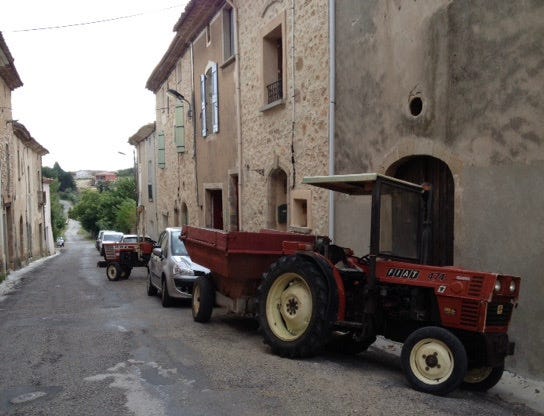
Yesterday, I read a breakdown of the French vote in the towns and villages in my immediate area. It confirmed what I’d largely suspected — that this rural, mostly agricultural area of France is heavily far right. Think rural Alabama— the most far right-leaning state in the country, according to Pew Research,
Regardless of the argument that as a non-voting foreigner I have no right to spout off on a country's politics, I’m pretty sure that if I lived in rural Alabama, I’d be spouting off anyway — and maybe find myself at the receiving end of a shotgun.
If my level of French was up to political debate, I’d probably do the same here in rural France. Unfortunately, or perhaps, fortunately, it’s not. So if I stop by the boulangerie and the baker is giving his stamp of approval to the radical views of the far-right candidate, or the friendly guy next door surprises me with his virulent anti-whatever rant, I’ll just keep my mouth shut.
All things considered, probably a good thing.
A few stories about life in a French village
Perhaps you’re a glutton for punishment? If so, you can also take me along on your walk, or wherever you’d like to go. Just press the listen button at the top of the story to hear it read aloud.


