
As a digital transformation coach, I think that design thinking should be mainstream for everyday use
Helping everyone navigate chaos and complexity
“Design is not just what it looks like and feels like. Design is how it works.” — Steve Jobs
Why aren’t we all thinking more like designers yet? That is the question I hope to unpack in this blog. As a digital transformation coach (fancy title for I help companies adapt to digital impact and change), I’ve seen firsthand how design thinking can turn chaos into clarity and complexity into innovation, in a corporate context. It’s not just a tool for designers; it’s a mindset that should be mainstream in every industry and used by everyone. I have even advocated for teaching this in school.
Imagine a world where every problem is an opportunity to innovate, where every challenge is a chance to rethink and reimagine. In my journey, I’ve witnessed incredible transformations — not just in systems and processes, but in people’s thinking and approach to work. It was so mind-blowing to me that I paid the hefty training to be among the first to train and become a Certified Design Thinking (DT) coach in 2017. It really helped me, not only get corporate gigs but transformed my life, helping me figure out a way to go back and finish my PhD, while working full-time and raising a family. While this may not be your jam, if there is something you want to do, DT can help you find a way.
So let me explain, with a growing and common case study, from my upcoming book, that can help you visualize how DT can help you find a way, if you have a will.
Introduction to Design Thinking (DT)
DT emerged as a problem-solving approach that involves empathy, creativity, and experimentation. It is a way of thinking that helps designers and non-designers, alike, come up with innovative solutions to complex problems.
DT mostly originates in the late 1960s, when scientist and Nobel Prize laureate Herbert A. Simon, in his book, The Sciences of the Artificial, suggested Design as a way of thinking. Simon would later contribute to many emergent theories, and frameworks throughout the 1970s which crystallized into what is now referred to as the principles of DT.
DT re-entered public consciousness when founder of the design company, IDEO, Tim Brown, published an article in Harvard Business Review (2008), “Why Design Thinking Works.” Brown is also the author of another great text, Change by Design, that I incidentally gave to each of my team members one Christmas. I had an opportunity to hear him speak many years ago, when I led the first design research team at a Canadian company that made mobile phones: — Research in Motion (now Blackberry). In that presentation, and also in his book, Brown suggested that there was merit in thinking like a designer, if you wish to transform the ways you develop products, services, processes — and even strategy. It is clear to see that the tools businesses adopt can also be appropriated for self-transformation as it has been for business transformation.
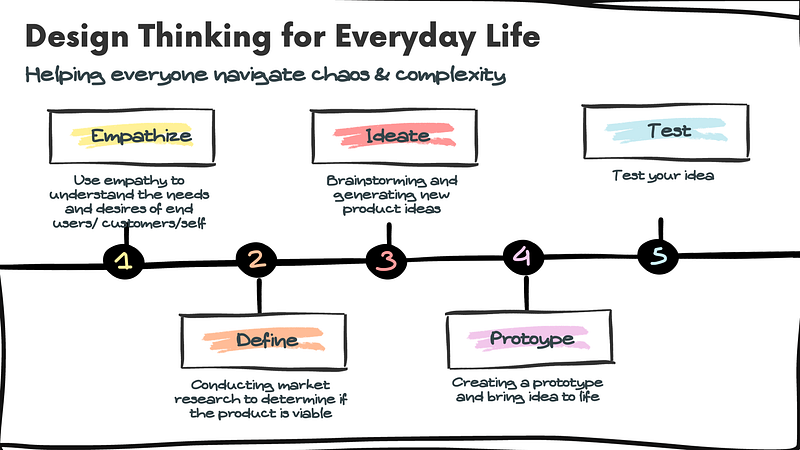
The DT process typically follows five steps, though this may vary (and condensed) by companies, depending on their proprietary processes, and associated visuals; however, used in a corporate space they are often presented as five steps, with these broad descriptions, which is often referred to as either the d-school DT framework or the EDIPD model.
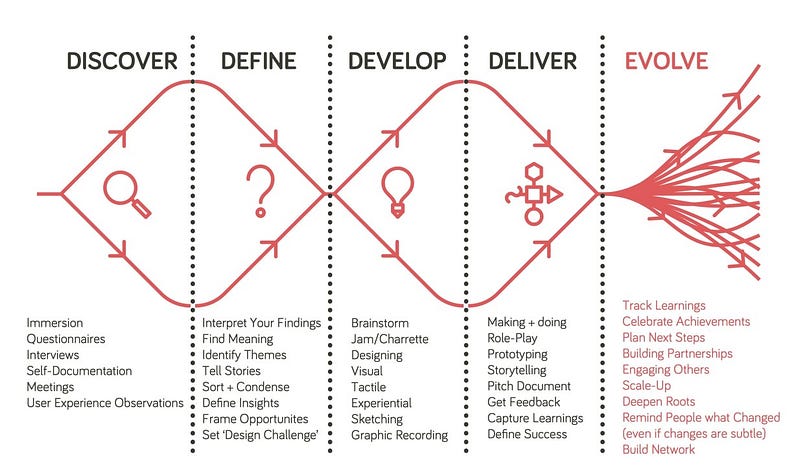
In my practice and long career in the wider Design Strategy space, you will also hear people refer to the double diamond approach to designing. It refers to the same idea. the below image provides a visual clue as to why it is called “double diamond.”
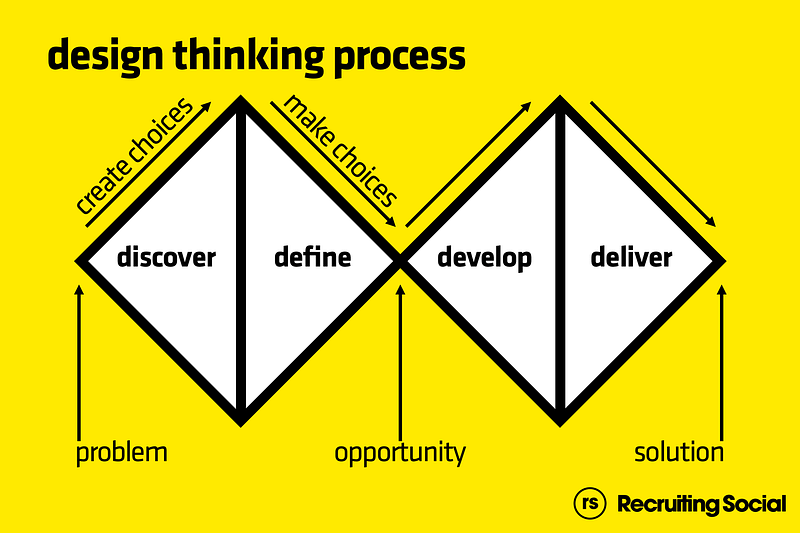
But for now, let’s focus on the d-school approach, which includes a series of 5-step process:
- Empathize: The goal of this phase is to understand the needs and desires of the people you are designing for, by observing and interacting with them.
- Define: Next, you need to clearly define the problem you are trying to solve and the constraints you are working within.
- Ideate: This is my favourite phase where you generate as many ideas as possible for potential solutions to the problem.
- Prototype: To give your idea life, you need to create a rough version of your solution, whether it’s a physical model, a digital mockup, or something else.
- Test: And lastly, you want to gather feedback on your prototype and iterate on it until it meets the needs of the people you are designing for.
Across these phases, we use tools, or techniques or methods — whatever term you chose, to do so. I cannot get into this here as there are so many techniques that too come with their own protocols. Tools like rose, thorn buds and contextual inquiry, what’s on your radar, to name a few, that enables each of the five phases move forward. This artillery of tools is what helps moves you forward in the process.
I describe them, while training others, as akin to having a drawer of tools (almost like cutlery drawer). And imagine you have a drawer of cutting utensils and tools — knives of all types, peelers, graters, etc., — there is a tool for a specific task. Just like in DT a skilled facilitator, as well as some training can inform you of which tool is ideal — for example, you would not use a butter knife to eat a steak nor a folk to drink soup. And so, following this thinking we begin to see that each knife, for example, has a specific cutting task. Just like in DT toolbox, there are many tools that may help your prototype or visualize but it all depends on several factors — that’s for another blog. But, for example, to visualize a plan, you may decide to create a vision board or creative matrix, or a diorama and so on; the options are many.

Without making this post too long, what you need to know is that from the three buckets of tools to facilitate this five phase process, you navigate a process that we refer to as divergent and convergent thinking, creating this double diamond effect. And there are tools that overlap in the granularity and precision that you need for the task. And importantly, it is iterative as you want to test and improve things.
I explore each of these in an upcoming 2024 book, Design Thinking for Everyday Life (working title).
Whatever the context of the thing you are trying to figure out, DT can enable a path to solutioning — from what school to attend, how to create a business plan to how to figure out what is wrong with your plants? The ideas can be big or small, DT can help.
A bit of caution
Before I continue, this is something talked about in hushed design circles but something worth bringing to your attention. Undoubtedly, DT has gained much attention and has since become a highly sort after skill in the design world, making it also easy prey for many forms of bastardizations of the process, from unskilled practitioners. Many people, as of late becoming DT coaches are doing this online at rapid rate and not truly appreciating the value of taking a full-length course as well as the necessary hundreds of hours needed to make you a more reliable facilitator. So choose cautiously, if you want to explore this space as some decry a subset of practice as having been “bastardized” by ill trained coaches.
This bastardization of a well-crafted framework like DT is endemic to any space where something becomes highly valued; sooner or later, everyone is doing some semblance of it without fully appreciating the deeper aspects of the framework’s value. So, DT is an easy prey for the bargain basement knock off with many moonlighting practitioners, who lack the ability to teach and advise on this amazing framework.
In part, it is due to a lack of their ability to critically think on their feet and string together appropriate methods to enable progressive actioning giving the changing and varying problem and challenges. So, no matter what the challenge space they will use only the tools with which they are familiar. workshops where I cringe at the lack of expertise and inability of facilitator to move attendees forward.
In one case, the facilitator, peppered with questions by attendees about the value of an activity, broke down crying. It was perhaps the most fantastic thing I had witnessed in the wider space of DT practice. This lack of experience also serves to lessen the perceived value of DT, by management, who do not realize what is going on, and at the same time sullying the practice and its true value.
Simply put, many times the DT Facilitator is not up to the job.
But I digress!
So, what does that look like in practicality? Let me share a short case study, taken from my upcoming book I mentioned, “Design Thinking for Everyday Life”)
In this case study I explore how Ifeoma, an entrepreneur, used DT basics to get her business up and running.
Case Study 2: Ifeoma — Starting a niche business with DT basics

Ifeoma is an entrepreneur who wants to start a business selling organic, locally sourced snack boxes to office and factory workers in a business area near her home. A recent resident to Canada, she has had challenges finding a job that works for her life needs — she has school aged kids and wants to be there when they come home. So, she decided that is better off using skills she learnt from her home country of Nigeria. She will instead get a license so she can set a stand during lunch hour nearby and manage her mommy duties. Ifeoma decides to use DT to help her come up with a successful way to move forward. Using the double diamond approach, she started thinking about how this applies to her.
DT Step: Empathize
Ifeoma’s first step in using DT was to understand the needs and desires of her potential customers, aside from empathizing with her own personal circumstance and the challenges therein. As it pertains to her potential customers, she goes to the location where many mobile food trucks park and noticed there were no healthy options for the hundreds of workers in the area (ethnography). Ifeoma then goes on to conduct some random customer interviews (interviews, asking workers walking about) if they had all the options they needed. She also collected some emails after exchanging her cards to see if they would partake in a small survey.
She wanted to gather insights about what people look for in a healthy snack box, and what their pain points are when it comes to finding healthy snacks near work — a place far removed from amenities like grocery stores and restaurants. Many would have to drive to get a healthy snack if they did not pack one, or a lunch.
DT Step 2: Define
From her research, Ifeoma learns that people value convenience, variety, and transparency when it comes to the food they eat at work. They also want to support local businesses and farmers. She employed affinity clustering among other DT tools to help her finely tune her offers across the various grouping she gleaned from using this method. Top of mind for her was her potential customer value, which were: convenience, variety, transparency. She felt confident and ready to ideate, with a group of friends who were also using DT for other projects.
DT Step 3: Ideate
With this information in mind, Ifeoma moves on to the ideation phase, where she generates a list of potential solutions to the values that her customers have mentioned (creative matrix). She considers various options, such as partnering with local farms to source ingredients, offering customizable snack boxes, and creating a subscription service. She was ready.
DT Step 4: Prototype (Visualize)
Ifeoma prototypes her ideas; she creates a website with a beta launch and buy-in from local farmers who were happy to be part of her business. She will spend some of her evenings and some mornings prepping her meal options in a side kitchen that she designed, with the help of her husband, an Engineer.
DT Step 5: Test
To test her snack boxes, Ifeoma creates a small-scale version of her snack box, using all local produce and target customers, who had signed up to participate in the survey to get their feedback (user testing). Based on their responses, she made some adjustments to the concept and repeated the process until she had the products that meet the needs and desires of her potential customers. She also considered a larger box that can be ordered by offices who want to treat their employees with healthy options.
Ifeoma is now feeling inspired and will wait to see how things unfold and decide how to grow from there, using DT, of course.
DT value in this example
Ifeoma launches her business, which becomes a hit in the local community. The snack boxes are a convenient and healthy option for office/ factory workers in her community, and the support for and from local farmers, resonates with customers. Ifeoma’s business grows quickly and becomes a thriving success, always remembering that the process is iterative and that she frequently asked what customers liked or didn’t like, or would like to see.
DT framework can be applied to any industry or type of business, and helps entrepreneurs come up with creative solutions to problems and design products and services that meet the needs of their customers.
DT methods used by Ifeoma: personas, ethnography, surveys, interviewing, creative matrix, (website prototype) design, user testing.
DT, is simply my go-to framework for my own personal problem solving. It helps me stay flexible and adaptable in a world that’s always changing. By focusing on empathy, iteration, and collaboration, you can come up with solutions that work in lots of different situations. And by staying curious and open-minded, you can come up with new and innovative solutions to problems that might seem impossible to solve. So, whether you’re trying to solve a problem at work, in your personal life, or in the world at large, DT can help you get there. It’s a powerful and easy-to-learn framework that anyone can use. So why not give it a try? You might be surprised by what you can achieve.
About me: Hello, my name is Kem-Laurin, and I am one half of the co-founding team of Human Tech Futures. At Human Tech Futures, we’re passionate about helping our clients navigate the future with confidence! Innovation and transformation are at the core of what we do, and we believe in taking a human-focused approach every step of the way.
We understand that the future can be uncertain and challenging, which is why we offer a range of engagement packages tailored to meet the unique needs of both individuals and organizations. Whether you’re an individual looking to embrace change, a business seeking to stay ahead of the curve, or an organization eager to shape a better future, we’ve got you covered.
Connect with us at https://www.humantechfutures.ca/contact