
As a child I scribbled.
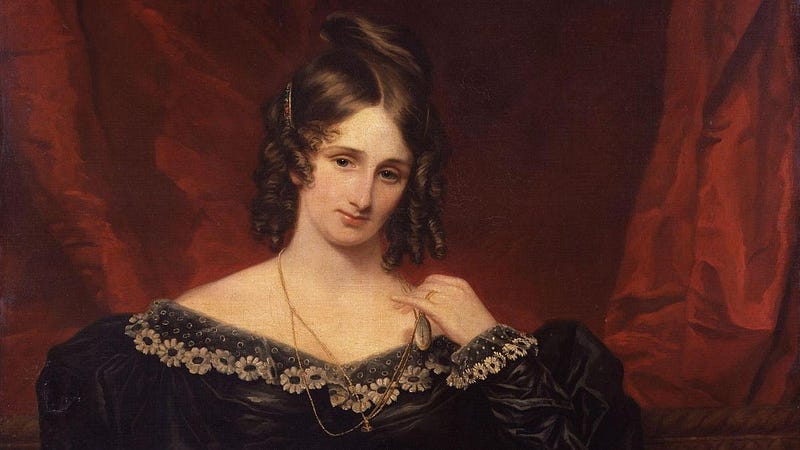
Mary Shelley on daydreaming. (The Commonplace Book Project)
The Commonplace Book Project is a daily post based on Ray Bradbury’s advice to aspiring writers: read a poem, a short story, and an essay every day for 1000 days. These posts start with a quote and go wherever the rabbit hole leads. Follow The 1000 Day MFA publication so you don’t miss a thing.
(Disclaimer: This post includes affiliate links. When you click one and buy something, it helps to support Ninja Writers without costing you anything extra. Thanks!)
“As a child I scribbled; and my favourite pastime, during the hours given me for recreation, was to “write stories.” Still I had a dearer pleasure than this, which was the formation of castles in the air — the indulging in waking dreams — the following up trains of thought, which had for their subject the formation of a succession of imaginary incidents. My dreams were at once more fantastic and agreeable than my writings.” — Mary Shelley, in the introduction to the 1831 edition of Frankenstein
I watched the 2018 biopic, Mary Shelley, tonight and there’s a moment in it when the writer (played by Elle Fanning) is at some kind of science exhibit — it’s set up nearly like a magic show — and learns about galvanism. The man touches a the legs of a frog (just the legs, the frog was cut in half at the waist) with some kind of electric current and they jump.
And I thought to myself, this is where ideas come from.
They come from being in the right place and the right time and seeing the right thing that galvanizes some kind of magic-science in your mind.
I have no idea how much artistic license was involved in that cinematic scene. But regardless, it was a brilliant visual example of an idea igniting. Between the frog legs and dreams about her premature baby girl, who died in infancy, being nursed back to life by fire, Mary Shelley started to write Frankenstein that summer.
Mary had a strange and sad life. She was remarkably well educated (by her father and the intellectuals who were his friends) for a girl born in 1797. Her mother, who died shortly after Mary was born, and her father were radicals who lived unconventional lives. Mary ran off with the poet, Percy Bysshe Shelley, when she was sixteen. He was a radical, too. They lived out of wedlock, because Percy was already married, ostricized.
It’s a little strange to imagine a time when the kind of romantic poetry that Percy Bysshe and Lord Byron wrote was once modern and new. That there was a time when people gathered to hear it recited fresh from the poet.
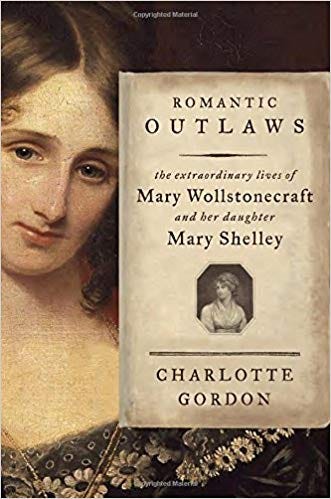
I’ve added Romantic Outlaws, Charlotte Gordon’s biography of Mary Shelley and her mother, Mary Wollstonecraft, to my reading list.
I read Mary Shelley’s Frankenstein years ago. She started writing it when she was eighteen-years-old, in 1809. She was grieving the death of her baby. Her father had not spoken to her for two years.
Her book was published anonymously first. She was constantly questioned about whether or not her husband had written it. It wasn’t published with her name on it until 1823.
The Frankenstein’s monster’s final words are my favorite.
“But soon,” he cried with sad and solemn enthusiasm, “I shall die, and what I now feel be no longer felt. Soon these burning miseries will be extinct. I shall ascend my funeral pile triumphantly and exult in the agony of the torturing flames. The light of that conflagration will fade away; my ashes will be swept into the sea by the winds. My spirit will sleep in peace, or if it thinks, it will not surely think thus. Farewell.”
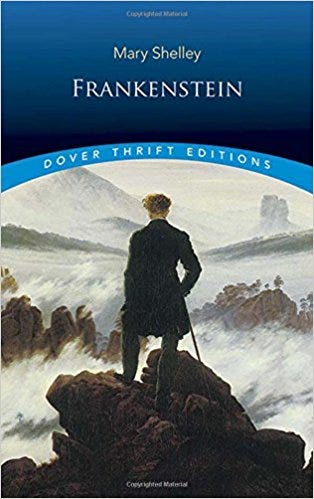
Mary started to write Frankenstein in the summer of 1816, which she spent with Shelley, her sister Claire, Lord Byron, and John Polidori. They held a contest that summer for who could write the best ghost story. Mary wrote Frankenstein. Byron wrote the first few lines of a vampire story which Polidori turned into Vampyre — the world’s first romantic vampire story. Two horror classics were born in the same house that summer.
Guillermo Del Torro said that Mary Shelley’s Frankenstein “is the quintessential teenage book. ‘You don’t belong. You were brought to this world by people that don’t care for you and you are thrown into a world of pain and suffering, and tears and hunger, and you learn to talk…’ It’s an amazing book written by a teenage girl. It’s mind blowing.”
I think I’d like to read it again.
Today’s Poem:
A Lament by Percy Bysshe Shelley
O World! O Life! O Time! On whose last steps I climb, Trembling at that where I had stood before; When will return the glory of your prime? No more -Oh, never more!
Out of the day and night A joy has taken flight: Fresh spring, and summer, and winter hoar Move my faint heart with grief, but with delight No more -Oh, never more!
Thanks for reading and clapping (to let me know you enjoyed it!) If you’d like to get these daily doses of inspiration in your inbox, fill out the form below.
Shaunta Grimes is a writer and teacher. She is an out-of-place Nevadan living in Northwestern PA with her husband, three superstar kids, two dementia patients, a good friend, Alfred the cat, and a yellow rescue dog named Maybelline Scout. She’s on Twitter @shauntagrimes and is the author of Viral Nation and Rebel Nation and the upcoming novel The Astonishing Maybe. She is the original Ninja Writer.


