
AI & Brain Activity Meet Art
Art’s Next Frontier: The Generative AI Meaning in Neuro-Art’s Revolution
Transcending Text-to-Image: The Dawn of Mind-to-Art Models
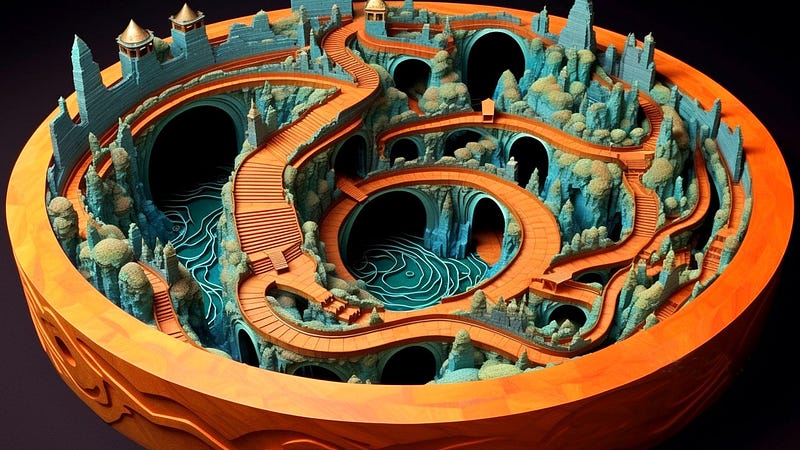
The Generative AI Meaning in Neuro-Art: Painting with Thoughts, Emotions, and Memories
Imagine an intersection where the cascading colors of creativity meet the intricate neural networks of our mind. Welcome to the revolutionary world of Neuro-Art, where Artificial Intelligence (AI) converts the beauty of your thoughts into tangible, stunning art.
Generative Artificial Intelligence: Everything You Need to Know
This grand spectacle is unfolding as AI researchers are brilliantly decoding the artist’s mind, using MRI scan data, to transform brain activity into imaginative visuals, such as images or videos.
AI & Brain Activity Meet Art: Your Mind, the Ultimate Video Canvas!
Neuro-Art, the exciting new field where neuroscience and machine learning converge, is creating ripples in how we perceive and respond to visual art. This technological marvel promises to offer personal art pieces crafted from your memories or feelings, and interactive displays that react to people’s emotions. The potential extends even to video games and movies, truly defining a new era of creativity without boundaries.
LIMA: Less Is More for Alignment
Moreover, the power of AI doesn’t merely lie in its capacity for large-scale data analysis. Instead, it lies in its ability to extract meaning and create new content even from small, carefully curated data sets. This is where the fine-tuning of AI models, like the Language Model fine-tuned on a set of curated examples (LIMA), comes in. With as little as 1,000 high-quality examples, LIMA can generate remarkable results across a variety of prompts.
Creating New Content with Text-Based Generative AI Models
LIMA by Meta AI, a 65B parameter LLaMa language model fine-tuned using the conventional supervised loss on 1,000 carefully chosen prompts and replies, without reinforcement learning or human preference modeling. LIMA learns to respond to complicated requests like creating travel itineraries and guessing about alternative histories from just a few samples in the training data. These findings clearly imply that big language models acquire practically all information during pretraining and that minimal instruction adjustment data is needed to educate models to generate high-quality output.
Yes, it requires mental effort to construct these examples, and yes, it isn’t as robust as some product-grade models yet. But this work’s evidence unveils the potential of using a simplified approach to tackle complex alignment issues. As AI becomes capable of responding more accurately to our thoughts, the implications for neuro-art and generative AI are extraordinary.
What Does Generative AI Mean for the Future of Artistic Expression?
The path to this extraordinary synthesis of art and technology wasn’t easy. But our journey into understanding five groundbreaking studies that combined AI and neuroscience in Neuro-Art reveals the potential of our brain’s power to create new content.
So, as we step into a future where your thoughts can sculpt art without lifting a brush, we see the essence of generative AI: using even the smallest amount of data, if of high quality, to make a significant impact. After all, what could be more precious and valuable than our thoughts?
Ready to learn how AI finds new ways people respond to visual art?
I’d like to invite you to continue exploring the revolutionary world of AI with us. Join MLearning.ai and read our latest article, ‘Text-to-image is already obsolete. Mind-to-Art models are here.” Dive deeper into the types of generative AI models and discover how new generative AI technologies are changing the landscape of creativity and human-computer interaction.
- Check out my instagram with new material every week
- If you enjoyed this, follow me on Medium for more
- Want to collaborate? Let’s connect on LinkedIn
- https://linktr.ee/evartology
Data Scientists must think like an artist when finding a solution when creating a piece of code. Artists enjoy working on interesting problems, even if there is no obvious answer.
All our writers (members) receive the opportunity to be promoted on our social media, which increases the popularity of articles published on MLearning.ai
- Linkedin (55K+ ML-professionals)
- Twitter (5.5K+ followers)
- Instagram (2.4K + followers )
- Sketchfab * — individual vRooML!
- Youtube
- Apple Podcasts
- Substack


