Artificial Intelligence — The Rise of Technological Era
Brief Introduction to Artificial Intelligence
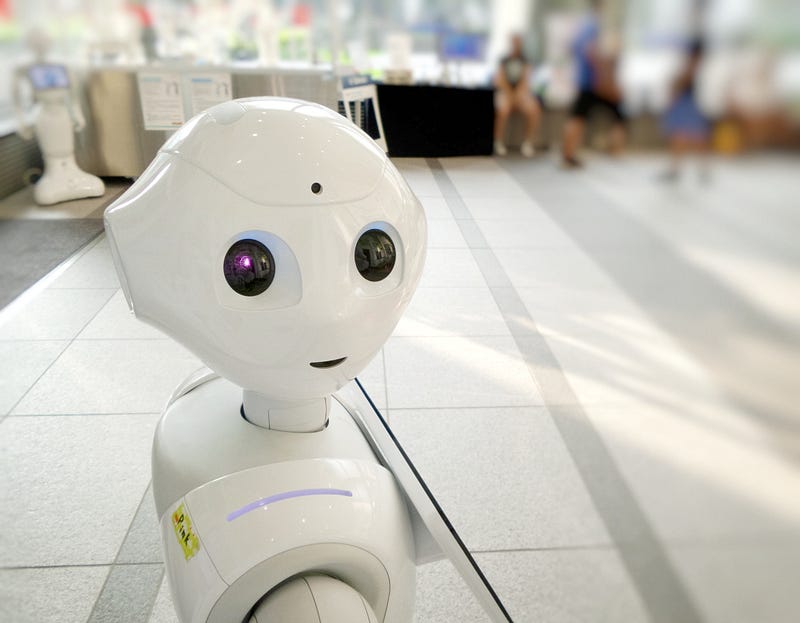
The dawn of the Artificial Intelligence (AI) era is upon us. The buzz-words Artificial Intelligence, Machine Learning (ML) and Deep Learning (DL) are used quite frequently in recent times. Let us introspect about each aspect individually to really appreciate these concepts. Firstly, I will list out the more boring formal definition and then proceed to explain them more intuitively with analogies to try and understand the concepts better. For today, let’s start off with the big daddy of them all — Artificial Intelligence (AI).
Artificial Intelligence (AI) is a broad field with many sub-categories such as natural language processing (NLP), artificial neural networks, computer vision, machine learning, deep learning, robotics, so on and so forth. The formal definition of AI is — “The theory and development of computer systems able to perform tasks normally requiring human intelligence, such as visual perception, speech recognition, decision-making, and translation between languages.”
Whew! Now with that out of the way, let’s try to contemplate what this AI exactly is and try to frame an analogy of AI with that of the universe.

The humongous Milky Way galaxy is similar to the broad field of AI. It contains billions of solar systems similar to how AI consists of so many sub-fields. We will focus on our solar system with the sun, earth and other 7 planets. Our solar system is similar to one of the sub-fields in AI which is “machine learning”. The earth which is the only habitable planet in our solar system can be referred to as “deep learning”. With our analogy we can conclude that artificial intelligence is similar to the vast milky way galaxy which is a broad field consisting of sub-topics such as machine learning which can be compared to our solar system and deep learning which is a sub-topic of machine learning is similar to the earth in the solar system. Below is a simple reference to understand this analogy better.
AI = Milky Way Galaxy | ML = Solar System | DL = Earth
The popularity of AI is rising faster than ever in present times and for this, we have to thank the abundance and increase of “Data”. Due to this increase in the amount of data, the growth of AI is highly accelerated. More data results in better training of the machine learning or deep learning models because we are able to train the models on bigger datasets which help the model to learn better during training and usually perform the task in hand better.
In the modern day, we are surrounded by artificial intelligence around us. Let us conceptually visualize some real life scenario’s where AI is utilized in our daily life.
1. Face Lock or Finger Lock Systems:

Ah, Smartphones! This is how most of us start our day i.e. unlocking our smartphone to check for messages/notifications. We also have some additional security like a finger lock or face lock for our phone to immediately recognize these and grant us access. Thanks to our buddy AI this is not much of an issue. The face lock system usually works on concepts such as computer vision and deep learning.
2. Predictive Searches:
Now, we successfully unlocked our phones and want to look for something over the internet, let’s say “What is the weather today?”

As we type in “what is the wea..” we already receive some predictions. These predictive searches also work on AI. These usually work on concepts such as natural language processing, machine learning and deep learning. A sequence to sequence mechanism with attention can be used to achieve a higher accuracy and lower losses for these predictions. We will understand these concepts in future posts.
3. Virtual Assistant:

I am exhausted from all that typing. Thankfully, for lazy people like me, we have virtual assistants like Google AI, Siri, Alexa, Cortana and many other such similar virtual assistants. With the help of these assistants we can just pass a command and using speech recognition, it tries to interpret what we are saying and automates/performs a realistic task. Using these virtual assistants we can make calls, send messages or emails, or simply browse the web with just a simple voice command. We can also just converse with these virtual assistants and hence they have the ability to also act as chat bots. In the future we will try to understand more about chat bots, their working and their implementations.
Final Thoughts
We are surrounded by Artificial Intelligence around us and I find the fast pace of progress in this field extremely fascinating. I am excited about the newer technologies in the future and the rise of AI. I plan on uncovering more amazing concepts as well as plan on publishing some cool projects related to Deep Learning. Stay tuned and have a wonderful day!