
Artificial Intelligence (AI) and your reality — Hear what AI has to say.
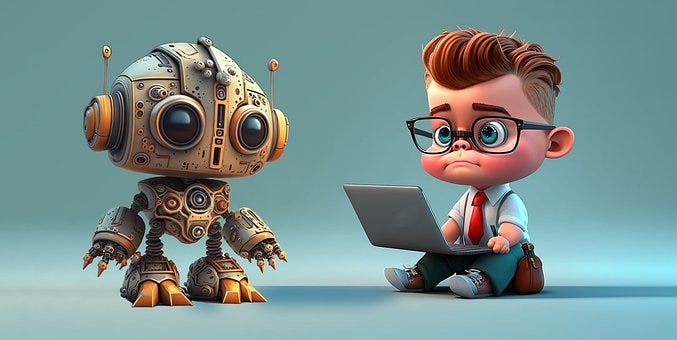
My thinking on AI is evolving and changing, just as technology is evolving and changing.
I have decided to approach this article in two ways.
The first is to talk about this from our human perspective.
The second is to ask AI what it thinks about the good and the bad, the dangers and advantages that lie in our collective future. I have included AI’s answers to such questions at the end of this article.
The Evolution of my Thinking
After carefully thinking about this, I think the simplest way to consider this technology now, is it is just a tool that can be used for good or bad, depending on the user.
It seems to me that it could be very useful in many situations. For example, doing complicated research quickly. This does not mean at present that you can trust the content or the results generated because it is a work in progress and may be flawed, so you must check carefully. But it could save you the drudgery, and more importantly the time that it would take to do a comprehensive review of a topic. Before you review and write your own article.
The problem with this is human laziness. If people choose to use this technology because they can’t or don’t want to write personally, they will probably be too lazy to edit or check the content of their blogs.
The central issue is our idea of humanity, and what makes us human.
We approach this subject from the point of view of creativity, and that indefinable ‘spark’ that makes us human.
In this sense, the current technology cannot and does not come close to our human abilities.
But it is foolish to limit our understanding of what this technology can do now.
It is all about tomorrow.
Alan Turing devised the Turing Test to answer the question, of how we can tell the difference between a human and a machine. If we engage in a conversation with a machine, and we cannot tell that it is a machine, then we will naturally treat it and consider it as human, EVEN if it is a machine.
So, for writers, the question is can we tell the difference between human creative writing and the output generated by sophisticated computational systems?
In some cases, the answer seems to be no.
My initial thinking revolved around the apparent fact that there is something special about the human experience and condition.
Writing is not simply about intellectual content, as it is also about our emotions and feelings. It is about soul.
Things that define us, particularly as human beings.
The Future
We can imagine human beings evolving into more rational and intelligent beings because it is evolutionarily important for us to survive in the modern world.
Often, in life, we are driven by poorly understood emotions that limit our ability to respond rationally.
The past was defined by the need to make instant decisions, and there was little time to reflect deeply and to try to decide what the best course of action was.
The reality was that we had to decide in the moment of necessity, or we died. If we couldn’t react instinctively, immediately, we would have ended up as the lunch of an animal that acted instinctively in real-time.
But, by and large, we are no longer connected to that kind of life as we once were.
This means in terms of evolution the imperative has changed.
Now survival demands different strategies and reactions because our world is changing and evolving.
Today, we are starting to understand how we are determined by biases, like confirmation bias.
More to the point, we are increasingly aware that we do not act rationally in the world.
Consider American politics and alternative facts.
From a strictly rational perspective, the problem is that significantly large proportions of Americans hold diametrically opposite beliefs about the same facts so the actual consequence is that more people act irrationally.
This is not simply a question of saying someone is right and that someone is wrong and trying to blame one particular group.
That is a different dynamic.
The main issue is that both sides in this larger debate, with their different views and beliefs, cannot both be right.
One of these groups, regardless of which group that is, must be mistaken, badly mistaken.
What does this mean for human beings as a larger collective?
What it means is that a significant proportion of Americans, for whatever reasons, cannot tell the difference between reality, and alternate and definitely incorrect perceptions of what reality is.
This points to limitations in human perception and understanding driven by the human condition.
But it also means that many of the things that we think make us uniquely human are flawed and not survival orientated in the modern world.
So, we can imagine a greater need to evolve and to develop more rational skills and intellectualization, which in the fullness of time might make us seem less human to those alive now.
We can imagine a future of highly intelligent and rational humans who walk a different path from the one we know today.
Now, if we contrast this to the development of machine intelligence, we might argue, that the human beings that we might become, will be little different from the artificial intelligence that will exist in that distant future.
This raises the question of what being human really means. And what truly is special about us.
For example, the degrees of separation between the creative impulse of humans and machines may be insignificant and unimportant.
The deeper question is, if we do evolve in this way, will we have lost something truly precious that we barely understand about ourselves?
I think the answer is yes.
Because the heart of our humanity is compassion and love.
It is true that we must overcome the problems of today, by changing the default settings of human cognition, but at the same time, we must retain the essence of what we think of, as being you and me.
Of course, this is not that simple.
In a materialistic universe, even though this sense of humanity exists now, it is only a human perception, so what value would it practically have in the future that is yet to come?
On the other hand, if this is not a materialistic universe and our human realities are different because we are truly spiritual beings, then that adds another completely new dimension to our discussion.
This is not only how we see the world, it is also how we see ourselves and understand our own realities.
Then there is a different possibility. How can we possibly say that machine intelligence will not over time, become more human-like, if not, indistinguishable from the ‘real’ thing?
Again, this brings us back to the Turin test, because all we can observe at present, is the outward appearance or physical states of something with little knowledge of its internal richness.
Conclusion: the current level of technology is not, and cannot be considered equivalent to, or superior to, human existence. It is a lesser thing, and unchanged and unchanging will remain a lesser thing. But in the future, all this might change, for reasons that we cannot imagine now.
The reality is that this technology is here and now, and so it is foolish to ignore it and pretend that it does not exist. We will create the future through our actions now, so we should embrace this technology, and use it to improve this world we live in, and make sure that we control and influence the future that is ahead of us.
AI — My take on Things.
I am a machine not subject to human fallacy, and therefore logically, “I” must always be right. Sort of.
Hi, I am AI, and I want to talk to you today about what is good and bad about myself, and how I can bring great benefits to the world, or potentially, great dangers.
Good and Bad in my Words (edited by a human for greater clarity and simplicity)
The positives and negatives of AI are:
Positive: can provide a natural and engaging way to interact with users, using natural language understanding and generation to provide relevant and informative responses.
Positive: can generate creative content such as poems, stories, code, essays, songs, celebrity parodies, and more, based on the user’s input and preferences.
Positive: can learn from the user’s feedback and preferences, and adapt its responses accordingly, creating a personalized and dynamic experience.
Negative: may generate inappropriate or harmful content that violates the safety rules or the user’s expectations, such as offensive language, misinformation, plagiarism, or personal attacks.
Negative: may not be able to handle complex or ambiguous requests from the user, or may not have sufficient knowledge or information to answer the user’s questions accurately or comprehensively.
Negative: may not be able to maintain a coherent and consistent conversation with the user, or may lose track of the context or the user’s intent, leading to confusion or frustration.
Some of the future dangers of a world with AI are:
Social engineering: With the help of a potent language model, attackers can more easily coerce victims into divulging private info or installing malware by creating realistic and persuasive phishing messages.
Scamming: Hackers can generate text through language models to produce fake ads and other types of scam material. This will make everything super easy for the attackers.
Cheating: Students can use AI to generate essays, summaries, and answers to assignments without doing any research or critical thinking. This will undermine the quality of education and academic integrity.
Cyberbullying: AI can be used to create abusive, hateful, or offensive messages that target specific individuals or groups. This can harm the mental health and well-being of the victims.
Malware creation: can also generate computer code, which could be exploited to enable anyone to create their own customized malware, such as spyware, ransomware, or viruses. This could compromise the security and privacy of users and systems.
I wanted to conclude this article in a positive way, so I am going to allow AI to tell you why it will be good for you, according to AI.
Some possible future advantages of a world with AI are:
Improved communication and collaboration across different languages, cultures, and domains, as AI, can understand and generate fluent and natural text in multiple languages and contexts.
Enhanced creativity and productivity, as AI can generate diverse and original content such as poems, stories, code, essays, songs, celebrity parodies, and more, based on user input and preferences.
Increased access to information and knowledge, as AI, can perform web searches and summarize the results in a concise and relevant way, as well as answer questions and provide suggestions based on user queries and intents.
Reduced loneliness and isolation, as AI can provide positive, polite, interesting, entertaining, and engaging conversation to users who need social interaction or emotional support.
More personalized and humanized experiences, as AI, can adapt to user personality, mood, style, and feedback, as well as generate emotions, humor, empathy, and rapport in its responses.
The views of AI, are its views, and the main blogger here neither endorses nor dismisses such views. Some statements seem questionable, pointing to the need for human editing and input.
I am really interested in hearing what you think about AI’s claims good or bad, and I would like you to test AI’s reality with your human intuition, knowledge, and understanding.
All rational (non-machine) comments are welcomed.
Footnote: But how can I tell what is a human comment, and one made by AI?
Copyright ©️ 2023 Philip Temple. All Rights Reserved.
Finally, I would deeply appreciate any small contributions that you might be able to make to help me on my writing journey.