
Art Collector Emily Fisher Landau:
From Victim to Patron (with the Help of Four Gentlemen)
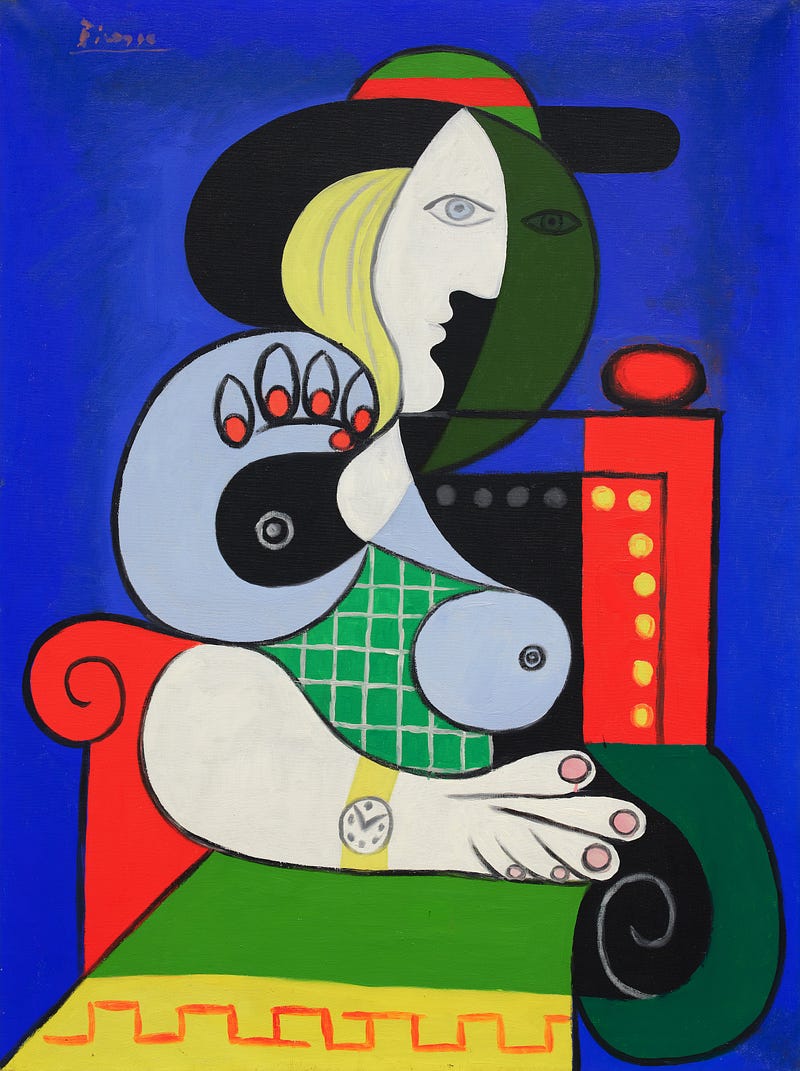
This weekend, Sotheby’s is auctioning the art collection of Emily Fisher Landau, a New Yorker who died in March at the age of 102. The estate is estimated to go for over $400 million.
In 2011, I had the pleasure of interviewing this extraordinary collector and arts patron and her daughter Candia Fisher.
Landau told me it had all started with a robbery; jewel thieves inadvertently begat one of world’s great contemporary art collections.
In the mid-1960’s, while she was lunching at the Plaza, burglars disguised as air conditioning repairmen, entered her East 69th Street apartment and snuck off with the contents of her brimming safe.
She had possessed major sets of jewelry, even some full parures in all the most desirable colors. When her late first husband, real estate legend Martin Fisher, wondered why she hadn’t at least been wearing her 37-carat solitaire diamond, she replied, “Who goes to a luncheon wearing a big diamond ring like that?”
She felt anguish at the time of the theft, yet no longer craved the dazzling stones.
When I met her, Landau, then still a beautiful woman at 91 years, was taking coffee in the sitting room of her elegant Park Avenue apartment (not the scene of the crime), Picasso’s spectacular 1932 “Seated Woman with a Wrist Watch” in red, green and gold on a blue background, was visible through a doorway, one of the breathtaking gems that eventually replaced the sapphires, rubies, emeralds and diamonds.
Sipping at a long cigarette, like a movie star from the 1940’s, Landau noted that the most glorious thing that could have happened to her as an art collector was having her jewelry stolen. “I got the money, as I was insured by Lloyd’s of London, and I didn’t want jewelry anymore, and I started collecting art. That’s going back a long time.”
There are more than 1200 pieces in the Fisher Landau Collection, although 419 works culled from this grouping have been bequeathed to the Whitney Museum of American Art, where Emily Fisher Landau had been a supporter for over fifty years and served as a Trustee.
Landau and her daughter, Candia, both with an abundance of russet-colored hair, and both keenly observed by Mishoo, a white Persian cat shaved like a lion, had worked assiduously with a team of curators to choose the pieces from the collection to be gifted.
Candia Fisher, who serves on the Photography Committee of the Whitney, explained, “We wanted to help fill in the Whitney’s — let us not say exactly void, but where they needed more in -depth collecting, — for their purposes, as well as for what would work for us to leave, so as not to just give them the top hits of our collection.”
Fisher continued, “It was much easier when Mother had two or three of something. For instance, with de Kooning, she had three, which remain with her (until the bequest). So she gave away one and kept two. So that was an easier decision than some things which were one-offs, where she only had one, but as I said, we worked with them to see what they were looking for. They wanted very badly a Barbara Kruger that she has.”
And yes, Kruger ‘s “Untitled(Hero)” is on the list of artwork to be gifted!
There was warm art market banter between mother and daughter, ping ponging words about an interesting piece coming up for auction by Claude Lalanne and a certain Robert Longo, Recent acquisitions then included work from Rudolf Stingal, and a slick black Michael Phelan declaring: “Shit happens rama rama”.
Both women were fascinated and amused by Andy Warhol’s latest auction results. Four of their own Warhols, including Landau’s striking 1984 portrait, were promised to the Whitney. (Another exemplar will be in the Sotheby’s auction.)
The Whitney determined that Landau would be adding major works that would enhance their collection by nearly one hundred key figures in American art, including Carl Andre, Richard Artschwager, Carroll Dunham, William Eggleston, Robert Gober, Peter Hujar, Neil Jenney, Jasper Johns, Glenn Ligon, Agnes Martin, Robert Rauschenberg, Susan Rothenberg, Ed Ruscha, Lorna Simpson, Kiki Smith, and Andy Warhol.
And, there would be multiple pieces from John Baldassari, James Rosenquist, Jenny Holzer, Terry Winters, Nan Goldin , Mark Tansey and…
From 1991 until 2017, Landau had an exceptional private/public museum space in Long Island City, Queens. The 25,000 square foot Fisher Landau Center for Art, housed much of her contemporary collection.
Inside, visitors were greeted by an Ed Ruscha canvas announcing, “THE ACT OF LETTING A PERSON INTO YOUR HOME, ”which now belongs to the Whitney.
The Center opened to the public in 2004, after a dozen years as an appointment only facility. The former parachute harness factory also served as an educational resource.
Each year, Columbia MFA students were granted a three week thesis exhibition in the Center, which features both artificial and natural lighting over three pristine floors.
Landau recalled, “When I bought the Center, I was keeping my art at Judson Warehouse and then I never got to see it. It went into storage and that’s the end of that. I had gone to London and I had seen what (Charles) Saatchi had done, and that gave me the inspiration to do what I did, buying the building in Long Island City. What a good move that was! Little did I know Long Island City would become what it became (a booming arts neighborhood.)”
Candia Fisher said, ”Some of the art was very avant-garde for a woman of a certain age to collect, like Keith Haring ‘Safe Sex’, things that were very explicit in sexuality, or like Glenn Ligan in his language. Now he’s quite established and it’s not so shocking. But when Mother was buying him, and you have a lot of his work, I remember being surprised, and I was a lot younger, at what you were collecting.”
Landau remarked on the sad fact that so many of those young artists whose work she embraced in the 1980’s were tragically lost to AIDS: Haring, Peter Hujar, Felix Gonzales -Torres, Robert Mapplethorpe, and David Wojnarowicz..
The names of four particularly fascinating gentlemen crop up often when Emily Fisher Landau discussed her history of collecting.
The Four Gentlemen
The first was the aforementioned Martin Fisher, who founded the Fisher Brothers real estate empire in 1915.
Turning to their daughter, Landau said, “The greatest complement Dad ever gave me was, ‘I made the money and you knew what to do with it.’ ” After the couple became art collectors in the 60’s, Martin Fisher’s wallet always contained a list of the artworks they had acquired together: work by Dubuffet, Picasso, Leger, Matisse, Giacometti…
The second fascinating gentleman was The Pace Gallery’s Arne Glimcher. whom she described as having been “instrumental” to her collecting.
I spoke to Glimcher who remembered, “Emily and I met in 1967 shortly after I moved into Imperial House on East 69th street. It was a building owned by her late husband Martin Fisher. She visited The Pace Gallery one day, we met and we realized that we both lived in the same building.… Her first acquisitions were amongst the greatest works in her considerable collection. She would come to the gallery to see works of art and I would send them home on approval after which I installed them and met with Emily and Martin to discuss the acquisitions, which almost always were consummated.”
Landau recalled being mesmerized by three paintings at Pace, and thinking ‘I’d be the luckiest girl in the world’ to be the owner of just one.”
Glimcher continued the story: “I had an extraordinary Picasso portrait of Marie Therese seated in an armchair, one of the greatest paintings of the period that I showed to Emily and instantly she fell in love with it. In addition she saw the great Leger Les Constructeurs painting, as well as a beautiful Mondrian.
“That was the first time that I took works to the apartment because Martin’s schedule would not allow him time enough to get out to the gallery. Emily told me that she thought he would buy one of them for her. I installed the works in the apartment and after dinner we went down to their apartment to discuss the paintings which resulted in Martin buying all of them.”
They remained in her collection. Years later, Glimcher added, “I had a major exhibition in ’79 of Rothko’s Seagram murals, These works differed radically from the classic sectional paintings that people were voraciously acquiring at the time. Most of the Seagram murals were sold to museums, but Emily was the only private collector to acquire a great work from the series. It demonstrated both her taste and her vision.“
That vision was always there. Emily Fisher Landau told me, “Nature gave me two gifts. One is that I had a tremendous amount of what I call street smarts. I always said you could drop me off at any city, leave me there for a short time and tell me what it is you want me to find and I can find it. And the other thing is, I have a great eye.”
Candia Fisher indicated another resource belonging to her mother, “And you were lucky enough to have the financial ability!”
Landau admitted to having suffered greatly from dyslexia, and established a foundation for people with learning disabilities.
Some years after the death of Martin Fisher in 1976, Emily Fisher Landau entered a second long and happy marriage, to clothing manufacturer Sheldon Landau (deceased, 2009).
But Sheldon Landau was not the third fascinating gentleman important to her art collecting.
No. That honor went to Bill Katz. Around 1980, dining at Soho’s Chanterelle, she was struck by the aesthetics of the restaurant, and having moved to the new apartment on Park Avenue, she wished to implement those particular aesthetics into her home.
She asked who had designed the restaurant and first heard the name Bill Katz. Designer/architect Katz became her dear friend and curator. She noted, “It was after I settled into the apartment that I got started on a whole new level of art collecting. That was Bill.”
Katz knew the artists, great established contemporary stars and cutting edge youth. Emily Fisher Landau was soon introduced to Cy Twombly and Jasper Johns, and became a collector of both.
Bill Katz introduced her to Ed Ruscha and she became his largest private collector. He noticed, “Emily was very attracted to Ruscha’s work. As a dyslexic, she’s very attracted to words.”
Ruscha told me, “I’m sure Emily was off like a rocket at a very young age, especially with all things art. She is the very definition of a dynamo.”
Emily Fisher Landau’s fourth fascinating gentleman is the estimable Leonard A. Lauder, Chairman Emeritus of both The Estee Lauder Companies and the Whitney Museum of American Art, to which, through his American Contemporary Art Foundation, he has donated works by artists including Rothko, Kline, Warhol, and Pollock, and an astounding $131 million dollars. (His legendary Cubist collection, worth well over $1 billion is now housed in the Metropolitan Museum.)
The two philanthropists met when Lauder was a teenager. When I spoke with him over the phone, he recalled, “My brother had been a classmate of her son Richard, who sadly passed away. And through Ronald’s friendship with Richard, I met his mother. And she was beautiful, and very young and very glamorous.”
Lauder was reacquainted with Landau when she joined him on the Whitney’s Board. “And her taste was incredible. Exquisite. And I often said to myself, ‘God, any contemporary of my parents has got to have my parents more conservative taste.’
“She had tomorrow’s taste, not yesterday’s or today’s taste. And I looked at her and her taste in everything with enormous admiration. Here’s a woman who is far ahead of her time, not of her time, but beyond her time!”
He continued, “ I looked at myself as her protector.
Leonard Lauder fondly remembered an art acquiring mission he shared with Emily Fisher Landau. “One of the dealers had a wonderful Cy Twombly painting from a period that we didn’t have in our collection. I called her up and said, ‘Would you mind coming with me. I want to look at this Twombly.’ And in truth, I didn’t want to bring a curator with me because a curator would have said ‘wonderful wonderful wonderful, buy it.’ I felt that her eye was cool enough and good enough, that she would say ‘buy it’ or ‘give it a pass’.
So off we went. We got into a car and drove downtown. We walked in and there it was on an easel. I looked at it and said, ‘That’s terrific. What do you think?’ She looked at it and said, ‘Mine is better’ and then left. That was it? Mine is better!
So eventually, she called me and said, ‘You know, since you didn’t buy that, I think I had better give you mine.’”


