
Does the Bible hate on gays with a weird old Greek word?
Let’s talk about ‘arsenokoita’
When you grow up Christian, they like to tell you that God is horrified by gays, and denounces them. Isn’t it clear in 1 Corinthians 6:9 and 1 Timothy 1:10?
Those are the lists of “bad people” as includes homosexuals. Or that’s what a Christian translation says. They don’t tell you about an ancient Greek word—ἀρσενοκοῑται or arsenokoitai—whose meaning is anything but clear.

The debate over the word began in 1980.
That’s the year a young polymath Medieval scholar named John Boswell published Christianity, Social Tolerance, and Homosexuality, as became something of a media bonanza.
At that point, ‘sodomy’, as it was called legally, was still against the law in many parts of America. That was thought to be religious law, enforcing the Bible’s ideas about ‘homosexuality’ being bad.
Boswell’s book was like a wrecking ball through Christian theology and tradition. He maintained that the anti-gay stance was relatively recent, and that the biblical origins were shaky at best.
A few vague usages of the word were found in ancient literature.
But arsenokoitai didn’t seem to refer to sex, much less same-sex sex.
All that was really known, really, was the word’s etymology, which was ‘man’ plus ‘bed’. Did that mean ‘sex’? In Christian history, the word, he wrote, was “associated with masturbation or general moral laxity.”
Only in the 13th century, with Thomas Aquinas, did the word become attached to gays. That happened, Boswell added, “in a work addressed to the Muslims of Spain.” Later translations had wandered around, as the arsenokoitai become everything from ‘child molester’ to ‘sissy’.
Boswell guessed that the word might refer to male prostitutes.
In English translations there’d been a puzzling range of variation.
The old KJV had translated arsenokoitai with “abusers of themselves with mankind” and also “them that defile themselves with mankind.”
In 1946, the RSV had arsenokoitai into ‘homosexuals’ — and also ‘sodomites’, though any connection to the Sodom narrative in Genesis was purely in the mind of the reader. The Bible supplies no such link.
A 1971 revision to the RSV shifted the translation to “sexual perverts.” In 2018, Kathy Baldock and Ed Oxford found the backstory. In 1959, a young gay seminary student had written the translators, protesting the RSV translation of arsenokoitai to ‘homosexuals’.
The translators wrote back, agreeing there was a problem—and in 1971, made the change quietly.
Christian traditionalists had to reply to Boswell.
The important context is that it was playing out as AIDS was becoming an epidemic. The traditionalists were in no mood to indulge any skepticism about the Bible’s views on gays. The AIDS epidemic was widely seen in Christianity as a new Sodom event, with God wiping out the hated homosexuals.
In 1984, David F. Wright, a Protestant historian at the University of Edinburgh (not, as he’d claim, a Ph.D.), took up the job of defending the traditional view. In his first paper on the subject, “Homosexuals or Prostitutes? The Meaning of ἀρσενοκοῑται (1 Cor. 6:9, 1 Tim. 1:10)” he announced the origin of the word had been unknown to Christian history, but was, he suggests, the text of Leviticus 18:22 and 20:13 rolled up into a word.
“And with a male you shall not lie a woman’s bed,” as that line went.
Paul might’ve used the word, Wright offers, as “a decently Jewish way of speaking” about gay intimacies.
Christians widely adopted the Wright theory.
There was little effort to probe the matter. I find myself with questions I’ve not seen addressed anywhere, like: Why had Paul encouraged Christians to not follow the Old Testament law—then re-authorized a single line of it through a very obscure word?
How were Christians supposed to adjudicate Leviticus 18:22? Because the verse is loaded with a death penalty.
Did Paul want gays executed? As often as I have heard Christians cite Leviticus 18:22 as an vital reference, with the arsenokoitai presumed to be a reference to that verse, I have never seen any stepping up to do their part.
“They are to be put to death; their blood will be on their own heads.”
Later Christians tried to tone down the anti-gay moralizing.
In the loose Message translation in 1993, Eugene Peterson had the arsenokoitia point to those who “use and abuse sex,” whatever that means.
But for the most Christians, it seemed to clearly mean ‘homosexuals’. The arsenokoitia, as commentators worked out, was Paul pointing to the “top” in a gay sex scene. In 1 Corinthians, after all, the word is paired with malakos, which means ‘soft’—so that’s clearly the “bottom.”
But was it? “Malakos can denote individual cowardice in battle,” notes the classics scholar Peter Hunt.
Scholars continued to discuss the matter.
In 1989, the gay Bible scholar William L. Petersen published a paper that described his search for all historical meaning of the word. Paul did have the first surviving usage of arsenokoitai, but later Greek writers who used it didn’t seem to be relying on him.
In the clearest usages, the offense the arsenokoitai commit seems to point to an episode in Greek mythology: Zeus with Ganymede, the beautiful shepherd. As Peterson writes:
“In the taking of Ganymede, Zeus is the model of someone who commits ἀρσενοκοιτία.”
More critiques were made. In a 2006 book, Dale Martin was skeptical that the etymology of “man + bed” really points to the meaning “homosexual.” He offers an example in the word ‘understand’. We might guess it means to ‘stand under something’.
In a 2011 paper, Alan Cadwallader had an even fiercer critique: “The Bible becomes little more than a killing field in and for the debate.”
What could ‘man’ + ‘bed’ mean?
Christians had assumed that ‘bed’ means people are having sex. Was there ever any evidence for that? The New Testament scholar John Granger Cook writes a 2019 paper on the arsenokoitia, and notes that ‘bed’ in a Greek word is often used in reference to sleeping.
The word ἡμεροκοίτης refers to ‘one who sleeps in the day’—maybe a bat. The word παγκοίτης means the ‘place which sleeps all’. This is a grave.
When I hear the word ‘bed’ in reference to the Bible, I would think it refers to a temple, as in Ezekiel 23:17 (cf. Isaiah 57:7, etc.). In a sacred context, one seems to be thinking of a meeting with a deity. An early Christian text called the ‘Acts of John’ has Jesus saying to the disciples:
“Thou has me as a bed, rest upon me.”
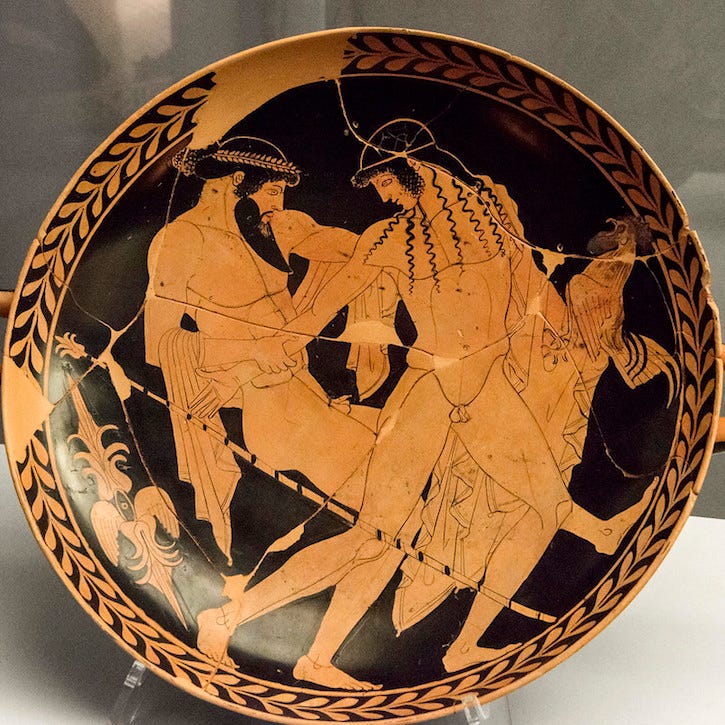
The crime happens when Zeus seizes Ganymede.
I think back to William L. Petersen’s framing of the arsenokoitia debate, and try to follow it from there. If the crime is Zeus seizing Ganymede, then what is the crime?
Is it that, in having sex, both Zeus and Ganymede were male? That seems to be the Christian view. It seems odd, however, to just ignore that Zeus is a deity and the location of the sex is Olympus—and that the sex is forced. Ganymede is kidnapped out of this world.
Then it’s not clear the young man and the god were having sex. Christians like to think everyone “bad” is having sex, but that isn’t always so. As the classicist Vernon Provencal details in a 2005 paper on the Ganymede myth, “Glukus Himeros: Pederastic Influence on the Myth of Ganymede,” in the original myth, Zeus and Ganymede aren’t sexual.
The reason that Zeus wants to take Ganymede to Olympus is because the shepherd has godlike beauty. As Provencal writes, “there is little sense that he is sexually attracted to the youth, whose beauty appeals to all the gods.”
For Zeus to take Ganymede out of this world is an effort by the god to enforce a gap between gods and humans. The young man is no longer beautifying the human race, no longer available to human lovers, and is no longer available to suggest that humans can be godlike. He has been stolen.
Could the problem be…theft?
It may be that Paul himself provides more evidence to the word’s meaning than has been noticed. The list of crimes in 1 Timothy 1:9–10 is arranged in a very particular way. “Note how carefully this list follows the canonical order of the Decalogue,” notes Reginald H. Fuller in another context.
The list of ‘vices’ in 1 Timothy 1:9–10, that is, tracks with the Ten Commandments. To correlate that passage with Exodus 20:1–17, and try to find the category for the arsenokoitai, we might see this:
“Honor father mother” ➤ “those who kill their fathers or mothers” “Murder” ➤ “murderers” “Adultery” ➤ “sexually immoral people” “Steal” ➤ “arsenokoitai, kidnappers” “False testimony” ➤ “liars, perjurers”
The arsenokoitai seem to fall under the domain of ‘stealing’.
Could the crime be taking humans out of the human world?
The Christian scholar Theodore W. Jennings., Jr., in Jacob’s Wound: Homoerotic Narrative in the Literature of Ancient Israel (2005), agrees that Zeus and Ganymede is providing the context for defining the arsenokoitai.
The Bible has a narrative of a deity taking great favor in a beautiful young shepherd—YHWH and David. But, as Jennings writes:
“YHWH does not extricate his beloved from the world of mortals. David remains a character in the social and political history of humanity.”
The spiritual crime Zeus that commits, when becoming an arsenokoitai, might then be the removal of humans from the world of humans.
What could this mean for Paul? How about religious staff for temples? Perhaps Christian leaders are meant to be, not in elite, isolated spaces, but among humans.
Perhaps all the ‘crimes’ in the lists he provides are done by deities, or characteristic of deities.
It’s not like anybody knows what these references meant.
Christians may continue to say that anal sex between men is criminalized.
For me, it comes down to this: If they wish to say that Leviticus 18:22 is to be enforced, then let them prove it by executing people, as required by Old Testament law.
If they don’t, then did they believe it? 🔶


