
Arrogant, Spiteful, Lazy= Yes That’s Me
Embrace your shadow to begin the path to self improvement

I am arrogant. I am spiteful. I am temperamental. I am lazy.
I am also kind, intelligent, a planner, and insightful.
Carl Jung would say the negative parts of my personality are a part of my shadow. I have struggled to be conscious of my shadow and to understand the side of me that can harm myself and others. If you hare able to confront and honestly examine this part of yourself, you will be on your way to improving yourself in whatever you want to do.
Unfortunately there can be no doubt that man is, on the whole, less good than he imagines himself or wants to be. Everyone carries a shadow, and the less it is embodied in the individual’s conscious life, the blacker and denser it is. If an inferiority is conscious, one always has a chance to correct it. Furthermore, it is constantly in contact with other interests, so that it is continually subjected to modifications. But if it is repressed and isolated from consciousness, it never gets corrected. — Carl Jung
Discovering your shadow
The first time I was consciously aware of my shadow was when I was in college. I hung out with two girls who were best friends. One day we had a big fight and none of us were talking. I was angry, hurt, and was hungry for revenge (for what reason, the sands of time have buried).
I sat down at my computer and wrote out a really nasty email to both of them. I basically took all their insecurities and fears and said they were bad people. After they read the email they didn’t speak to me for months.
I was ashamed.
The momentary sense of power I had over them was short-lived. I thought I had lost two of my good friends over a stupid email.
When I reflected on what I did, I was afraid. There was something in me that scared me.
Some perceived slight caused me to lash out. I was spiteful and temperamental.
I was lucky that they later forgave me and we continued to be friends.
Viewing yourself objectively
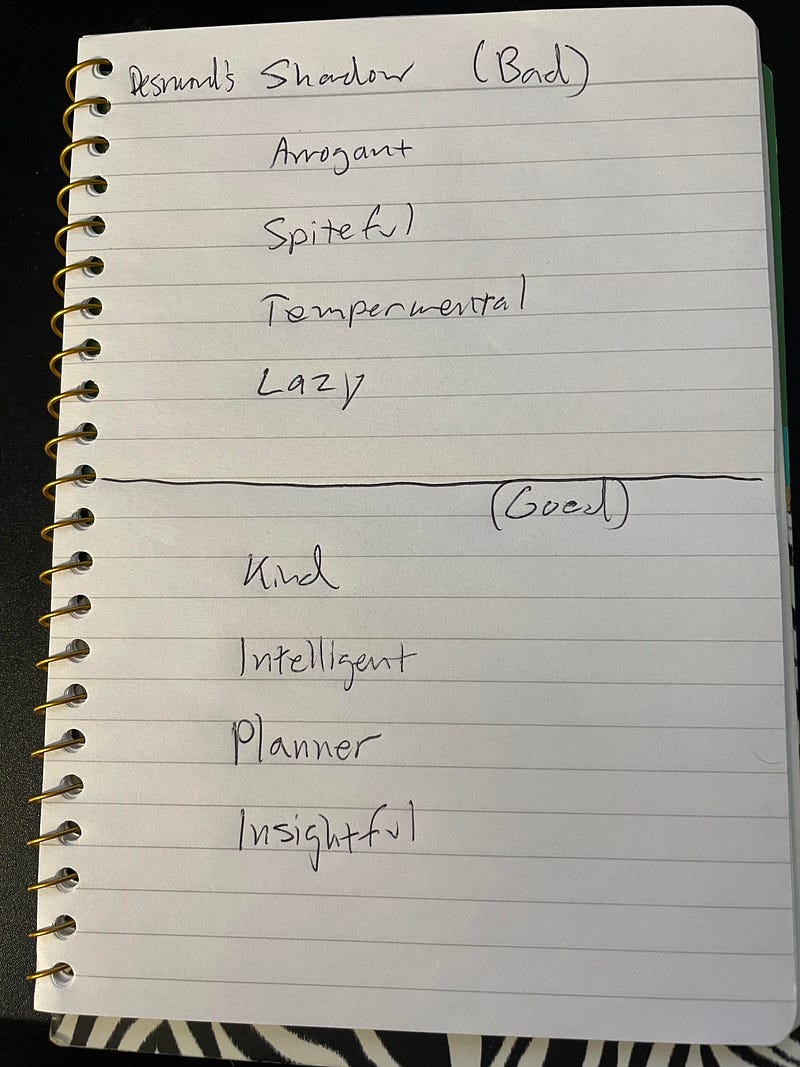
I was doing some research on Jung’s shadow, and I found a website that said you should write out a few negative adjectives that describe you. Then you should repeat saying them.
“I am spiteful. I am spiteful. I am spiteful. I am spiteful. I am spiteful.”
Then when it doesn’t hurt, you can say something like
“Yes, I am spiteful, but I am also kind.”
Next you can write out a few positive words that describe you.
I chose: kind, intelligent, a planner, insightful.
I can do the same thing with these words.
“I am insightful. I am insightful. I am insightful. I am insightful. I am insightful.”
“If you imagine someone who is brave enough to withdraw all his projections, then you get an individual who is conscious of a pretty thick shadow. Such a man has saddled himself with new problems and conflicts. He has become a serious problem to himself, as he is now unable to say that they do this or that, they are wrong, and they must be fought against… Such a man knows that whatever is wrong in the world is in himself, and if he only learns to deal with his own shadow he has done something real for the world. He has succeeded in shouldering at least an infinitesimal part of the gigantic, unsolved social problems of our day.” — Carl Jung
Conclusion
Why should you get to know your shadow? Wouldn’t it be better if I just thought of myself as a saint? Jung would say that the only way we can improve the world is to confront our shadow. To improve the world, we must come to terms with our shadow.


