
Philosophy | Reading | Success
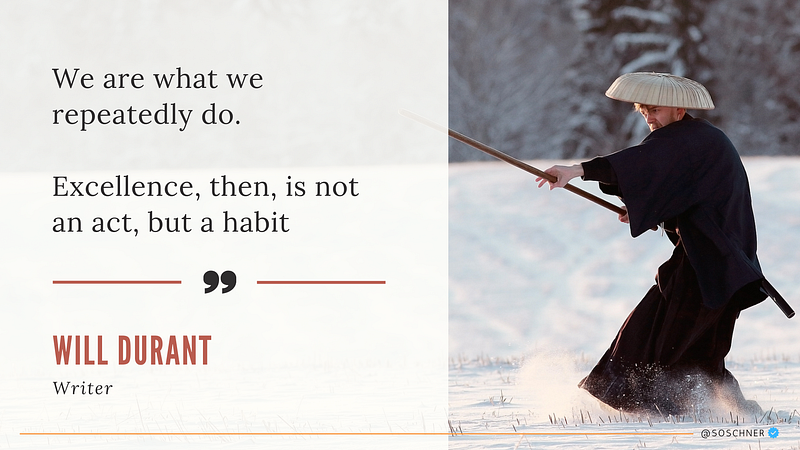
Aristotle Never Said, "We are what we repeatedly do. Excellence, then, is not an act, but a habit."
… but it doesn't matter, and here is why
When I was in my twenties, I tried figuring out how to make it.
Spoiler Alert: I am still working on figuring it out.
The biggest questions I had:
- How can I create success in my life?
- How do I find the activities that help to enjoy my day?
- And how can I make it last?
I believe similar questions many twenty year old's have — still today.
It is a generational thing.
In my late teens and early twenties, the Internet went public. It was 1993 when the CERN Institute decided to put the WWW into the public domain.
It was the beginning of the rise of the Internet that changed our society forever.
From one day to the other borderless global communication became a reality.
The most logical thing to do was:
Going online to find answers to life's most pressing questions:
How can I create a happy and fulfilled life?
These days I studied at the University of Graz and enjoyed learning ancient Japanese martial arts, as well as running.
The world was a loud place, and meeting people came with many advice. But what was the right one?
On one of those days, I stumbled across the quote:
“We are what we repeatedly do. Excellence, then, is not an act, but a habit.” — Aristotle
Success isn't created by chance
It was a revelation that answered many of my questions. Success isn't something that comes accidentally, and it is projectable.
It is what people repeatedly do that defines the result after decades.
Since I started training in Japanese martial arts, I also asked the teachers about their opinion on Aristotle's quote:
“Trust in the process of training”, were their responses — summarized.
People who want to move faster toward their goal of becoming a Ninja or Samurai must dedicated more time to training; people with other goals might be better off with less training.
No matter how you turn it in, if someone wants to excel in a field, they must dedicate sufficient time to practice in that field.
10,000 hours rule
For his book "Outliers" Malcolm Gladwell analyzed the lives of the most successful people on earth.
He described that achieving proficiency in a complex skill takes about 10,000 hours of dedicated training. Doing is what matters the most.
It resembles the theme that Aristotle's quote has put into his words:
You become what you repeatedly do
When I look at the most successful people they all stick to a few essential habits:
- Warren Buffett loves investing; that's why he reads a lot. Mostly quarterly and annual reports — 500 pages every day.
- U2 is well known for their music because they dedicate their lives to it
- Tim Denning is well available for his writing on Medium, and he publishes 1–3 times per day
Go through your own life, identify the most successful people and ask yourself, what they repeatedly do in their lives.
Success then becomes easy and reproducible.
When people like Aristotle, Martial Arts Teachers, or Malcolm Gladwell are right, then success is a simple process:
Identify your goal
The first step is to figure out what someone wants to become.
Find the 5 essential habits.
When I talk with artists, musicians, Investors, or whatever skill you want to enter, how they created their success, they usually refer to a few simple habits they practiced daily.
It is like Bruce Lee said:
I don’t fear the man who has practiced 10,000 kicks once, I fear the man who has practiced 1 kick 10,000 times.
Execute daily
There is no shortcut.
- People who want to be writers need to write.
- People who want to invest, need to gain experience with investments
- People who want to be a great guitarist like Jimi Hendrix, The Edge, or Eric Clapton
There is no way out, even when someone says they have a shortcut. They don't exist.
Be easy on yourself
Atomic Habits author James Clear points out, that mastery doesn't need giant leaps right from the start.
On the contrary, doing too much too quickly can easily break the motivation, which initially was high. Progress takes time, and when progress differs from the amount of work people put into, the chance to lose motivation is high.
Practicing a new skill 5 minutes per day is more beneficial than doing one hour once a week.
Start small and add 1% per day, week or month, depending on your own goal.
But Aristotle never said something like that
Coming back to the title, I stumbled over an article a couple of years ago that stated that Aristotle never said:
“We are what we repeatedly do. Excellence, then, is not an act, but a habit.”
Frank Herron corrected this misattribution that sticks on many web pages these days:
In part VII of that book, dealing with “Ethics and the Nature of Happiness,” Durant sums up some of Aristotle’s thoughts. After quoting a phrase from Aristotle’s Nicomachean Ethics (“these virtues are formed in man by his doing the actions”), Durant sums it up this way: “…we are what we repeatedly do. Excellence, then is not an act but a habit.”
Will Durant wrote about Philosophy and put the work of Aristotle in his own words. Wikipedia emphasizes the same.
Does it matter?
Does it change anything?
No, not in my life.
I am thankful for the misattribution as it led my attention to the quote, that I otherwise would have missed.
In its essence, it doesn't change anything and still holds today:
- Define your goal
- Figure out the 5 critical habits from role models
- Execute daily
- Repeat
Did you enjoy the content?
Then you can do the following:
- Clap a couple of times and leave a comment.
- Check out my other profiles,
- Sign up for my deep tech newsletter,
- Subscribe to my medium profile for frequent updates
This article is for informational purposes only. It should not be considered Financial, Investment, or Legal Advice. Consult a financial, investment, or legal professional before making significant decisions.


