
Are You Willing to be Relentless?

“Being relentless means demanding more of yourself than anyone else could ever demand of you, knowing that every time you stop, you can still do more.” — Tim Grover
Relentless, by Tim Grover, promises to show you the secret of superstars that are the best in their fields. It can be summed up by the title — those people all have a relentless drive to succeed.
His particular expertise is with training basketball players — he was the trainer for Michael Jordan, LeBron James, and Kobe Bryant — but his work is applicable to fields as different as plastic surgery, flying combat helicopters, and high school teaching.
He repeatedly emphasized that the people who make it, who become the greats in their field, are willing to sacrifice everything else in relentless pursuit of excellence. They are never satisfied. No matter what their achievements, they want to reach higher, or go farther.
After reading this book, I was forced to face the truth that I will never be the greatest in my chosen field. I am not what he terms a Cleaner.
If you read that description, and also thought, “That’s not me,” that’s okay. Because being the best in a field is not the only goal worth having.
Going narrow versus going wide
“You don’t become unstoppable by following the crowd, you get there by doing something better than anyone else can do it, and proving every day why you are the best at what you can do.” — Tim Grover
Grover describes many of his clients. He states with pride how these athletes sacrifice friends, family, hobbies, and all the other aspects of their lives in pursuit of excellence in their field. They don’t just go to the gym every day. They go to the gym multiple times every day.
Think of your life as a mountain. If you’re happy at the bottom of the mountain, your life is incredibly wide. But as you go higher and higher up the mountain, your life gets narrower and narrower. By the time you reach the peak, there’s barely enough room for you to stand. There’s no room for anything else in your life but being the best.
Do you want that? I sure don’t.
I want a well-rounded life, where I have a vibrant and fulfilling marriage, and routinely spend quality time with friends.
One where I have the leisure time to dedicate to reading and learning new things. They may never have a bearing on my career but it makes me a better person.
I want to be good at my chosen field, sure. I even aspire to be very good at it. I’m willing to put in the work and the dedication and the practice to grow my skills as a writer, as a teacher, and as a coach.
But I’m never going to be relentless. I never want to sacrifice something else that I value for the sake of being just a little bit better.
There are tradeoffs, of course. Will I stay in my office researching my next blog post instead of parking myself in front of the TV with my husband to binge watch a series for a few hours? Absolutely. In a heartbeat.
But I still make his dinner. We still eat together and talk about our day. I’m not giving up on him, just the television.
You’re probably the same way. There are things you do that are time wasters or don’t really move your life forward. You’d be willing to stop doing those things — or stop doing them as much. But you wouldn’t be willing to stop doing the things that matter.
Incremental progress toward greatness
“Just keep working at it, and you’ll get there…is wrong. The right sort of practice carried out over a sufficient period of time leads to improvement. Nothing else.” — Anders Ericsson
The good news is, being mediocre or having a relentless drive to excel are not your only options. The book Peak, by Anders Ericsson and Robert Pool, offers a third option.
If you want to get better at something, as long as there is someone who has achieved what you want to achieve, there is a specific method of practice that will allow you to do it. This goes for physical endeavors as well as purely mental ones.
The key is that you need to use deliberate practice. You need to isolate exactly what you want to improve. For example, it’s not enough to say you want your golf game to improve. It’s not even enough to say you want more of your drives to land on the fairway.
You have to narrow it down to, “I am hooking too many balls. I want to adjust my swing so more of the balls will go straight.” Then, you can practice that one particular element.
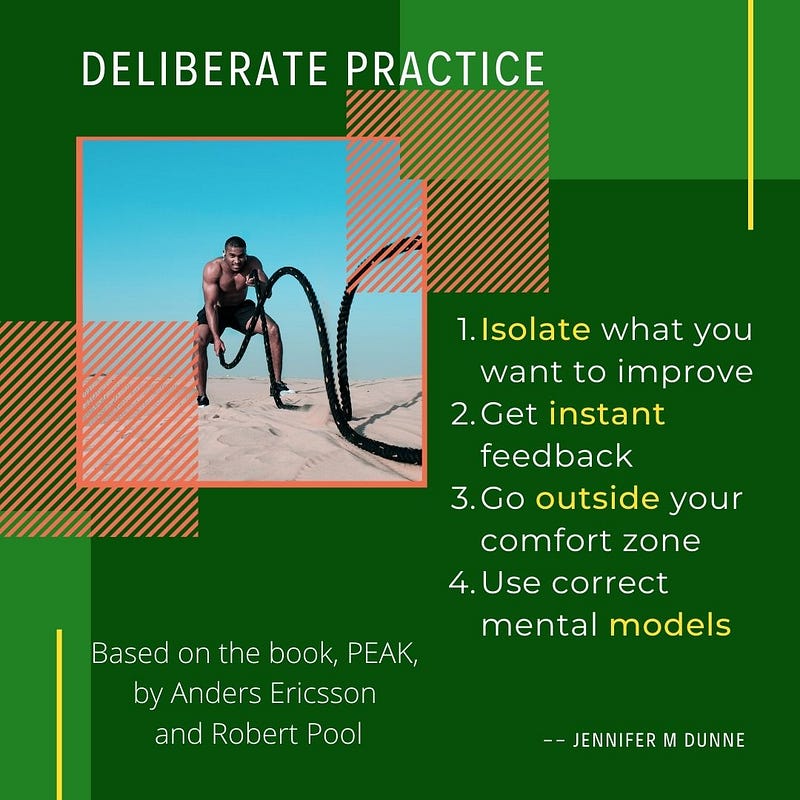
You also need to have instantaneous feedback. You take the shot. Did it hook or go straight? Then you know right away if that particular swing was correct or not.
Compare that to hitting a bucket of 100 balls at the driving range. You can’t see where each one lands, but someone is keeping track for you. At the end of the session, they tell you, “Pretty good! 60 of your shots went straight, and only 40 hooked.” How would that help you? You’d have no idea which shots, and therefore which swings, were correct.
You also have to practice outside of your comfort zone. You need to be practicing just a little bit past your current level of abilities. Not too far above your current level, but enough that you can be expected to reach the target at least some of the time.
Finally, you need to have proper mental representations of what you’re doing. Going back to the golf swing, you don’t want to be swinging and swinging until someone tells you, “Yes, that one. Swing so it feels like that.”
You want to know you’re supposed to hold your arm like this, position your feet like that, move the club this far, and then swing it like so. And eventually, you’ll recognize how it feels to do all of those things correctly. But you have a mental model of what you’re supposed to be doing before your muscle memory makes it automatic.
Conclusion
If you want to be the best in a particular field, from surgery to shot putting, you need to have a relentless pursuit of excellence. Never be satisfied with what you have already achieved, and always strive for more. Dedicate every aspect of your life to that pursuit.
If you want to be very good in a particular field, or even just better than you are now, you need to use deliberate practice. Break down the skills you need into fundamentals of the activity, and slight upgrades to those fundamentals. Practice just outside of your comfort zone to incorporate those improvements into your mental models of the activity.
Ready to have a better tomorrow?
I’ve created a cheat sheet to help you gain control of your life, increase your confidence, and become optimistic about the future. If you follow this daily, you will change your life very quickly!


