Are You Virtually Dead Before The Deadline?
Blame it on PROCRASTINATION

I don’t have a personal preference for time-tables. I have to confess I work on my whim, devoting time to stuff I find intellectually or emotionally stimulating. Well, at times, that comes off as a deterrent because I fail to stick to the rules — something that is expected of me 24*7 — me, being a junior resident!
A few days back, a friend of mine was hell bent on following his self-made study time-table without fail and he was clueless about how he’d stick to it for long. Of course, I reiterated he had sought help from the wrong person. He remained unconvinced about this though. I’m not sure if this turned out to be a positive reinforcement for my writing goals. But this actually did get me thinking about ‘procrastination’.
The Bard of Avon in Henry V (Act 4, Scene 3) writes, “All things are ready if our minds be so.” So, this implies there must be a psychological basis behind ‘procrastination’.
As early as 500 BC, Lord Krishna warns against procrastination in The Bhagavad Gita, the most sacred text of Hinduism.
The mind is a perpetual procrastinator — it postpones our resolutions to someday, then some decade and then some lifetime. Chapter 18 | Verse 28.
Hamlet is also seen postponing action for most of his self‐title play with eloquence including his soliloquy starting with “To be or not to be, that is the question”.
Thus, the emotional component underlying this human trait cannot be written off.
Procrastination as we know it now
van Eerde in 2003 gave the best definition for ‘procrastination’ as the delaying of a task that was originally planned despite expecting to be worse off for the delay. True procrastination is a complicated failure of self-regulation: experts define it as the voluntary delay of some important task that we intend to do, despite knowing that we’ll suffer as a result.
In the words of Joseph Ferrari, a professor of psychology at DePaul University, “While everybody may procrastinate, not everyone is a procrastinator.”
Even though after the Industrial Revolution, ‘procrastination’ assumed the image of an ‘evil phenomenon’ as more stringent schedules based on industrial production discouraged delay, it was still considered synonymous with laziness by most of the psychologists and the general population. It was not until 1984 that the first study addressing the reasons students procrastinate was done by a pair of prominent psychologists, Linda Solomon and Esther Rothblum of the University of Vermont.
There are conflicting views on the subject. The sympathizers of procrastination tend to believe that pressure-cooker like situations in life bring the best out of them. We often hear them say it doesn’t matter when a task gets done, so long as it is eventually finished.
Procrastination in the academic realm has many negative consequences including lost time, increased stress, lower grades, poorer health, decreased long‐term learning and lower self‐esteem. Chronic procrastinators have perpetual problems finishing tasks. Initially there seems to be a benefit to procrastination, as these students have lower levels of stress compared to others as they put off their work to pursue more pleasurable activities. However, in the long run, procrastination is really a self-defeating behavior. (Tic and Ferrari, 2000)
Needless to say, since the turn of the century, there has been a rise in procrastination. This can be attributed to two factors. Firstly, an easy access to modern technology which serves as a distraction, unnecessarily delaying the task at hand. Secondly, modern values like hard work, security and prosperity are co-existing with the post-modern values like tolerance, appreciation of social contacts and self‐actualization. Since there is limited time to pursue different academic and leisure activities, it leads to a motivational conflict between the two. Postmodern value orientation has been positively linked to academic procrastination.
Much to do with the frontal lobe
The idea is that procrastinators calculate the fluctuating utility of certain activities: pleasurable ones have more value early on, and tough tasks become more important as a deadline approaches. (Psychological Bulletin, 2007).
Since studies have found procrastinators carrying accompanying feelings of guilt, shame, or anxiety with their decision to delay, it brings me to the emotional basis of procrastination lurking underneath. ‘Task aversiveness’, as referred to in the Temporal Motivation Theory, is another word for lack of enjoyment. Those are feeling states.
Generally, people tend to learn from their mistakes. However, in chronic procrastinators, this feedback loop seems to be missing. An explanation for this behavioral paradox seems to lie in the emotional component of procrastination. Procrastinators comfort themselves in the present with the false belief that they will be more emotionally equipped to handle a task in the future. In short, they dread coming in terms with their ‘future self’.
Our frontal lobe takes care of a number of processes. These behaviors — problem-solving, planning, self-control — fall under the domain of executive functioning. To understand the neuropsychological basis of procrastination, Rabin and colleagues gathered a sample of 212 students and assessed them first for procrastination, then on the nine clinical subscales of executive functioning: impulsivity, self-monitoring, planning and organization, activity shifting, task initiation, task monitoring, emotional control, working memory, and general orderliness. Procrastinators showed significant associations with all nine, Rabin’s team reported in a 2011 issue of the Journal of Clinical and Experimental Neuropsychology. This was suggestive of ‘subtle executive dysfunction’ in people who are otherwise neuropsychologically healthy.
Undeniably, procrastination is the “quintessential” breakdown of self-control.
Temporal Motivation Theory a.k.a. The Procrastination Equation
Motivation = (E X V) / (I X D)
- Motivation for a task is driven by its utility i.e. how desirable it is to complete. Human nature dictates that more desirable tasks will be completed first while less desirable tasks will be delayed.
- The expectancy of the task (E) refers to the chance a certain outcome will come about.
- The value that task holds (V) refers to how rewarding the task is while performing it.
- Basically, a task that is pleasurable and has a good chance of success will usually be completed.
- Delay (D) refers to when the activities is performed. Enjoyable activities that are immediately realizable will have a short delay and thus a high utility while activities in the distant future have longer delays and have a low utility and low motivation.
Now, let us break each variable further.
- The expectancy of a task (E) is linked to self‐efficacy. Self‐efficacy refers to a person’s belief in his or her ability to achieve a task at hand.
o In academics, self‐efficacy has shown to increase academic performance and has an inverse relationship with procrastination. However, the impact of self‐efficacy is most felt when the task is specific rather than general.
- The value of a task (V) is represented by: task aversiveness, need for achievement and boredom proneness.
o Since people tend to avoid unpleasant tasks, task aversiveness has a positive relationship with procrastination.
o The need for achievement has a negative relationship with procrastination.
o Boredom proneness has a positive correlation with procrastination. Boredom proneness increases task aversiveness. It increases the likelihood that a variety of tasks will be found boring and unpleasant.
- Sensitivity to delay (I) can be linked to four separate variables: distractibility, impulsiveness, lack of self‐control and age.
o Increased distractibility, impulsiveness and a lack of self‐control increases the sensitivity to delay which causes the utility of a task and hence motivation to decrease.
o Age, has a negative relationship with procrastination. With age, people gain experience and most of them can better evaluate the benefits of the present and future, leading to a decline in the hyperbolic discounting of time.
- The delay of a task (D) is determined by: timing of rewards and punishments, organization and the intention‐action gap.
o The more time there is between the task and the reward or punishment, the more procrastination there will be.
o People who can set solid goals and keep a schedule will procrastinate less.
This probably is a major take-away tip for me and a word of relief for my friend!
o The intention‐action gap refers to the failure to live up to one’s expectations and has a positive relationship with procrastination.
A classic example drawn from real life
A college student named Tom Delay has been assigned an essay on September 15th which is due on December 15th. Until December 3rd, the utility of socializing surpasses that of writing as the reward of writing is temporally distant while the reward for socializing is present immediately. However, on December 3rd, the utilities switch as the deadline nears.
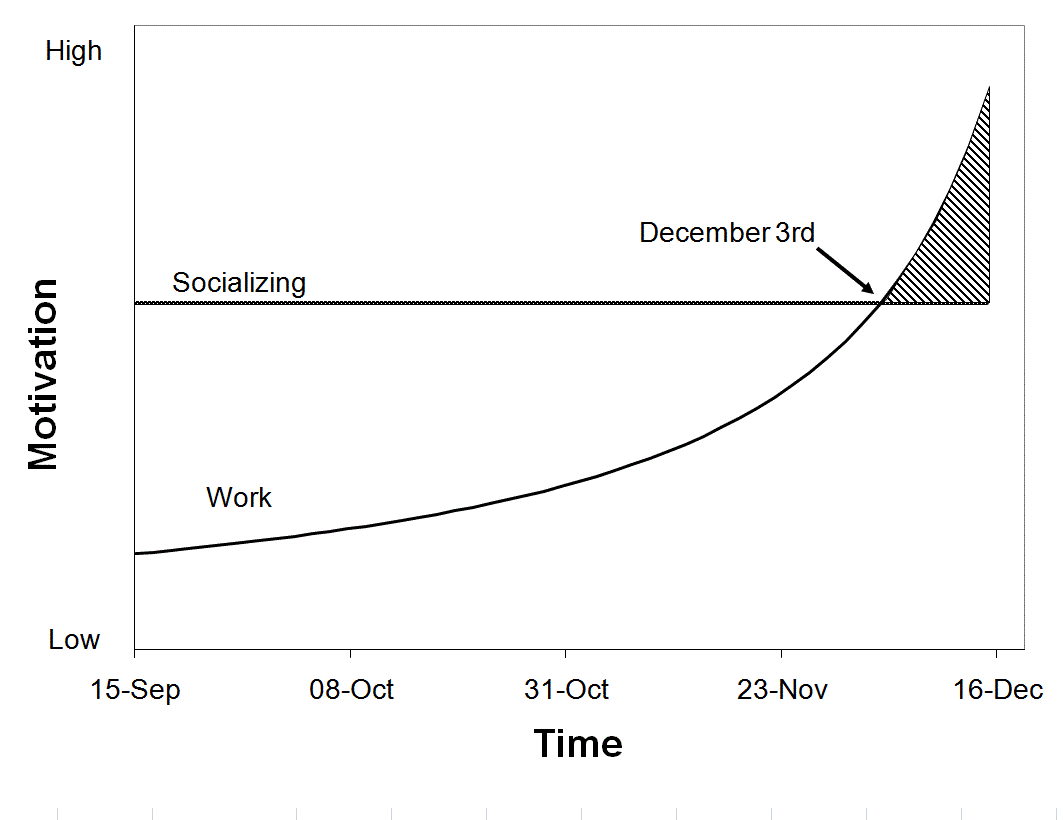
If graphed, the curve is shaped like a hyperbola, which led to this phenomenon being called the hyperbolic discounting of time.
The Temporal Motivation Theory is the most valid theory of procrastination today. It incorporates the self‐regulatory and self‐efficacy theories and accounts for task aversiveness and the hyperbolic discounting of time.
References:
- Why Procrastinate: An Investigation of the Root Causes behind Procrastination | Thakkar, Neal 2009–03 | Downloaded from OPUS, University of Lethbridge Research Repository
https://hdl.handle.net/10133/1241
- Why Wait? The Science Behind Procrastination | Eric Jaffe | Observer | March 29, 2013


