
PERSONAL GROWTH STRATEGIES & STORIES
Are You Still Missing Deadlines?
Former General & US President Dwight D. Eisenhower created this matrix to help him prioritize his career
In 1954, U.S. President Dwight D. Eisenhower quoted Dr. J Roscoe Miller, president of Northwestern University —
“I have two kinds of problems: the urgent and the important. The urgent are not important, and the important are never urgent.”
“Eisenhower Principle” is how he used to organize his workload and priorities.
In today’s world, almost everything is urgent. That can lead to the urgency trap. We can get stuck working only on urgent activities and ignore the important ones. The Eisenhower or Ike Matrix helps us get out of that trap.
When I was leading the marketing and sales divisions of a startup, we had dozens of projects, leads, and activities coming our way. On top of that, we had to create strategies for marketing, revenue and channels. Ike/Eisenhower Matrix helped us manage all of that better. What’s Important?
Important are the tasks that get us closer to our goals. For example, for B2B sales manager, a meeting with a new potential client is an important activity that can result in eventual revenue.
What’s Urgent?
Urgent is an activity that requires immediate attention. They are often associated with crisis management, adapting to new needs, or late reaction to an existing problem. For example, for a digital marketing manager, scheduling today’s posts for social media is urgent.
How Eisenhower Matrix works
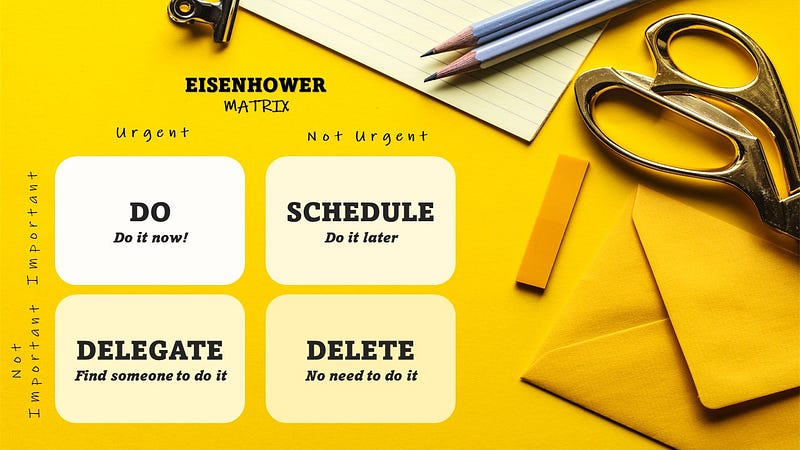
As you can see from the chart above, there can be four types of activities. Depending on where the activity falls, we can decide our next course of action
Important & Urgent
For activities that are both important and urgent, we must do that as soon as possible. These are activities that are aligned with the overall goal and have to be done immediately.
For example:
Let’s assume you are a brand manager. You have a press conference today for a new advertisement campaign. Preparing for that conference is bot urgent and important for you.Important but not urgent
This group of activities has to be completed as they help achieve our goals. But they can be scheduled for later.
For example:
As a brand manager, you have another product launch lined up for six months from now. It’s not urgent as of now but you need to make sure you are doing all activities on time to stay on track.Urgent but not important
If possible, this kind of activity should be delegated. Sometimes they do need some involvement. But these kinds of activities usually create the urgency trap. You keep on moving from meeting to meeting without getting anything important done.
For example:
Your advertisement campaign hurt the sentiments of some social media users and they are badmouthing your company. You need to craft a response and control the negativity.Neither urgent nor important
These activities are not worth your time. While the model suggests deleting them, you may consider delegating or reassigning them too. It’s possible these activities will be important for someone else but somehow have penetrated your task list.
For example:
Although you are a brand manager, your IT team asked you to user test an app they developed for the HR team. It’s not important or urgent for you. You can say no and recommend them to bring someone from the HR team.How to use Eisenhower Matrix
- For each of your activities, assign a deadline and an urgent zone. If it’s a 1-day activity, it should enter the urgent zone at least 3 days prior to the deadline.
- Similarly, write important/unimportant beside each activity.
- If you have accepted the job that is neither important nor urgent, discuss again to reassign to someone else
- Maintain an excel file or download an app to prioritize according to the matrix. I use an app named IKE for this purpose.
Final thoughts
As you can understand, the most important activity for you is to identify what’s your goal. Once you know that, you can get out of the urgency trap and avoid useless activities. But if you are not aligned with your goals, then someone else will hijack your time.
Once your activities move into the urgent boxes you’d know that you need to get them done without any sort of procrastination.
If you like this article and want to read more such articles without any restrictions, you can consider becoming a Medium member (if you are not one already) by using my referral link below.
I get a portion from your monthly fee at no extra cost to you and it will go a long way in supporting me as a writer.
You can also buy me a ‘coffee’ if you’d like.


