
Are You Sitting Comfortably?
A brief history of the Eames Plastic Side Chair
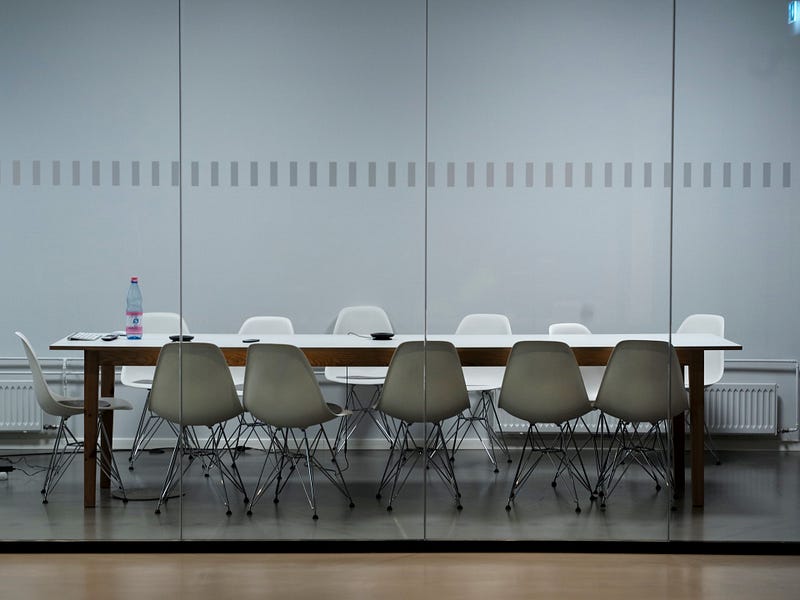
One day, a man drove a truck halfway across the country and up my driveway to drop off six Eames Plastic Side Chairs. Neatly wrapped, brand new, licensed models by Vitra.
Could it get any better?
Yes. They were free.
Up till then, online raffles and surveys had materialised me a handful of book vouchers, cinema tickets and a coffee maker. Surprising what personal data is worth to a marketer. In my case, I assume the design retailer, Donum needed to free up space and generate some buzz while they were at it.
So here I find myself, cradled in living history by a stroke of luck.
That is how I got there. But how did it get there?
How were chairs made before the advent of plastics? You could choose from sawn, milled, hewn, bent, woven or forged. All that changed when new production methods and materials enabled the creation of furniture that more readily adapted to the human form.
But first, let’s start with the chair itself.
The original
The models in my possession are all DSR, which stands for Dining-Height Side-Chair Rod-Base. The chromed steel pylon divides the load evenly in all directions and guides the eye downwards in appreciation of its strength and elegance. Neither too heavy nor too light, its low centre of gravity makes the chair as stable as a rotary dial phone.
Despite being low, it offers more support than expected. The shell’s organic shape narrows as it goes upwards, leaving room for arm and shoulder mobility. It looks balanced from every angle.
The curve gently accommodates the lower back. Together with the matt surface of the material this ensures that the user will not slide off. The shell’s waterfalling contours give it sturdiness with no sharp edges. After nine years, the high-quality polypropylene has not lost any of its flexibility, colour or texture.
Where imitation is degradation…
You can’t flip through an interior design magazine without encountering the Plastic Side Chair. Whether at low-end shops, trade exhibitions or your favourite blog, its imitators are just as ubiquitous.
These 40-euro knockoffs tend to offend at least three of the five senses. They will soon turn yellow. The shiny surface pains the eyes. The shell sounds harsh upon contact as it amplifies vibrations, foreboding brittleness and poor longevity. Inferior rubber caps and rings, if present at all, will do little to dampen the impact of the sitting motion.
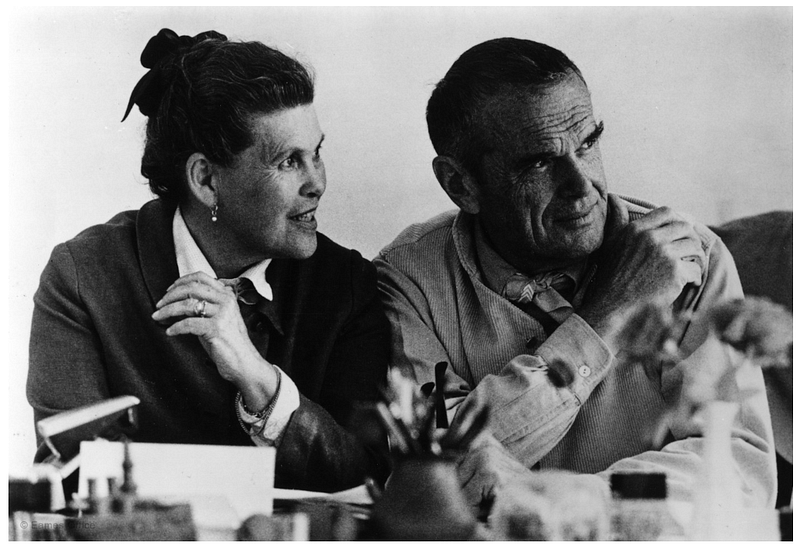
As Charles Eames would have put it,
“The details are not details. They make the design.”
Another quote that springs readily to mind is the Eames mantra, “Getting the most of the best to the greatest number of people for the least.”
Reproduction is an intrinsic aspect of design philosophy. The Plastic Side Chair itself stems from the Low-Cost Furniture Design competition organised by the New York Museum of Modern Art in 1948.
Then what distinguishes between a design that pays homage and a mere imitation? Vitra Chairman, Rolf Fehlbaum has this to say:
“The status of an original is determined by the relationship between the designer and the manufacturer. Aside from the legal component to this relationship, there is a transcendent, immaterial one based on shared ideals and cooperation. Because the plagiarist does not have this relationship, there is uncertainty about the degree to which the copy deviates from the original, whether for reasons of ignorance, carelessness or cost reduction.”
— citation edited for brevity, full essay here
…Inspiration is flattery
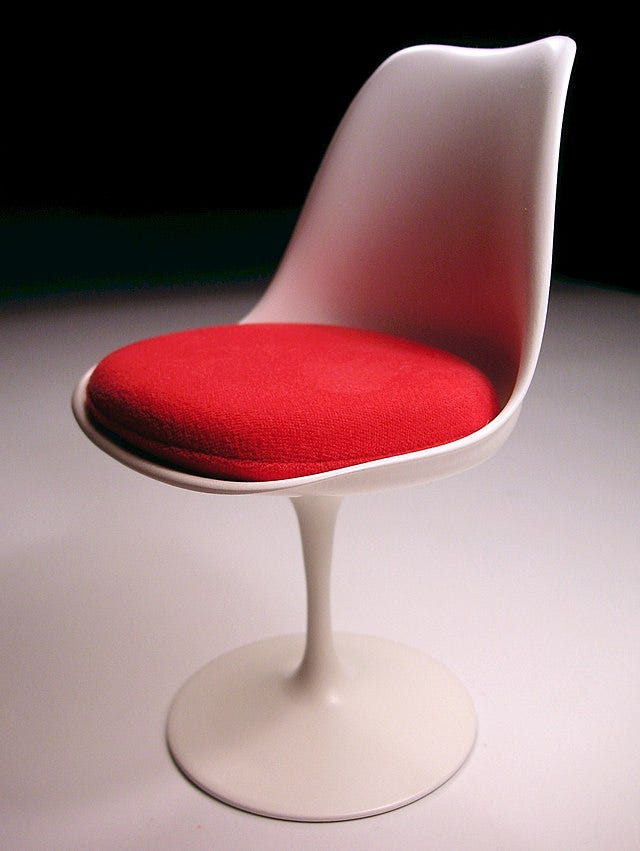
and, using the methods pioneered by Charles and Ray Eames, some of their collaborators created their own interpretations of mass produced chairs that respect the human form. Eero Saarinen’s Tulip and George Nelson’s Swag Leg Armchair are just two of the Plastic Side Chair’s acclaimed cousins.
Plywood and the painful lessons of war
To understand how furniture made from plastic came to be, it is worth exploring the history of its forerunner, plywood. By the 1940’s, some of today’s processing methods of plywood were already known from boat and aircraft construction, and even from earlier furniture pioneers such as Michael Thonet.
Plywood was the first material that allowed the Eames team to develop mass production methods suited to anthropomorphic shapes. All following designs would draw on the experience they gained from two simultaneous challenges that presented themselves during the Second World War.
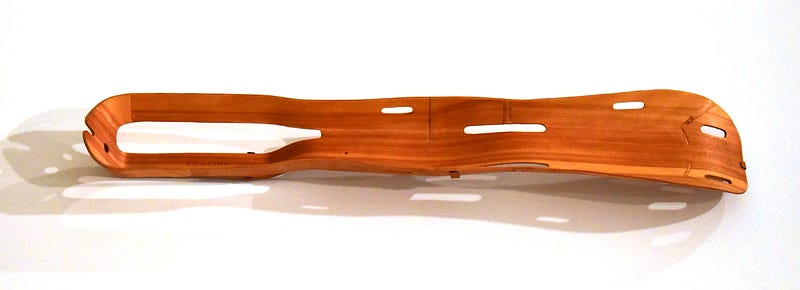
US Navy doctor Wendell Scott was an acquaintance of Charles and Ray. When existing metal leg splints were found to cause further injury, he approached them with this specific problem in 1941. The Navy and other branches were in urgent need of mass produced splints that followed the contours of the leg without cutting off circulation or amplifying vibrations.
Not long before, Charles, Ray and Eero had participated in a contest held by the Museum of Modern Art in New York. The intent was to find new ways to manufacture organic shaped furniture.
For this purpose, Charles had put together the Kazam! machine, a contraption made out of wooden slats, an electric coil embedded in a plaster mould and a tire pump attached to an inflatable bag. First, Charles and Ray glued and crisscrossed sheets of wood. Then they pressed this veneer sandwich down into the mould by inflating the bag which was held down by a lid.
The curing process took up to six hours. To avoid overloading their apartment’s electricity supply, Charles decided to borrow some by venturing up a utility pole with a cable. This was not the only questionable decision he would make. The mould for the splint was based on a cast of his leg, which pulled out his hair as it came off.
During the earlier work on the organic chair, Ray and Charles found that shells would sometimes split at their weakest point due to the stresses of pressure and curvature. To overcome this, they integrated various slots that permitted some flex. When applied to the splint, the slots also proved to be ideal openings for threading bandages.
The Navy accepted the concept for the splint and the Eameses went into business with Evans Products, who eventually manufactured an estimated 150,000 pieces.
The post-war years
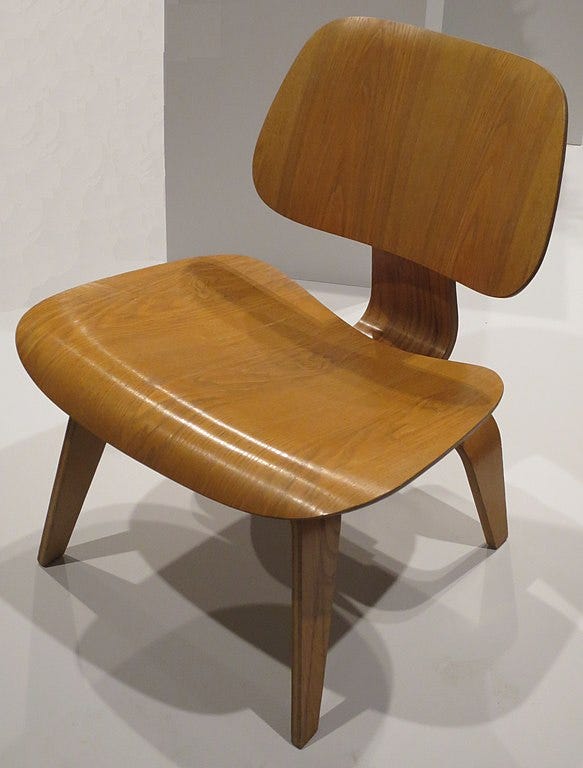
With the war coming to an end and armed with know-how, tooling, facilities and funding, Charles and Ray were set up to work on furniture full-time. The LCW or Lounge Chair Wood was to become the herald of this new era.
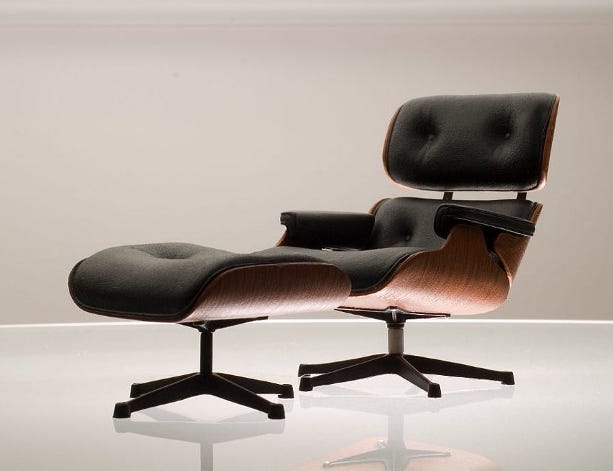
Plywood however, was still prone to crack when forced into curves. This is why they composed the LCW out of separate pieces for the seat and the backrest, joined by a plywood spine and placed upon plywood legs. As the chair was meant to be comfortable even without upholstery, they equipped the legs and the spine with rubber shock mounts, which made the LCW one of the first chairs with a responsive backrest. Eventually, the insights gained during the LCW’s creation would lead to perhaps their most famous piece, the Lounge Chair.
From wood to metal to fibreglass to polypropylene, and back
The post-war market was hungry for innovative, durable and affordable furniture. The earlier mentioned 1948 Low-Cost Furniture Design competition encouraged Charles and Ray to pick up the idea of a one-piece organic chair. Though the first proposal in sheet metal won the favour of the jury, it was dropped for reasons of cost efficiency as well as for the cold feeling of the material.
Continuing their research, their attention was soon drawn to fibreglass. Known from boat hulls and airplane parts, it had never been used in furniture up till then. Finally here was a material that they could mould into a one-piece shell without cracking. They partnered with Zenith Plastics and repurposed a press normally used for boat parts.
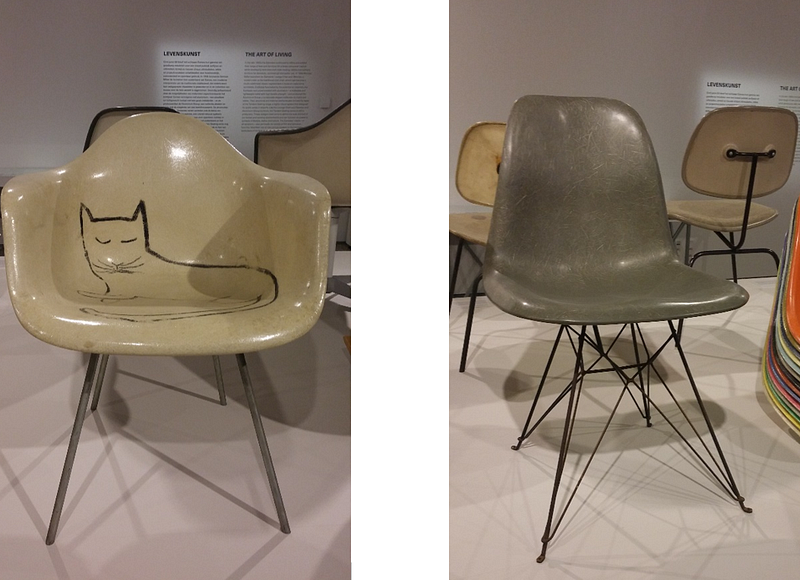
Fibreglass-reinforced polyester was the first type of polymer that the Eameses would employ. In 1950, Herman Miller launched the Armchair, followed by the Side Chair in 1951. The latter proved more challenging to work out, as it lacked the armrests that provided the necessary rigidity.
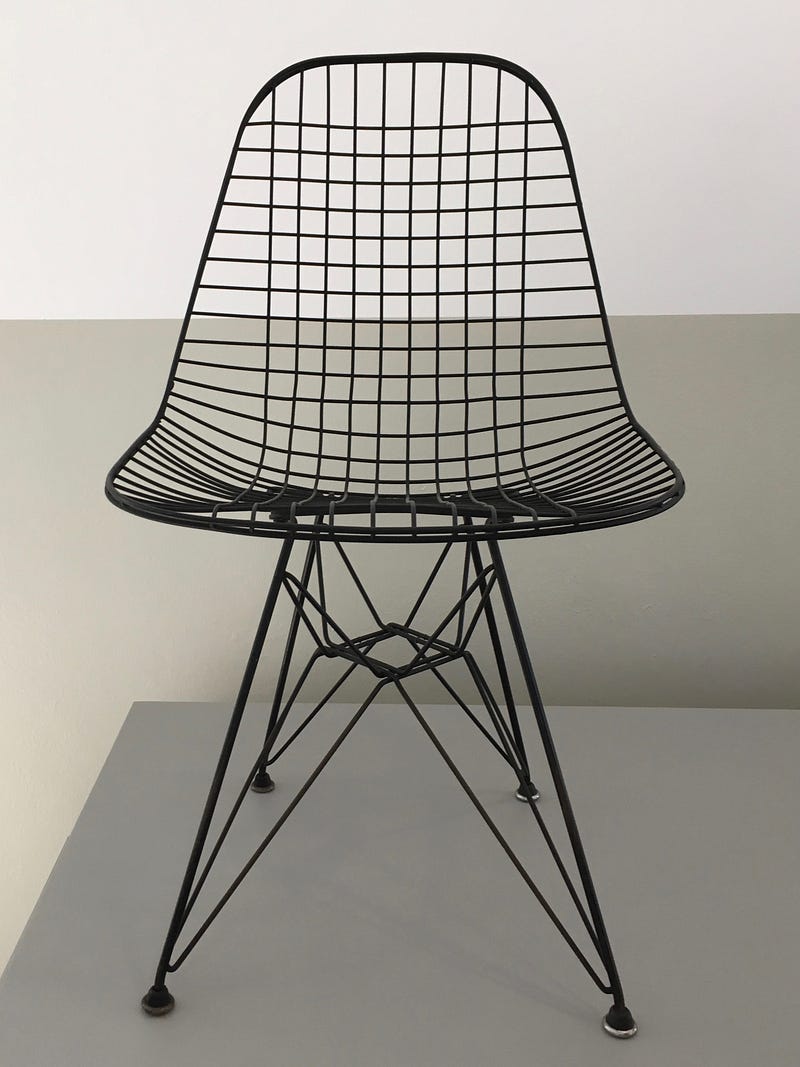
While the team were working out the issues with the armless Fibreglass Side Chair, Charles became inspired by the honest aesthetics and functionality of steel wire consumer goods such as trays, baskets and even rat traps. The result became known as the Wire Chair (1951), an iteration of the organic chair that combines transparent lightness with technological sophistication.
For decades, Herman Miller and Vitra fabricated the Armchairs and Side Chairs in fibreglass-reinforced polyester. Technological advances, new types of polymers and competing designs ultimately eclipsed the original fibreglass range. One of the most notable challengers was the injection moulded Polypropylene Stacking Chair, designed in 1962 by Robin Day for S. Hille & Co.
Environmental concerns also played a role in the decisions of Herman Miller and Vitra to discontinue production of the fibreglass range in the early nineties. It took them until 2018 to relaunch the range in eco-fibreglass, manufactured using a new environmentally friendly process.
Meanwhile, in 1998, Vitra had reintroduced the Plastic Side Chair in polypropylene, followed by Herman Miller, in 2001. This is the version of which I am currently a proud owner.
The most dramatic return to the initial challenge of a one-piece plywood shell came in 2013, when Herman Miller launched the Moulded Wood Chair. They partnered with Davidson Plyform (US) and use 3D-veneer supplied by the German company Danzer.
3D-veneer is made by slicing wood into super-thin strips and then gluing it back together. This makes the veneer as flexible as card and suited for three-dimensional forming far beyond what was possible before. This short video by Danzer shows the Moulded Wood Chair as well as a close-up demonstration of their 3D-veneer.
Although Ray and Charles pushed plywood as far as it could go in their lifetime, they never achieved the one-piece shell that they envisioned. Along the way, however, they remained at the vanguard by relentlessly pursuing every opportunity to apply new materials in innovative ways.
Every Eames legacy product is infused with the passion and playfulness that bound Charles’ hands-on technical approach to Ray’s artistically trained senses and understanding of conceptual thinking.
Vitra from Switzerland and US-based Herman Miller continue to manufacture the Armchair and Side Chair ranges in a multitude of shell types, base types, upholstery and colours.
The Ant Chair, designed by Arne Jacobsen, and Marcel Breuer’s B3 or ‘Wassily’ Chair are also discussed by Remy Dean in Signifier.
All images are used here by kind permission, or under commons license.
Sources and acknowledgements:
Danzer: 3D-veneer Eames Office: Molded Plywood Leg Splint Eames.com: War time leg splint Herman Miller: Molded Wood Chairs Hyperallergic: How a Medical Leg Splint Shaped the Iconic Eames Chair The Collector: Charles and Ray Eames: Modern furniture and architecture Vice: Sitting pretty: How a Leg Splint influenced Charles and Ray Eames’s Iconic Chair Vitra: About Charles and Ray Vitra: Is It Vulgar or Is It Art? Vitra: The Kazam! Machine Vitra: The Original Vitra: The Story of an Icon Wikipedia: Eames Fiberglass Armchair


_Chair_by_Charles_and_Ray_Eames,_Honolulu_Museum_of_Art_4410.1.JPG)
.jpg)
_02.jpg)