
JUNGIAN PSYCHOLOGY
Are You My Mother?
Not a good question to ask your wife.
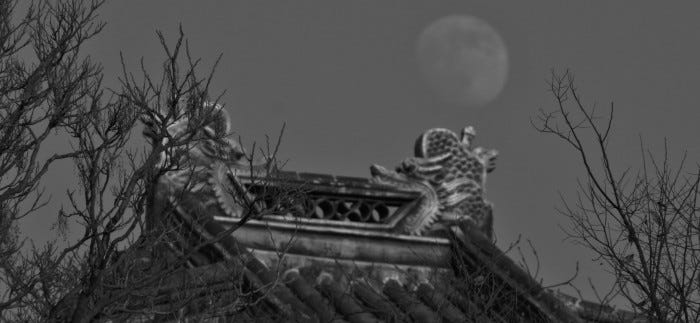
I chose black and white to go with this image. Because of depth of field being narrow, the moon came out as very faint and fuzzy. I have quite a few much better and clearer images of the moon, but this is the one that makes the cut for this post.
Why? Because the moon is “faint” in appearance. This view speaks to me of the “numinous.” One knows the presence is there though that knowledge is fuzzy, an archetypal presence. The moon is associated with the feminine, or the mother.
“I attribute to the personal mother only a limited etiological significance. That is to say, all those influences which the literature describes as being exerted on the children do not come from the mother herself, but rather from the archetype projected upon her, which gives her a mythological background and invests her with authority and numinosity.” (Jung, CW 9i, par. 159)
Somehow I am sure that any biological mother who has engaged in raising a child is well aware of the power she has over her child(ren). Sometimes that power is a burden as she is supposed to know everything, to heal everything, to hold everything for the child(ren).
It seems that children tap into bigger picture of mother rather easily, unconsciously. But since it is mostly unconscious, all of the archetypal energy of “mother” is projected onto the personal mother.
Having her child(ren) grow up to be conscious and independent adults is a good thing but also a process that leaves her in a depression (empty-nest syndrome) as there is a loss, not just of the presence of the child, but also a loss of her “power,” her “authority” as the projections of her child are withdrawn leaving her stripped bare, exposing her as a vulnerable, fallible, and weak as any other person.
“Our task is not, therefore, to deny the archetype, but to dissolve the projections, in order to restore their contents to the individual who has involuntarily lost them by projecting them outside himself.” (Jung, CW 9i, par. 160)
It sounds simple, but it isn’t simple at all. Few ever completely withdraw their projections. As an adult, we are left with mother-complexes which are a melange of the archetypal and personal mother. Here I am in old age still dealing with a mother complex.
Our journey is to rediscover the mother within regardless of our gender. We need to learn how to answer ourselves, how to heal ourselves, how to nourish ourselves — to mother ourselves in our adulthood. Read on, I have more to say.
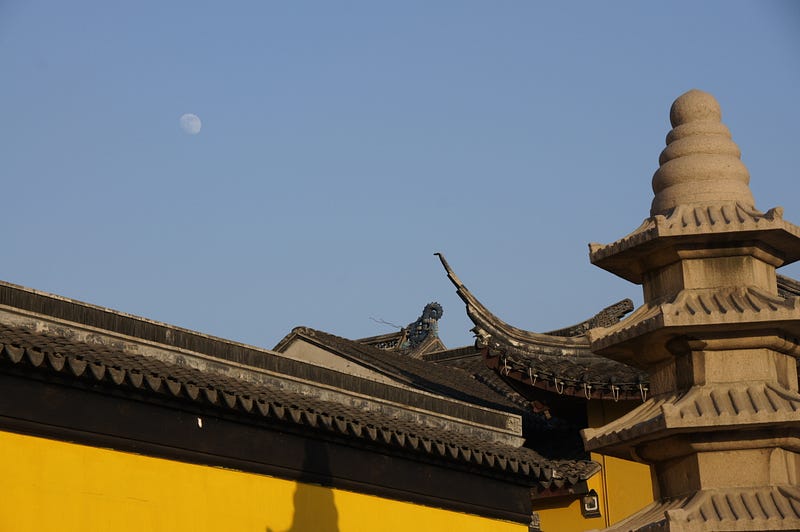
This photo was taken in front of the Tianning Buddhist Temple in Changzhou. Why? Well, I don’t know if I have a good reason other than I am drawn to the moon as though being drawn into love, into desire.
I want to be the man in the moon at times, enclosed and consumed by the moon. I want to return to a place that I don’t remember, but somehow know none-the-less. That is the pull of the mother, the desire to return to the womb, to possess and be possessed in turn.
Of course, all of this is projection and I know it, at least on one level, the personal level. The archetypal level? Well, that is another story.
As I learn more, I begin to see how my relationships with others are all shaded by the archetypes of Mother and Father. Falling in love with a person is normal, but who is that person we see when we fall into love?
No woman can contain all of the image, all of the projections that flow from me to be caught (or not) on the hooks that await. The same can be said for hate. The intensity of both hate and love are too expansive for the container of a personal other.
Yet, despite the reality of the other with their flaws or their perfections, we load the scales so that balance is gone. Rationality disappears and we are left with the affect of either love or hate within us.
And what about the other person who receives these projections? Confused, bemused, angered, frustrated, awed . . . Thus the power of archetypes blind us to the prosaic world of ordinary humans.
“As we live our lives through projections, we are not unlike a person stumbling through a haunted house, brushing the cobwebs away, never being able to see or discern clearly. Even when we are aware of some etiological influence, the staying power of such energy is immense.” (Hollis, Mythologems, p. 50)
How do I know that I am engaging in projection? Well, it is only after the fact that I can have some sort of idea. When my head is back on earth and I have recovered from the intensity of some interaction with an other person, or persons, I examine myself rather than the other person.
In the heated moment, what I said and did more than likely came from something [some entity] within myself. What does it say? I don’t mean to say that others don’t push buttons, deliberately, but it is the buttons I am talking about, not the person doing the pushing.
When a button is pushed and a reaction follows, that reaction is almost always a projection. And the roots of the projections is invariably rooted in an archetype.
Other writers at Illumination