
Are You Living Your Own “Renaissance”?
There might be something common between our journeys towards embracing change.
Have you ever stumbled across people who are addicted to change?
They are like plants that grow in pavement cracks or like bacteria living at the bottom of the Mariana Trench. They survive the harshest conditions of their environment and still bloom. They persistently learn and adapt. Their minds are hungry for new insights as they strive towards finding new, better versions of themselves.
It’s one of those friends of yours who randomly calls you one day to announce that they are into paleontology now. It’s when you call them out about what they did a few weeks ago, and they react with a sincere “Did I really do that?”. It’s those who ask you to urgently meet up because, apparently, they read a new book and it changed their life forever. Long story short…
… if you leave them today, you will meet someone different tomorrow.
In my attempts to understand what causes people to recognize change as an indispensable part of their life, I started having conversations with restless learners, self-improvement enthusiasts, and radical personal revolutionaries. By hearing their many stories and reflecting on my own, I managed to take a peek into what it takes to break free from the grip of stagnation.
Now, I am not going to give you “Five Quick Ways to Become a Voodoo of Self-Improvement” or anything. Instead, I am going to give you an idea that will require some tweaking and interpretation from your side. This article is about being left in the dark in order to find your own light with the framework provided here.
Ripples of Change
I have come to think that every human being endures a period of dramatic change in their lifetime. It is no ordinary change but an ultimate one — when initiated, it creates ripples, which propagate through life. It is that point when a human being reaches just the right amount of self-awareness to understand three essential realizations. These realizations affect our lives by leaving lasting impacts on our personalities. Based on my experiences, I distinguished three major ripples.
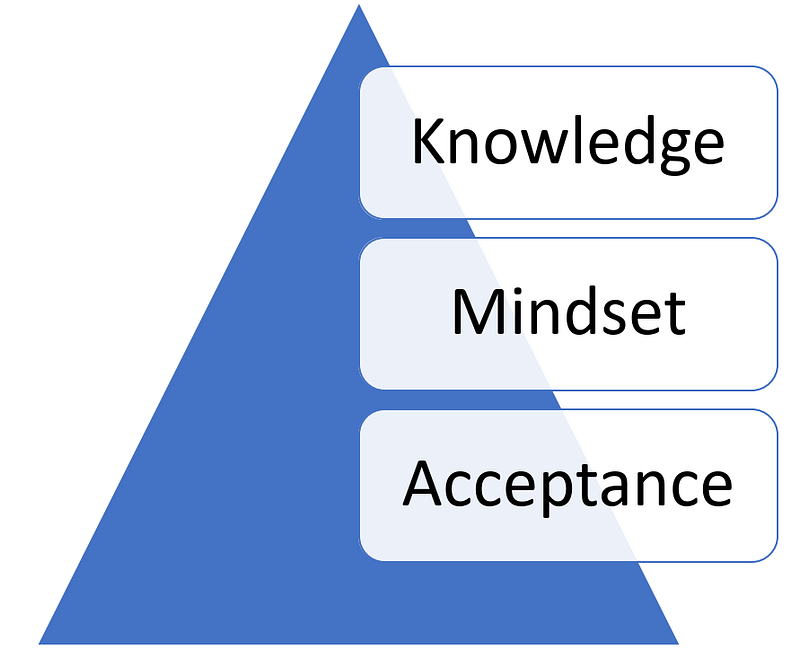
As we move through each ripple, from the bottom to the top of the pyramid, we start to better understand the importance of change in our lives.
- Acceptance
Going through “Acceptance,” we push through our self-serving biases and honestly reflect on our past behaviors. We recognize that our thinking processes and personalities are flawed and require drastic reforms. “Acceptance” may very well come with the realization of the scope of our own negligence. It’s not simply about “I was wrong.” It’s about understanding that if you were wrong once, you might as well be wrong twice.
- Mindset
The second ripple is about removing psychological barriers. In order to drive personal change, one must come to a realization that change actually can happen in the first place. In order to adopt such a mindset, we need to abandon all notions, which imply that our world is static by nature. Nothing can be further from the truth.
Most things in the natural world are changing dynamically, and the human mind is no exception. Having this mindset allows us to have faith in our novel endeavors and will remove all unwanted psychological obstacles such as “I don’t think I can change” or “I was born this way.”
- Knowledge
Once we face ourselves in the mirror, we begin to seek knowledge (both consciously and subconsciously), which would assist us in our endeavors. But why?
One of my friends made a beautiful analogy in an attempt to describe how knowledge affects us. He would argue that engaging with books, podcasts, people, or any other sources of information for that matter is very much like “going through a portal into your new self, without even realizing it.” At that point, I could do nothing but to wholeheartedly agree.
Indeed, knowledge affects us on a different level. In my personal view, each piece of information we receive can be thought of as a small piece of a puzzle that is our understanding of the world. As we learn something unique, we spill some light on the previously hidden areas of that puzzle. This is precisely the reason I always try to engage with all fields available to humanity, starting from science & engineering and finishing with sociology & philosophy.
My Personal “Renaissance”
“Acceptance,” “Mindset,” “Knowledge.” Combined, this very understanding sets the stage for a different kind of personality — one that strives for self-improvement. And the period during which this mindset comes into being? I call that period a personal “Renaissance,” and I believe that it has close ties to our values and experiences. Thus, it is a deeply personal matter, which manifests itself in many forms for different people.
My “Renaissance” began with a feeling. After landing in Ankara for my undergraduate studies and standing more than 1500km away from the closest person I have ever known, I felt a slightly nauseating feeling of utter excitement. At that moment, I did not realize that these feelings were closely related to the fact that for most of my life, people in my immediate surroundings existed for the sake of unending comfort and short-term satisfaction. Breaking away from the regime that I was so comfortably a part of led to a transformation that was long-delayed.
For the first time in the 17 years of my life, I was the sole bearer of the consequences of my actions.
But “Renaissance” isn’t a peaceful period of transition that leads to a happily ever after. It is a violent battle for your future, and it is you against yourself. Triggered by a drastic change in the environment, it requires you to adapt. And as one long-suffering theory states, adaptation requires struggle.
After coming to university, I found myself in the same pool with highly intelligent individuals. I fought the same battles as people who earned their place there through decades of discipline and hard work. I knew that my previous lifestyle, my old habits, my rusted thinking processes, and my lacking experiences have put me at a severe disadvantage.
That notion was a key driver of my “Acceptance.” Living in that competitive environment has pushed me to recognize one very important thing: in order to end up successful among these brilliant people, my personality needs a major do-over.
Despite being confident in what is needed to be done, there was a significant barrier on the way to embracing change. Fixated on the thought that intelligence is a deciding factor in my success, I was hurt that I can’t always pull off what an intelligent friend of mine could. Let’s call him Jerry.
Jerry would study in the last few days before the exam because, according to him, he would forget everything if he would do otherwise. I thought that if Jerry is successful using this strategy, then this must the one formula of success I was looking for! After a series of (expected) mediocre results, I blamed it all on my intelligence. It was decided.
“I am not smart enough, and I can’t do anything about it.”
By having this distorted and rather deterministic view of reality, I was blocking myself from actually acting on my downfalls. I was stuck in a never-ending circle of self-pity and incorrect decision-making. I was repeating the same mistakes over and over. This is an example of how a wrong mindset can truly go a long way towards wrecking your life, especially one that favors status-quo.
It was “Knowledge” that rescued me out of the pit. Thanks to the insights and life stories of brilliant individuals around me, TED talks, and academic research, I realized that a growth mindset together with grit, discipline, and, my favorite, openness to experimentation were much better indicators of success than just sheer intelligence.
Personal success is about understanding what works best for you.
In the end, I adopted a lifestyle of a self-improvement witcher. Just stay with me on this one. Equipped with knowledge as my ingredients, I got myself a cauldron and started experimenting with my recipe. Work during the day or at night? With coffee or without coffee? In a coffee shop or a quiet room? A 15-minute streak or a 60-minute one? That technique or another?
Yes, occasionally, my recipe would blow up on my face. But at least I wasn’t falling into the same pit every time. It is as important to know what doesn’t work as to know what does.
In the end of it all, I can’t say that I won all the battles. I can’t say I’m winning all of them now, either. But I feel I will never be the same person after the ripples.
This is my “Renaissance.”
What about you?
Are you living your own “Renaissance”?


