
Are you Investing or Gambling? The Power of Time in the Market
Unveiling the odds of investing long-term

Your time horizon makes all the difference.
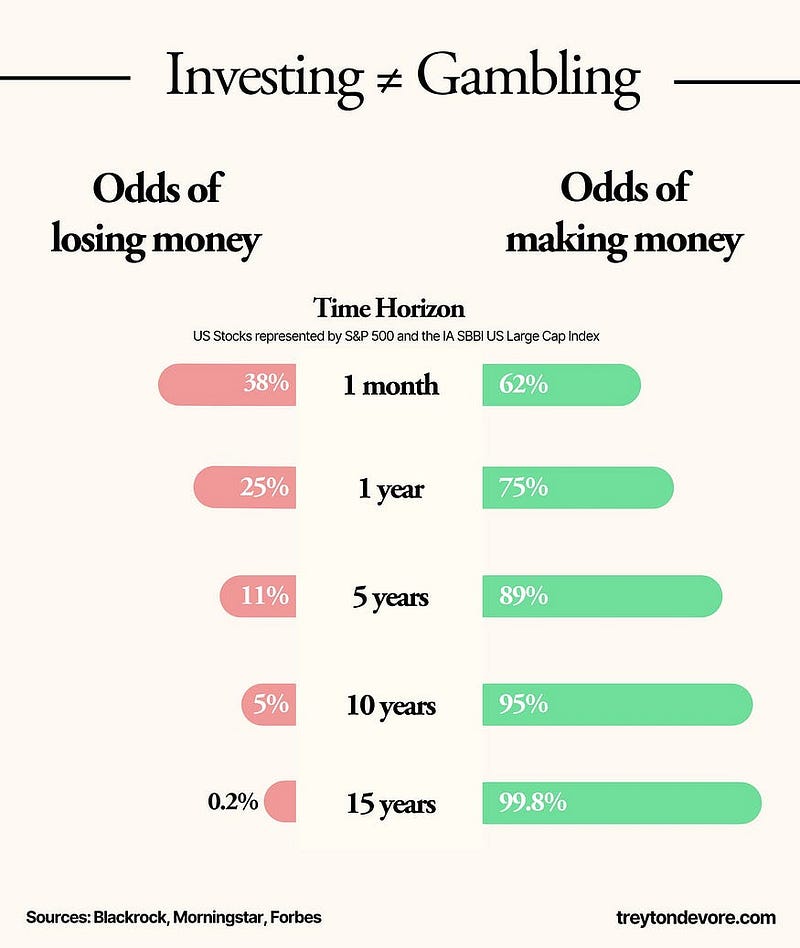
The odds of losing money after buying an asset decrease the more time you hold them. As you see from the chart below 99.8% of investments in the stock market make money.
The problem?
Having the patience to wait for 15 years for an almost assured profit.
While short-term fluctuations can be unpredictable and volatile, over the long run, markets tend to follow upward trends due to several key factors:
- Economic growth: Historically, economies have shown consistent growth over extended periods. As economies expand, businesses tend to thrive, leading to increased profitability and higher stock prices.
- Compounding returns: With time, investments can benefit from the power of compounding. Reinvested dividends and capital gains can generate additional returns, leading to exponential growth over the years.
- Market resilience: Despite facing periodic downturns and crises, markets have shown resilience and the ability to recover and rebound over time. Investors who hold through market downturns can benefit from eventual recoveries.
- Innovation and technological advancements: Advances in technology and innovation often lead to enhanced productivity and profitability across industries, driving the growth of companies and their stocks.
So while short-term fluctuations can create uncertainty and challenge investors’ emotions, taking a long-term perspective provides the opportunity to weather market cycles and benefit from the historical market's upward trend.
The historical odds of profit in the U.S market
The history of the U.S. stock market reveals intriguing insights.
Over one-year periods, returns can be unpredictable, with a 27% chance of experiencing a loss.
As EMCEE points out, “Out of total 146 one-year periods of the US stock market (…) there were 40 periods where investor returns were negative. That amounts to a loss probability of about 27%. Also, an investor could have lost up to 39% of his capital in just one year.”
However, as we extend the duration to five or ten years, the odds of achieving positive returns significantly improve. Only 15 out of 144 five-year periods (i.e. 10% probability) had a loss and 3 out of 139 ten-year periods (i.e. 2% probability) had a negative return.
Over these periods, the likelihood of achieving positive returns rises significantly. The key is patience, allowing us to ride through market fluctuations and flip the figurative coin multiple times. Time in the market can mitigate risks and increase the chances of a profitable outcome.
So as the saying goes,
Time in the market beats timing the market
Nothing in this article should be considered financial advice. It was written for educational purposes only.
Consider signing up to become a Medium member. It’s just $5 a month, and you’ll have unlimited access to articles from amazing writers worldwide.
Subscribe to DDIntel Here.
DDIntel captures the more notable pieces from our main site and our popular DDI Medium publication. Check us out for more insightful work from our community.
Register on AItoolverse (alpha) to get 50 DDINs
Join our network here: https://datadriveninvestor.com/collaborate