
Mean Wage Movement
Are You in the Wealthiest 10%? | Chapter 3
Connecting economy and ecology
←← Introduction | ← Chapter 2 | Chapter 4 → | Latest chapter → →
According to the 2018 Intergovernmental Panel on Climate Change report, we need to cut our greenhouse gas emissions in half by 2030 to limit warming to 1.5ºC. Then, we need to reduce emissions to zero by 2050.
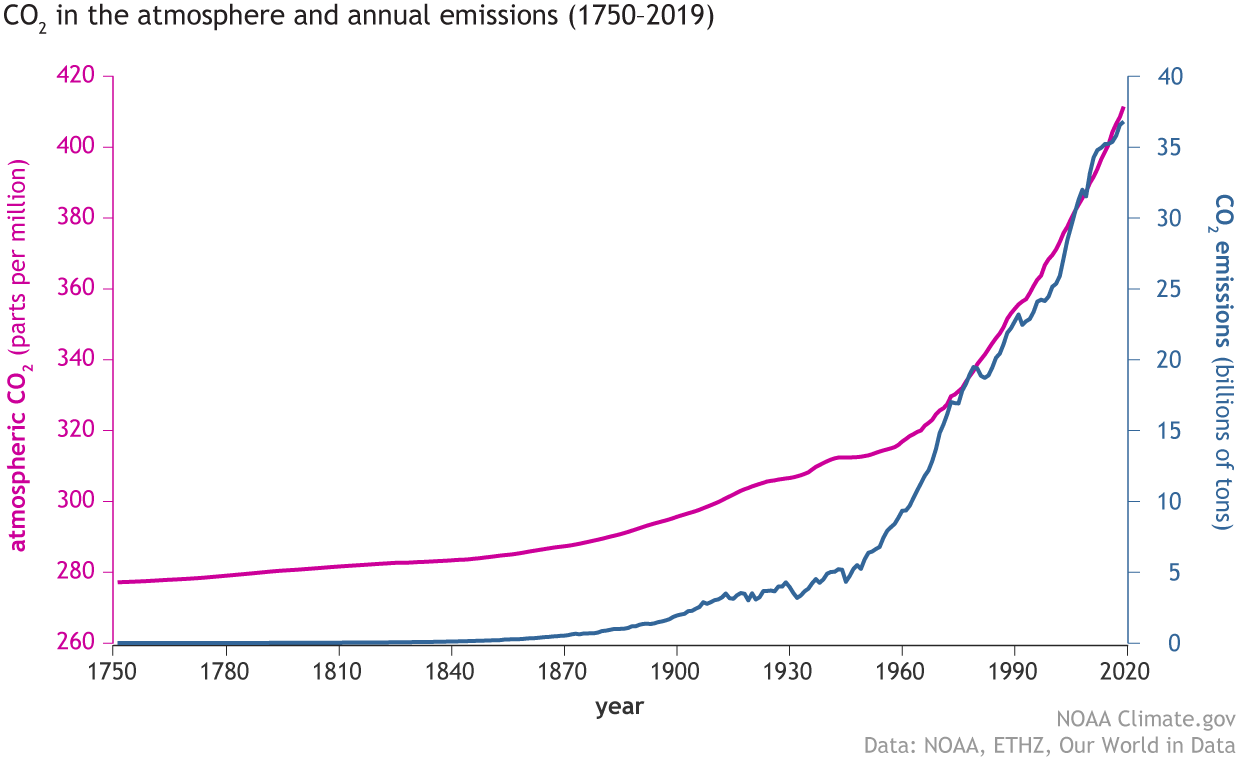
Here is how global emissions have been trending since 1750 (in navy):
The IPCC is saying we need to do this in order to not be screwed:
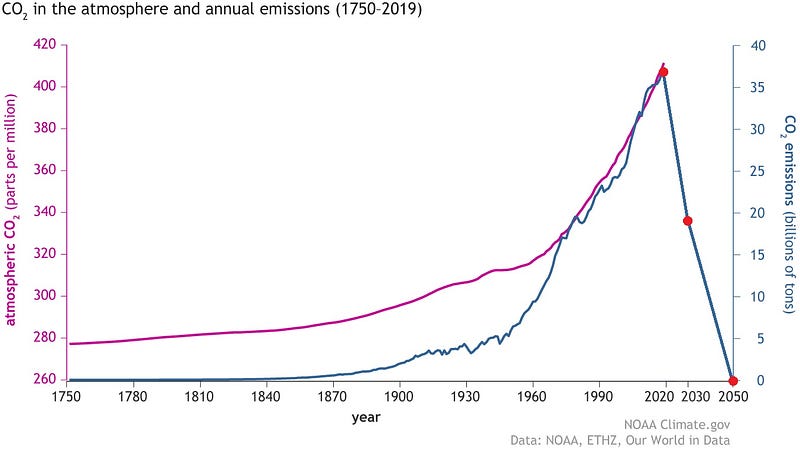
That’s an about-face from the steady march of the last 150 years. How will we reverse course so quickly?
The realistic answer is that we won’t, and the August 2021 IPCC report acknowledges that we will almost certainly break 1.5ºC by 2040. I’m not trying to sell you false hope. Solving this would require us to upend our entire global economic system in less than 10 years, and since the people with the most power to change it are the same ones who benefit most from constant growth, it’s not looking good.
Here are three reasons I’m writing this book anyway:
- Even if we can’t secure an ideal climate future anymore, we can still avoid making it worse than it needs to be.
- The lifestyle strategies I’ll be describing are not only helpful for lowering our impact but also for surviving a post-collapse society.
- If our world does go up in flames I at least want to look back and know I tried.
Setting aside pessimism for now, our goal is to reduce total emissions as much as we can, ASAP.
How can we accomplish that?
- Some would say it has to be through technology: we need electric cars, alternative energy, and carbon sequestering. It’s unrealistic to get humans to dial back their consumption, so we have to provide better options that entice people away from conventional energy sources.
- Some would say we need political action. Governments are the only entities with the power to regulate polluting industries and impose a carbon tax, so we need to elect leaders who have the willpower to force corporations to operate more cleanly and give us better options.
- Others would say corporations and governments are made up of people, and only follow the demands of the people, so all responsibility for the current state of the world rests on the shoulders of the general public. If we want a less polluting world, we have to enact that change in our own lives, and the supply will eventually come around to meet that new demand.
Climatology is a complex science to begin with, and every approach to addressing climate change comes from a different field you could spend your whole life trying to understand! No wonder we haven’t figured this out yet.
I believe there are some good arguments to be made from all of those perspectives.
- Yes, many people are selfish consumers and will not switch to cleaner technology unless it is better and cheaper than what they currently use. We definitely need more efficient products and also new technologies that combat global warming directly. However, I’m skeptical better tech is the solution all by itself. Technology already gets more efficient all the time, but due to Jevons’ paradox it doesn’t reduce overall impact.
- There is some precedent for environmental problems being solved by government regulations — a good example being the hole in the ozone layer. If a carbon tax system were implemented, it could change economics so that emissions are part of the bottom line, not just shareholder profits, which would make a huge difference. The difficulty (at least here in the US) is that our politicians are in bed with corporations, and corporations have so much money and influence that they can usually prevent outcomes they don’t like. Telling them “you have to stop half of your pollution” is definitely not something they like to hear.
- A constant debate: if a small number of the heaviest-polluting companies cause most greenhouse gas emissions, are those companies to blame and we’re off the hook? Or are they innocent, because they only exist to meet our demand? I think it’s neither. Yes, if everybody on Earth suddenly realized the effects of their consumption and boycotted all wastefulness, a lot of polluting corporations would go out of business. But also, if those corporations stopped lobbying politicians, spending millions on advertising, and choosing harmful business practices just to save a few bucks, maybe the public wouldn’t have so much to fight against.
My perspective is that all of these theories (and many more) have a role to play, and we can all get involved in whatever arena we feel most competent and effective.
In the introduction to this book I claimed the world needs a cultural adjustment, a revolution of our values, to have any chance of changing things. I admit I was eager to identify a singular solution and it’s more complex than that, but I still think a shift in core values naturally motivates people to pursue all the other solutions I’ve described here.
If someone has a mindset of material entitlement, excess, and greed— unquenchable and blind — how can that person become part of the solution? Why would they want to? They don’t even see a problem, let alone a reason to solve it. Their talents and efforts are not being put in the direction of mutually ensured survival, but instead towards further destruction and inequality.
On the other hand, if you help someone understand the threat we’re up against, and they discover a passion inside themselves to be part of the solution, they will naturally find their own ways to get involved. They’ll be more likely to vote for candidates who promise to make the environment a priority. Maybe they’ll apply their engineering skills to renewables instead of oil extraction. Maybe they’ll make changes in their own patterns of consumption.
Some of us have a special ability to contribute within these areas of expertise, and I want to help motivate people to do that; but all of us make choices about our lifestyles, and we vote with our dollars every day. Especially in America, the average person has the potential to reduce a lot of impact by making some key lifestyle changes. These are the reasons I’m interested in talking about our individual responsibility rather than analyzing technological or political solutions.
Back to the question of how we can achieve the dramatic reduction in emissions laid out by the IPCC:
On the most zoomed-out level, one solution is obvious (if difficult): emissions scale with the size of our economy. Reducing economic activity also shrinks emissions because there simply isn’t as much demand for drilling, mining, manufacturing, transportation, etc.
If we all simply bought less stuff, stopped flying on planes, drove less, and ate lower-impact diets, that would make a big difference.
The people with the most ability to shrink their economic demands and environmental footprint are the world’s wealthy. They already live in more luxury than everyone else, and look how disproportionate their emissions are:
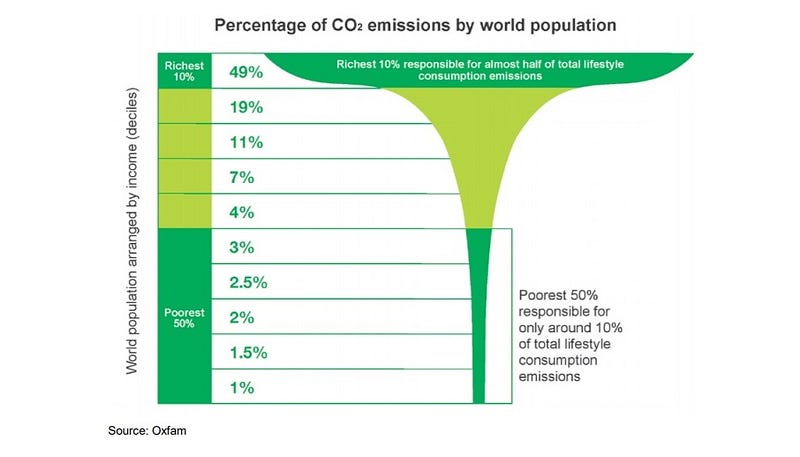
The next source shows the distribution being somewhat more balanced, but it still highlights the disproportionate impact of wealthier people.
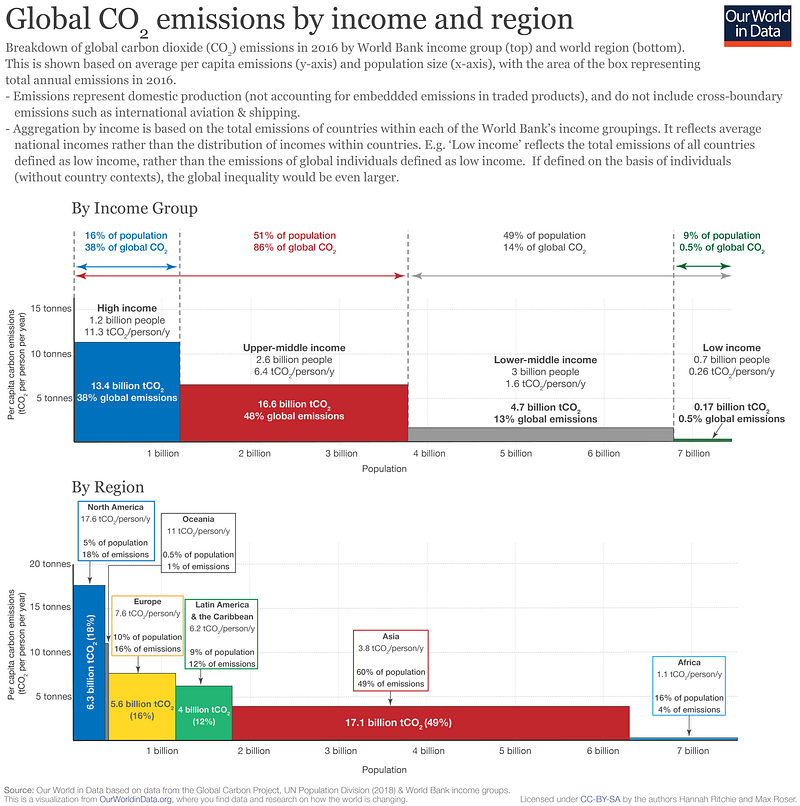
Wealth roughly correlates to environmental impact, and people in the lower income brackets are already doing more than their fair share to limit emissions — they should actually be supported in using more resources to gain more stability, health, and happiness. It’s those of us on the upper side of the scale that have the adjusting to do.
Maybe you’re thinking: “Top 10%? That’s not me! I’m not rich.”
If you’re an American comparing yourself to other Americans, you’re probably right. To be in the top 10% of earners in this country you have to make more than $158,000/year.
What we often take for granted is how wealthy our middle class is compared to the rest of the world.
According to this calculator using data from the Brookings Institute, you are in the top 10% of worldwide earners if you make over $18,000/year. If you make more than $50,000/year, you’re in the top 1%! Go have a look — you can see how your own income compares.
I live below the poverty line, and I’m still making more money than 79% of the world.
To further put this into perspective, consider the median global income. This marks the 50th percentile, meaning that half the world’s population lives with less money than this.
Any guesses as to what the number is? One person I asked recently guessed $13,000, but that was too high.
The real answer, using the Brookings Institute data, is around $3,700. I’ve seen other sources calculate it at closer to $2,800.
Now you might be thinking: in a lot of countries, you can live very comfortably for $3,700/year because the cost of living is so much lower. That’s actually not how this works!
This figure is after adjusting for the fact that other countries have a lower cost of living. “Purchasing power parity dollars”, used in this data, represent people’s buying power in terms of US cost of living. A citizen of a low-cost-of-living country whose income is represented as $3,700/year in this data actually makes substantially less than that.
Can you imagine what kind of lifestyle changes you would have to make to survive on $3,700/year, or $308/month, in the USA?
Half of everyone on Earth is already facing a tougher reality than that.
It begins to make sense why malnutrition is common in many places, why entire families ride together on one scooter, why people live in huts made of mud or scrap pieces of metal. That’s all the budget allows for.
Most of us who complain about having a hard time making ends meet in the USA are still living lives of relative luxury and cannot fathom the hardships we would endure if we were truly poor — though certainly there are some Americans suffering from extreme poverty, too.
I think most of us in the first world are unaware of our relative wealth because we naturally perceive the enviroment we grew up in as “normal”. When we see most of our peers earning the same amount of money as we do, it’s hard to understand that we might actually be in the top 10% or 1%.
However, if we want a more equitable future and a habitable planet, it’s important that those of us who are globally wealthy recognize our position of power and act accordingly.
Addressing climate change is difficult because it involves convincing wealthy people to voluntarily become poorer and less powerful. That’s a hard sell. Everything in our culture tells us that if you want to be successful, you should always be seeking more wealth.
However, I genuinely believe life can be better with less money. I know there are loads of people who want to simplify, minimize, escape a stressful job, find more free time, work towards positive change, and live a life that is rich in meaningful experiences and connections. That’s basically the millennial dream. Unless you absolutely love your work, dropping out of the rat race can make life far more enjoyable — once you realize happiness doesn’t come from fancy possessions and a big number in the bank account.
I have reduced my own income from $70k/year to $10k/year, and I have no intentions of going back, so I know it’s possible.
Excessive spending is a direct cause of climate change and ecosystem destruction. To thrive as a species — and for future generations to have a shot at a good life — we need to leave oil in the ground, forests intact, mines undug, plastics unproduced, fish unfished, cattle unborn. We need to take up less space with our farms and relinquish control over more sections of the Earth. Instead, we can work on filling our lives with love, community, and personal fulfillment. We can work together to create robust social systems that provide everyone a better quality of life while also preserving the biosphere.
The rest of this book is meant to give you some inspiration for how to reduce your spending while actually improving your experiential quality of life. Come back next week for chapter 4!
Be notified when I release new chapters!


