

Are You In Love Or Addicted To The Chase?
Do you want to win the game more than you want to be with the person?
You meet someone, and there’s an instant connection. From the moment you lock eyes, you can sense this is going to be different. As you begin to talk, you discover the incredible amount of things you share in common. The conversation flows easily, numbers are exchanged, and you arrange to meet again. When you ask friends for their thoughts, they comment on the natural chemistry and undeniably flirtatious behaviour between you both. Before your next meeting, the butterflies start swimming in your stomach — a mixture of excitement and nervousness. It’s another great interaction, and things are looking promising.
In those first few weeks, you’re confident of mutual attraction — clear signs of interest and constant contact. But as time goes on, that certainty turns to doubt. You can’t put your finger on it, but unconsciously you know something has changed. Maybe the other person starts replying a little less frequently. Perhaps the content gets shorter, or when you see them, they don’t look at you with the same lusty gaze. Either way, the change drives you crazy, but when you think all hope is lost, they throw you a bone — a clear indication that the spark is still there and hope remains.
And so the chase continues.
You find yourself staring at your phone, waiting for that message or call. You start planning what you will say, the places you can go, and thinking of how you can impress them. When you get the chance, you put your best foot forward. Not everything gets a response, but occasionally something sticks. But for all the moments where you think all is lost, that one sign of interest, no matter how small, leaves you in a feeling of euphoria. Soon this person and winning them over is all you can think about, leading you to ask an important question:
Am I in love with the person?
The emotions have become so overwhelming, so why couldn’t it be? You’re on a roller-coaster experiencing excitement, nervousness, anticipation, elation, disappointment, sadness — surely these are the signs of love?
Unfortunately, it’s not for me to explicitly categorise your feelings. Who am I to discredit another person's world? What I do know, having worked with 100s of clients, is you could have fallen for the chase itself more than the actual person. See, many of us can’t distinguish between genuine love and an obsession with the pursuit because we don’t understand how the chase works, and specifically why it’s so damn addictive.
The solution to that problem lies in this post, as we unpack the mechanisms driving the thrill of the chase. After reading this, you’ll be able to clearly see when your emotions are being manipulated by the construct of the chase rather than the person themselves. From there, you can ask yourself honestly – is it love, or am I just addicted to the chase?
Let’s dive in.
What Makes The Chase So Thrilling?
There’s no doubt that romantic games of pursuit are amongst the most addictive elements in life. As mentioned earlier, very few experiences mimic the breadth of sensation like chasing a person romantically.
While we may believe our emotions are based on deep attraction to another person, it’s not always the case. As a coach, I’ve worked with 100s of clients who pursued people they believed they were deeply attracted to. In many cases, they found themselves somewhat underwhelmed when they got what they thought they wanted. A large part of that belief was founded on the assumption that the other person was the cause of their powerful emotions. When they reached their destination, the reality was very different from what they imagined.
So if it’s not the other person, why do we feel so much during the chase – a range of sensations that are so hard to replicate anywhere else?
The answer lies in the influence of Dopamine, aka The Happy Hormone. This mischievous neurotransmitter is responsible for many fundamental processes, including:
- Regulation of movement
- Attention
- Learning
- Ability to see rewards and take action towards them
- Creation of pleasurable feelings in response to rewards
That last point is especially relevant because dating is a game of rewards — specifically four main types:
- Attention — that could be in person, through texting and calling, social media etc. Anything where their focus is on you.
- Physical affection — touching, kissing, sex, etc.
- Emotional connection — sharing personal stories, vulnerabilities, passions, life goals, and things you don’t tell anyone else.
- Fun Experiences — activities, dates, games, travel etc.
All of the above involve the release of Dopamine, and thus our body is flooded with endorphins and euphoria. In other words, we feel amazing and will look to repeat whatever action that made us feel that way — more on this later.
What affects Dopamine?
So we know that Dopamine allows us to see rewards, physically take action towards them, and feel amazing in the process.
The logical question is — what impacts the level of Dopamine in us?
Stanford Professor Robert Sapolsky has studied the neurotransmitter extensively. In one of his more recent explorations, his team investigated the conditions of release by conducting experiments on monkeys.
First, the monkeys were trained to identify a signal (a light switch turning on) and press a button ten times in exchange for a food reward. As this proceeded, the researchers measured the amount and timing of Dopamine release. Logically, we would expect levels to rise at receipt of the reward; however, the team discovered that the signal itself triggered release. This initial secretion kept the monkey pressing the button ten times — the anticipation of a reward, not the receipt.
In a second experiment leveraging the same principles, Sapolsky’s team only distributed the reward 50% of the time. Incredibly, twice as much Dopamine released when there was a 50% chance of getting the reward. When the team altered these probabilities to 25% and 75%, the increase in predictability matched with a corresponding decrease in Dopamine levels, i.e. the more the result was a 50:50 chance, the more excited the monkeys became. What’s even more interesting is how the monkeys still completed the work when the result was less predictable. Despite a smaller guarantee of reward, they still performed the task.
How Does This Apply To Dating?
We can summarise the findings of Sapolsky and apply them to dating as follows:
- Anticipation is enough — you don’t need to receive the reward, merely fantasizing gets you a flood of Dopamine (think about the excitement before a date or wondering how that person is going to react when they see you, will they touch you will you get the kiss you’ve been waiting for)
- Uncertainty doubles the effect! The less certain you are about the above, the greater the Dopamine release. One thing to note here is that less certain means it could go either way — if you think there is minimal hope, then that’s a form of certainty (there’s less doubt).
- That release of dopamine from the prior two stages gives you motivation — you get the energy and inspiration to pursue the reward even though there is no guarantee!
If you look at all of the above objectively, you may notice no mention of what the person is like — their qualities, traits, habits etc. This is purely about the chase itself, and we can clearly see how slight manipulations by either party can stimulate powerful emotions that may be misleading. Again, I am not saying this means there are always no feelings, but rather highlighting how you could endure a rollercoaster of emotions generated from uncertainty and anticipation.
Put simply, you can be desperate to chase someone because of how the pursuit feels, rather than how you feel about them.
Is The Dopamine Feedback Loop Creating An Illusion??
Let’s take this analysis one step further by looking at the Dopamine Feedback Loop. Below is a model I created, which helps us visualize the process a bit more clearly.
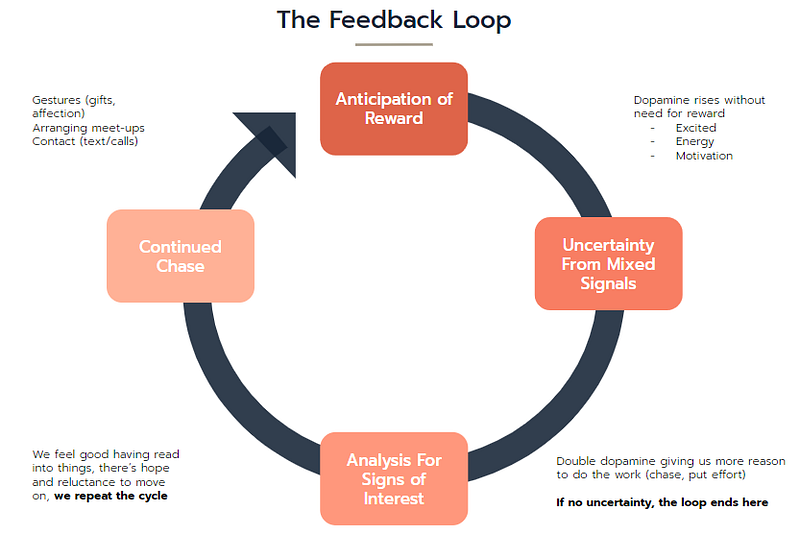
Everything starts with the anticipation of those rewards we discussed — attention, physical affection, emotional connection, and fun experiences. We get Dopamine release without needing to receive the reward, which makes us feel excited, energised and motivated. At that point, we naturally associate these emotions with the other person, but is it them or the nature of Dopamine that is causing the stimulation?
From there, it’s all about how the other person behaves and specifically how you receive or don’t receive what you were anticipating.
There are a few possibilities here:
- Everything goes really well, and things progress how you want
- The other person gives you certainty in another way through a hard rejection leaving no doubt. In either of these scenarios, you exit the loop.
- You get mixed signals.
What is most likely to happen, especially if you’re chasing someone who doesn’t want you, is scenario 3 — mixed signals.
Remember, those signals don’t have to be real — they can be perceived (something you read into). In most cases, that’s enough to give you hope. Many people who are the subject of crushes hate to reject another person bluntly — they tend to soften the blow. You will also find that these very same people feed crumbs to keep the attention (sometimes unconsciously). Sure, it’s not ideal, but you can’t blame them — we’re all human and enjoy external validation. Either way, that uncertainty boosts Dopamine, giving you the energy and motivation to carry on.
So what next?
You spend time analysing what happened and searching for those signs of interest. You’re likely to find them because they don’t need to be validated by anyone but you. Remember, when you’re high on dopamine, you’re super-charged and committed to finding evidence and taking this forward.
Once we’ve read into the situation further, we feel good about our chances and reluctant to consider anything else. We repeat the cycle not only because of hope but because unconsciously, we know how good it makes us feel — all those moments of excitement, the wonder of what will happen, the enjoyment of solving the puzzle and the euphoria when you get a reward.
So we continue to chase the person, even if we aren’t that interested in who they are. We might not be that committed to a future with them, but we are tricked into the illusion of feelings by the sheer thrill of this entire loop — the roller-coaster of emotions, highs and lows.
The circle continues, and we re-focus on what we can do next. Typically this ends up being a gesture (some gift or display of affection), an attempt to arrange a fun meet-up, and of course all the contact between — trying to send crafted texts that make them attracted or memes to make them laugh.
And there we are back where we started — in anticipation of their response, wondering why we think about the person so much. Sometimes the easiest option is to rationalize we are in love. We can explain how we have behaved (usually uncharacteristically), the emotions we have felt (stronger and more varied than normal), and justify our continued chase. Unless we know the mechanism that makes the chase so addictive, what other choice do we have to believe that the person is the source of all our intense feeling? The longer you play this game, the more you lose sight of reality — it takes disassociating to see the truth.
All that I have described here is my idea of the Dopamine feedback loop. Now, I’m aware it’s not a perfect model, but I truly believe this is an excellent representation of the high-level processes we go through during the chase. It helps us understand how we can believe in the illusion of feeling when we are really a slave to Dopamine, and in particular, it’s vulnerability to uncertainty and anticipation.
Why Can’t I Enjoy The Chase And Be In Love?
You can.
Even if we consider all the above, who am I to say you’re not in love?
Is it possible you can enjoy the chase and have strong feelings? Absolutely. The purpose of this post isn’t to try and convince you of anything. I intend to provide you with an objective overview of how the chase can manipulate our emotions and create illusions for deep feelings.
Perhaps it is worth asking two more important questions:
- How concerned are you with the other person’s happiness compared with winning them over?
- How much anticipation and uncertainty is there in your situation?
The former question allows us to consider whether our feelings are strong enough to put the other persons wants above our own. In her work on Limerence (obsessive crushes), Dorothy Tennov commented that one of the distinguishing features of love was the genuine desire for the other person to be happy. You can read more about this concept here while you consider the thought.
The latter question on anticipation and uncertainty speaks to how much exposure you have to a dopamine feedback loop. If you find yourself battling mixed signals and fantasizing about the future, there’s a strong chance of dopamine influence. It doesn’t mean your feelings aren’t real, but it gives you perspective and the chance to ask whether this about winning the game or being with the person.
At the end of the day, this is your call. You know how the chase works, and it’s up to you to become more self-aware. At a minimum, you will be able to spot the signs of falling for the chase and avoid the trap of playing the game for the sake of victory.
Make it happen.
Fed up with repeating patterns in dating? Or perhaps you’re ready to attract the love you deserve.
I’ve helped 100s of clients crush overthinking, heal the pain of rejection and become their most attractive selves.
If that sounds interesting, why not book a FREE Breakthrough Call — let’s see how we can make it happen.
You can also pick up a copy of my FREE eBOOK, “Three Essential Keys To Move On From Heartbreak”, here.


