
Are you Engaging The Blockchain Revolution?
A Blockchain 101 Primer
The blockchain is a type of database. Unlike current relational database systems, it is based on a shared database technology that provides inherent data integrity and security to facilitate unshakeable trust among its authorised users.
The blockchain is the emergent database standard in a future where business and social processes connected by ubiquitous computer networks are unified by impersonal trust embedded in decentralised data for its integrity and security. The blockchain allows the confident trading and transaction of assets eg property, currency, information, certificates, secured papers and other valuables eg paintings and art, without the fear of counterfeit asset ownership or unauthorized changes of the transaction details.
A blockchain is so-called because it is indeed an unbroken continuous “chain” of blocks of data structure. Each block is linked to the previous block by a cryptographic algorithmic “hash”. A “hash” is a digital code which is mathematically generated by an algorithm in a special computer program. As it is practically impossible to reproduce or duplicate the “hash”, the resultant impact is to empower the blockchain with its distinctive character of immutability and permanence.
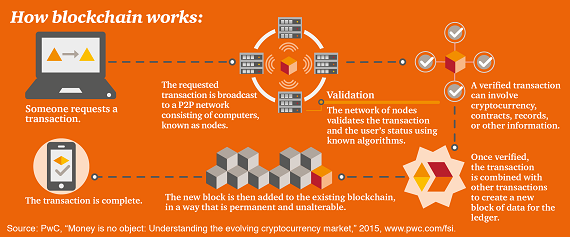
Transactions can involve both financial payments as well as non-financial exchange of value. Participants in a blockchain use the same software applications on their terminal devices or “nodes” eg desktops, notebooks, mobile phones, which have no central owner or controlling authority. Together, they form a distributed and decentralised computer network in the crypto-cyberspace of the internet.
When the computer network platform has received verification and validation from most of the network computers (“nodes”), the authenticated transactions are bundled or “blocked” to be stored chronologically (“chained”) together with other similarly validated transactions. Digitally and organically connected, a blockchain of related blocks of data-structure becomes a ledger in cyberspace which records the listings of transactions among and between peers on the same blockchain network who have been granted permission and access privileges to create, exchange and modify its data elements. Some types of blockchain designed for public users also allow for permissionless access, but these often also require verifiable personal identification.
In essence, the immutable blockchain is a cyberspace ledger containing trusted and transparent information regarding ownership, and serial ownership, which have been authenticated and agreed by its validated network participants. Since it does not depend on human entities or third parties for trust validation, the decentralised blockchain itself thus becomes the new trustless standard.
In a developed blockchain system populated by many blockchains, a blockchain is able to communicate with other blockchains and their users on compatible platforms. This interoperability within and across blockchain platform builds the essential interconnectivity through suitable decentralised dynamic applications (Dapps) to leverage on the immutability, transparency and trustless-worthiness of the blockchain data structure. The interactions of decentralised blockchains in a blockchain cyberspace synergise and strengthen each other to grow the omnipresent and ever-expanding blockchain ecosystem.
Blockchain Creates Competitive Value Advantages
Blockchain technology refers to the capacity and capability to create immutable digital data-set that can be shared on a distributed network in such a manner that enables “hash” chains to store, maintain, organize, access and manage securely according to a consensus mathematical algorithm.
Blockchain technology can streamline business processes by facilitating transactions among various stakeholders in the business eco-system. Its platform engine drives data and information management to new levels of efficiency and effectiveness. Decentralised and immutable, blockchain technology unblocks new opportunities to embolden fresh and innovative approaches to disrupt legacy internet paradigms and further enhances the customer experience by re-constructing, re-engineering, re-configuring and re-calibrating the business process. Enterprises in various industries are designing different blockchain adoption models with unique proof of concept (POC) schema to suit their needs and circumstances. No single blockchain can be expected to address and resolve every issue and problem.
Swish Labs has suggested some factors that have contributed to increasing demand for blockchain technology in enterprises:
· Reduced administrative cost and fast processing of transactions
· Reduced chances of fraud, human error or manipulation
· Enhanced yet controlled transparency
· Elimination of extra charges of offline reconciliations
· Secured settlement of cross-company transactions
· Real-time data access
· Authorized access
· Reduction of redundancy in the organizations
According to a McKinsey study, “approximately 70 percent of the value at stake in the short term is in cost reduction, followed by revenue generation and capital relief.” Implementing blockchain technology has positive productivity and efficiency impact as it leads quickly to manpower, material and organisational cost savings through the elimination of redundant record maintenance, auditing and reconciliation processes. Post-blockchain value canvas will show the shifting value flow from obsolete systems to new value offerings and real revenue from blockchain-linked services like smart contracts.
The innovative smart contract is empowered by blockchain technology which has motivated its functionality development. Smart contracts are straightforward computer programs which assess, verify and implement or execute a contract. They deploy embedded coded instructions automatically according to specified pre-set terms and conditions in an irreversible (ie. immutable) manner and render the smart contracts trackable through specially-designed Dapps software. The Ethereum blockchain platform is one of the most popular for the creation and implementation of complex smart contracts. Other blockchain platforms with different capabilities which are also optimised for smart contracts include Corda, Hyperledger and Monax.
The advent of smart contracts also disrupts and challenges legacy mental constructs of financial assets. Smart contracts facilitate value exchange through the use of “tokens”. A token is a uniquely coded string of characters generated by a special complex mathematical algorithm in special computer software. Nearly everything considered of having some tangible value can be tokenised. Many tokens today are extrapolated or based on the bitcoin. Some have attempted to develop their own non-conventional currency such as the Libra.
Tokenisation is a process using blockchain technology to digitise and digitalise real-world assets and convert rights to the corresponding assets on a blockchain. The tokenisation process transfers the information and whatever associated values of real-world assets onto a blockchain. In a sense, tokens represent the fractionalized ownership of the assets, thereby allowing cost optimization to make them more tradable and profitable.
Tokenomics combines blockchain tokens with the economics of business. It is the emergent business model without intermediaries which leverages on the embedded value (token) in the blockchain data-set for the exchange of valuable real-world goods and services within a blockchain ecosystem. And as blockchain ecosystems multiply and expand with increasing functional interoperability, the blockchain token becomes the new currency and legal tender in the “tokenomy” of blockchain marketspace.


