
Should You ‘Buy The Dips’ In This Bear Market Rally?
Timing and sector are everything

Many people argue we are already experiencing a new bull market—and technically that’s true – so buying on red days or ‘buying the dips’ makes a whole lot of sense. However, with a raging pandemic and infection numbers rapidly rising in a second wave, could it be that we are really experiencing a massive Federal Reserve-fuelled bear market rally rather than a new long-term bull market? Based on recent insider selling ratios, I would recommend extreme caution.
‘I can’t take how stupidly bullish this market can be’ — Jim Cramer, August 5, 2020
If one were to run across a sleeping bear in the wild, a sensible person would naturally give it a wide berth. A startled bear is a dangerous and wildly unpredictable animal. If you’re too close and the bear decides to attack, a grizzly can run 35 mph, far exceeding the top human speed of 27.8 mph. If too close, a bear could be on top of you before you knew what was happening.
A bear market rally is not so dissimilar from a sleeping bear in the wild. It looks peaceful, beautiful, even safely approachable. However, an experienced outdoorsman would never allow himself to be tricked by a sleeping bear.
Similarly, experienced investors must stay vigilant during a bear market rally and carefully evaluate down-side risk before making any big moves. Extreme caution is warranted because a bear market rally can awake at any moment and charge. If your money is too close to the top of the rally, the decline in volatile stock prices may put your portfolio deep into the red in only a few trading sessions. Suddenly investors are forced to make investment decisions under extreme pressure – precisely the time when investors can make the biggest mistakes.
In this article
- Buying the dips, works …
- however, this bear market rally looks ‘long in the tooth’ …
- and the insider selling ratio at a 20-year low
- Final thoughts
Buying the dips, works
I bought a number of technology stocks in 2017, including Tesla (at around $380). Tesla had just run up from $180 only a few months earlier. The Model 3 was finally being produced and it felt like Tesla would finally prove all the short-sellers wrong.
Well, it turns out I was wrong and Tesla promptly fell to around $300 per share. However, I was committed to the long-term success of the company and I believed the shares would inevitably go higher. I made a commitment to buy the dips and after 4 smaller, separate purchases, I slowly lowered my average cost to just over $300 per share.
If you’re a committed investor, buying the dips over a long period of time is a powerful strategy. However, to make this strategy work, an investor needs to be comfortable buying additional shares even when losing money like crazy. Believe me, this is much harder than it sounds when your portfolio remains deeply in the red for months, or even years.
I’m living proof, buying the dips works — but with particularly large-cap tech names currently at massively over-inflated prices, should the bear market awake, it could be a very long, painful ride down to the ultimate bottom and perhaps years before seeing a new high.
This bear market rally looks ‘long in the tooth’
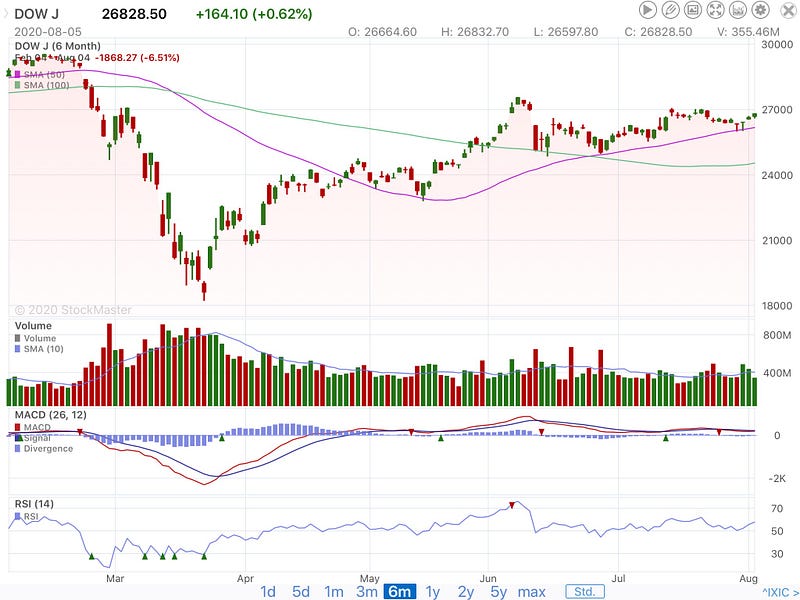
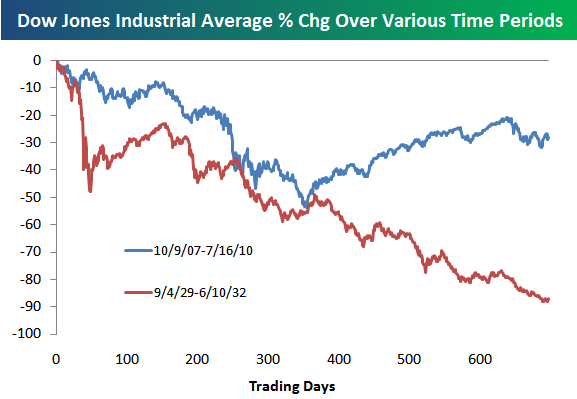
Honestly, I’ve been been far too conservative during this multi-month rally from the March lows. Sitting on the sidelines has cost me a lot of potential gains. I clearly underestimated the effect of the unprecedented Federal Reserve stimulus and the tolerance of risk being displayed by new investors in the middle of a full-blown pandemic. Investors with the guts to buy the dips on the way up, have been rewarded handsomely. Having admitted all of that, the DOW still does not look good to me.
After peaking at just over 27000, the index has traded sideways for the better part of two months. In the crash of 1929, massive financial stimulus was attempted by the powerful bankers of that era. However, these men did not have the power to push interest rates to zero. Nor did they have the power to print unlimited amounts of money to prop up zombie companies and distressed debt through the purchase of ETFs. In their time, dollars were backed by the gold standard, digitally printing cash didn’t exist, and ETFs wouldn’t be invented for decades.
The question investors have to ask themselves is whether the extensive Federal Reserve intervention and Congress-led stimulus packages will ultimately be enough to keep the stock market propped up for the entire length of the pandemic, without something blowing up. Clearly, markets have already priced in permanent Federal Reserve support and trillions more in more stimulus.
We are in uncertain times — any trip-up could re-spark a serious slide in stock prices. For example, should a state or even a country be forced into insolvency, will we finally see a financial credit crunch the way we did in 2008? Would the Federal Reserve still be able to maintain liquidity and orderly trading? If not, it may become very important for investors to have a significant amount of cash on the sidelines to ensure they can buy the dips, all the way down to the ultimate market lows.
Insider selling ratio at a 20-year low
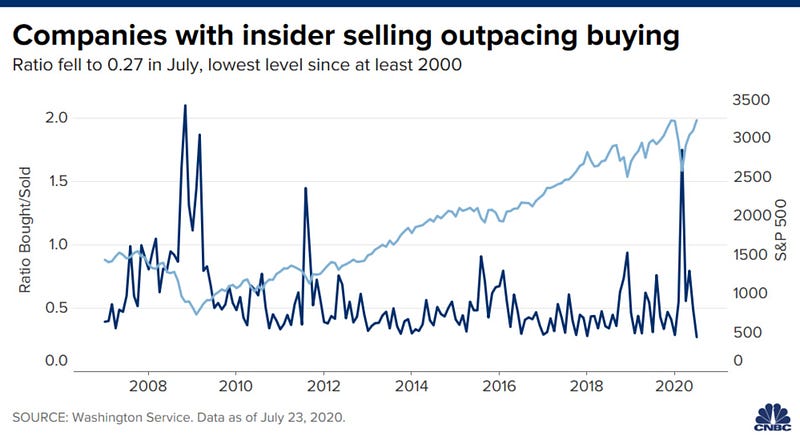
In March, corporate executives recognized the share prices of their companies had fallen too far, too fast. In response, executives poured money into the shares of their own companies at rates not seen for many years. However, the situation has changed quickly. Only a few months on, corporate insiders are selling their own company shares at a rate, not seen in 20 years.
Of course, it could be simply a case of pulling excess profits off the table, but when we take a closer look at which executives are buying and which executives are selling, I think we have a much clearer picture of what’s going on.
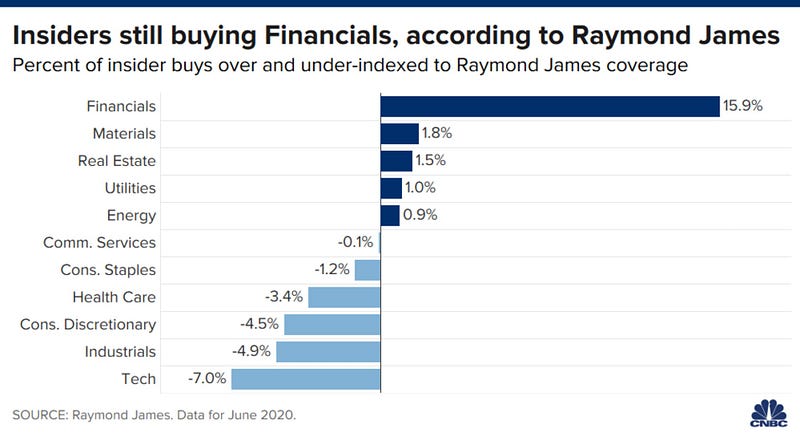
It’s clear by the levels of selling in the tech industry, executives recognize the stretched valuations of the companies they lead. On the other extreme, executives of financial firms are starting to pour cash into the shares of the financial firms they guide.
On the one hand, large-cap tech has been bid up to fantastic levels. Many of these firms have had blow-out quarters, due to unprecedented spending during the pandemic. It makes sense — living in lock-down, people had to have purchases delivered to their door and working from home made purchasing a new Mac, Surface tablet, or a second monitor for the home office a necessity.
Based on the selling of technology shares, it looks like tech executives realize the best days may be over (at least for the next few quarters). With home office hardware purchases largely saturated and people hoarding cash at unheard-of levels (just in case things really go to hell), tech executives may be telling us the next few quarters could be a lot tougher.
On the other hand, financial firms generally haven’t recovered much since the sell-off earlier this year. Financial firms have set aside billions into contingency funds to ensure they have enough liquidity to off-set the record-breaking pace of bankruptcies throughout 2020 and likely well into 2021. With so much uncertainty surrounding the pandemic’s length and therefore the ultimate number of companies forced into bankruptcy, investors have naturally been avoiding financial companies. However, financial executives may be signaling they think the worst is over and future bankruptcies can be absorbed.
Final thoughts
Buying the dip works, but it's a whole lot easier strategy when the market is rising. Should the markets reverse and close what I believe to be a massive bull trap, investors who have bought stocks recently will have a tough choice to make — sell out at a loss, or buy the dips all the way down.
In these uncertain times, I again would like to suggest using extreme caution. To decide on what is the best strategy going forward, I believe investors need to ask themselves a couple of tough questions;
- What’s my financial situation — do I have enough cash saved in case of an emergency?
- What’s my job situation — Is there a possibility of being furloughed or laid off?
- How much lower could this stock go? After looking at the reaction of a particular stock in previous bear markets am I still willing to buy the dips, all the way down?
- If insiders are selling, should I really commit myself to buy the dips all the way down, even if it means being out-of-the-money for months or even years?
- Would it make more sense to use a ‘buy the dip’ strategy with companies experiencing net insider buying?
If you found this article useful, please forward it to someone you care about.


