
Are You As Empathetic as a Rat?
What we hate says a lot about us.
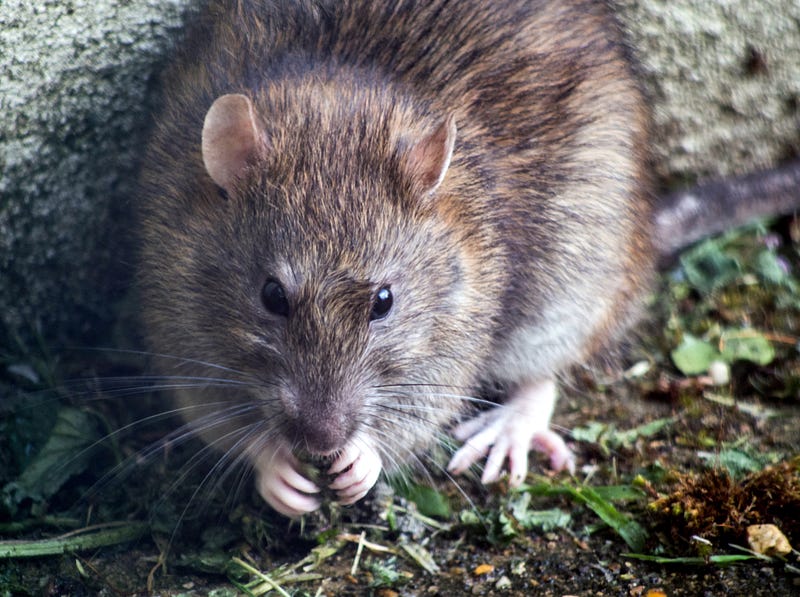
I knew what I was getting into.
When we first moved into the house I live in now, I saw the telltale hole chewed by relentless teeth in the bottom of the shed door. Everywhere — almost everywhere — has rats, of course. Originating somewhere in Asia, these crafty creatures have followed us everywhere. Thanks to our garbage and the homes we create, rats have ridden our coattails to becoming one of the world’s most successful creatures.
Surrounded by farms as we are, the acid tang of manure drifting on the wind that blows through the valley, it was preordained we would have rats. But I was determined to let them be. They were here before I arrived, and they’ll still be here long after I’m gone. I’m not interested in yet another war of attrition.
I don’t know how many rats I’ve killed in my life.
Probably thousands. I used to do it for a living. If rats had an organization like Mossad, I might live in fear at every knock on the door or every strange car that rolls slowly down the street. Like Eichmann in Argentina, twitching the curtains while waiting for the blow to fall.
Given my tally, it would be hard to deny that rats would have some justification in renditioning me to face whatever they consider justice.
But I don’t kill things for money anymore. So long as the rats stayed out of the house, I told myself, I would leave them alone.
The complicated relationship we have with rats is typical of humans.
We are a species that excels at wiping out other species. Ever wonder why the closest thing on earth to a human is a chimpanzee? That wasn’t always the case.
There used to be other species of humans living in the world with us. From time to time, our ancestors might glimpse a group of stout Neanderthals making their way across a distant ridge, long spears slung over their shoulders. Not any more.
Denisovian DNA still curls its tired tail inside our cells, but the Denisovians are gone, along with three other species of humans that didn’t survive. We interbred and outcompeted and straight-up murdered our way to our unique position now, the sole inhabitants of a genus, the single branch on the family tree.
And that’s other humans. Animals less closely related to us don’t fare any better. We’re in the middle of the sixth mass extinction event in the history of the planet, and it seems like it’s all our fault. We wipe species out just by building houses or drinking coffee or driving to the mall. We’ve annihilated entire populations of creatures without ever knowing that they existed.
In all of our movies, we’re the good guys, with coiffed hair and perfect teeth. But we are, without a doubt, the most successful, most voracious predator that has ever emerged on this planet.
And yet we can’t get rid of the rats. Despite trying for centuries. Despite bending a whole multibillion-dollar industry toward their eradication. Along with the cockroaches and the mosquitoes, rats not only survive but flourish even as they absorb our wild hatred and all the ingenious mechanisms of destruction we turn on them. In some of our most densely populated cities, rats outnumber the human population by as much as five to one.
To call someone a rat is to insult them. First, the resourceful creatures are inextricably linked with death and disease. We hate them with a bright-burning and ancestral enmity, a revulsion that says more about us than it does about them.
How they feel about us is much less clear. They fear us, generally, as any sensible animal ought to do. But it’s easy to imagine that, after all, we’ve done for them, rats, like viruses and parasites and other organisms we despise, are in love with us.
We have cause to be grateful to them too. While it’s true that rats have been the unwitting vectors of human diseases including the Black Death, it would be difficult to form an accurate list of the medical breakthroughs they’ve been responsible for. It would probably be easier to list the ones they haven’t had a hand in.
Thanks to their size, reproductive rate, and in part their bad reputation, rats make ideal laboratory test subjects. Similar enough to us that the results they yield can be medically useful, but different enough that nobody tries to free them. Just about any drug you or I will ever take in our lifetimes has been tested on rats first.
When you work with animals — especially when your job is to eradicate them — it’s easy to think of them as being furry machines. Unfeeling robots that operate solely on instinct without the finer characteristics we like to think make us unique. But it turns out, rats are capable of behaviors that are uncomfortably close to our own. Even some of our best impulses, such as empathy.
Almost the first thing students learn about in introductory psychology class is the Milgram experiment. You’ve probably heard of it. Students were ordered to deliver electric shocks to strangers by an authority figure. Troublingly, a large portion of the students continued to administer the shocks even when they believed they were doing serious harm to another person. Just because a man in a white coat told them to do it.
Rats do better. Back in 1959, a study run by Russell Church found that rats were reluctant to press a button that would give them a treat once they realized that it would also cause another rat to receive an electric shock. A later study found that this effect was even stronger if the rat in control of the shock had itself been shocked.
In other words, a rat that has been through something unpleasant is far less likely to inflict the same unpleasantness on a fellow rat. These results demonstrate an understanding of altruism and empathy that many humans might struggle to emulate.
Show me what you hate, and I’ll tell you what you fear.
At the base of the brains of even the most well-behaved of us, is a shrieking ape that knows only terror. Our fears of spiders and snakes are justifiable, even if, in temperate climates, they have nothing to do with reality. In the dark jungles and open grassland where brains developed, things that creep and crawl were an undeniable threat.
We hate rats because they eat our food. In doing so, they leave behind urine and fecal matter that can make us sick. But often, what we fear in our fellow animals is the facets of ourselves they reflect.
The teeming world of the anthill reminds us that maybe we aren’t the unique individuals that we feel we are. The ooze and slime of the festering swamp highlight our vulnerability to disease, the hapless victims of pathogens we can’t even see.
And in their way, rats remind us of parts of ourselves we would like to ignore. Furtive, sneaking, greedy, unclean parts. The parts that prize survival above all else. The part that flees the sinking ship without bothering to help anybody else.
Rats are nothing if not survivors, just like us. And maybe these rodents remind us a little too well of where we came from and what it took to get to where we are today.
The life of a wild rat is often violent and short. At best, these rodents rarely last more than a couple of years. That’s assuming they don’t fall foul of any of the numerous threats that lie in wait for them. Humans and their millions of cats and dogs. Larger wildlife. Birds. Even other rats. The altruism of a rat only goes so far, and they will fight to the death over territory. Then again, so will we.
It was dusk.
The kind of sweet warm dusk you wait half the year for, the purple shadows lengthening as the sun slowly darkens in the concrete patio gives back the heat it’s been accumulating all day to keep the chill of the evening away. Everything was finally quiet.
In my suburban neighborhood, I’m surrounded by people, and on a sunny day, everyone wants to enjoy the outdoor space they have. But as the day comes to an end, things get quiet. The sound of cutlery clinking against plates drifts from the open windows of houses as people sit down to dinner and leave me alone in the garden.
There was a furtive rustling among the nettles that grow against the fence at the bottom of the yard. Something moving through the undergrowth, its progress visible by a trail of nodding leaves. I sat still. Finally, the rat dashed an open patch of ground before disappearing under the thick hedge that stands between my neighbors and me.
Years of working in pest control have trained me never to leave food outside, especially overnight. Never allow a gap bigger than a quarter coin in the exterior of your house. Do that, and you’ll mostly stay untroubled by rats. Even in a place where I sometimes see them climbing up the wheels of the neighbor’s cars, seeking out the warm heat of a recently used engine.
Live and let live. That’s a luxury I have in a country where infectious disease caused by rodents is rare and usually easily treatable. Where I live, the worst thing a rat is likely to do is to chew through an essential cable in my lawnmower or leave a pile of dried-out droppings in my shed. It doesn’t seem to call for the death penalty.
But the rustling started again. And suddenly, in a few hurried bounds, the same rat burst out from under the hedge and made a diagonal run across my lawn. A run that carried it directly into the chair I was sitting on.
I leaped to my feet, snatching up the book I’d been reading and the glass I’d been drinking from. In so many ways, rats are just like us. That doesn’t mean I’m willing to share my house with them.


